
Depression Isn't Apathy: The Anger No One Talks About

Depression can look like indifference.
A person stops answering messages. Ordinary tasks become difficult. The interests that once gave life color lose their appeal. From the outside, the person may seem detached, unmotivated, or unreachable.
Inside, however, there may be no indifference at all.
There may be anger, grief, exhaustion, and a profound loss of hope.
Chapter 6 of Dr. Greg Stewart’s I³: Information, Interpretation, Intensity, Unlock the Inner Strength Behind Your Negative Emotions offers a practical lens for understanding this experience. It is not a medical definition of depression, and it is not a substitute for clinical assessment. It is an emotional-management framework: depression may look like apathy after a person has spent tremendous energy trying to change what hurts, then concludes that change is impossible.
That conclusion can become especially dangerous when the person stops extending grace to themselves.
Depression May Be Anger After Hope Has Burned Out
In the framework of Chapter 6, anger is directed toward the environment. It carries energy. It says, “Something is wrong, and I must change it.”
Depression appears when that effort has continued for too long without the desired result. The person has tried, waited, explained, endured, negotiated, prayed, worked, or hoped. The emotional goal remains blocked.
Eventually, the person raises what the chapter calls a white flag of surrender.
The environment appears to have won.
But the surrender often carries a second conclusion: “If the environment will not change, I must be the reason.”
The person then declares themselves the loser.
This is where anger can turn inward. The person no longer directs all of the emotional energy toward the situation. They direct it toward their identity, value, and worth.
Research supports the importance of this distinction. Anger and irritability are common in depression, yet they are frequently overlooked when depression is associated only with sadness or withdrawal (Psychology Today, n.d.; “Anger and Major Depressive Disorder,” 2017). Self-criticism, rumination, and hopelessness can reinforce one another, creating a cycle that is painful and difficult to interrupt.

The Hidden Sentence: “Something Is Wrong With Me”
The I³ framework places special emphasis on the sentences people believe about themselves, other people, life, and God.
Those sentences matter because they do more than describe experience. They shape interpretation. Interpretation influences intensity. Intensity influences response.
A painful event may begin as information: rejection, abandonment, failure, abuse, loss, or prolonged disappointment. The mind then interprets the information. If the interpretation becomes, “I am unwanted,” “I am powerless,” or “I will never be safe,” the emotional intensity can become overwhelming.
Children who experience abuse or neglect face a particular burden. They do not possess the emotional or intellectual resources to evaluate the adults responsible for their care. They often cannot conclude, “The adults are acting from dysfunction.” Instead, they may conclude, “I am the problem.”
That conclusion can reach directly into identity and worth.
It can remain active long after the original circumstances have changed.
This does not mean that every negative belief is consciously chosen. It does not mean that a person should simply replace painful thoughts with cheerful ones. It means that therapy may need to examine the sentences beneath the symptoms with patience and precision.
Name the Emotion Before You Judge It
Negative emotions are not moral failures. They are natural, useful, and necessary forms of information.
Anger may identify a violated boundary or blocked goal. Grief may identify meaningful loss. Fear may identify perceived danger. Shame may reveal a painful belief about the self. Depression may signal that emotional resources have been depleted and hope has narrowed.
The goal is not to eliminate negative emotion. The goal is to develop the right type and amount of emotion for the situation.
This requires accurate labeling.
A person may say, “I feel nothing,” when the more precise statement is:
- “I feel angry that nothing changes.”
- “I feel ashamed that I cannot fix this.”
- “I feel exhausted from trying.”
- “I feel afraid that the future will repeat the past.”
- “I feel grief over the life I expected to have.”
- “I feel hopeless about my ability to influence anything.”
These distinctions matter. “Apathy” can close the conversation. “Anger, grief, exhaustion, and hopelessness” can open it.
The American Psychological Association emphasizes that depression requires careful assessment and evidence-based treatment, especially when hopelessness or suicidal thinking is present (American Psychological Association, n.d.). A label should create a path toward understanding, not become another judgment.
The Sentence Dump: A Way to See the Mental Model
Chapter 6 presents the sentence dump as a practical exercise. It is not a diagnostic tool. It is a way to bring hidden interpretations into view.
Choose one current source of distress. Write every sentence that appears in your mind about it. Do not edit the sentences while writing.
You may find statements such as:
- “Nothing will ever change.”
- “I always ruin everything.”
- “No one would care if I disappeared.”
- “I should be stronger than this.”
- “This proves that I am broken.”
- “There is no point in trying again.”
Then examine each sentence carefully.
Ask:
- Is this a fact, an interpretation, or a prediction?
- What evidence supports it?
- What evidence complicates it?
- Is the sentence specific, or does it condemn the whole self?
- What would be a more accurate and compassionate sentence?
The purpose is not to force positivity. It is to reject a lie by replacing it with truth.
“I failed at this attempt” is more accurate than “I am a failure.”
“I am exhausted after prolonged disappointment” is more accurate than “I am lazy.”
“I need support” is more accurate than “I am weak.”
Research on emotion-regulation training suggests that skills such as awareness, acceptance, self-support, and modification can reduce depressive symptom severity, although these practices should not be treated as a replacement for individualized care (Berking et al., 2019). Related research also finds that self-compassion and cognitive reappraisal can help explain the relationship between emotional pain and depressive symptoms (Meilasari & Utami, 2022).
Grace Is Not Excusing the Problem
Grace toward oneself is not denial. It does not excuse harmful behavior or prevent accountability.
Grace separates behavior from identity.
It allows a person to say, “I made a serious mistake,” without concluding, “I am beyond repair.”
It allows a person to say, “I have been hurt,” without concluding, “I am permanently damaged.”
It allows a person to say, “I cannot change this situation alone,” without concluding, “I have no value.”
This distinction is central to restoring emotional movement. When a person stops attacking themselves, some energy becomes available for observation, support, treatment, problem-solving, grieving, and change.
That process may include logging negative emotions, identifying the information beneath them, examining the interpretation, measuring the intensity, and developing a response. It may also include medication when a physician determines that it could help stabilize symptoms and make therapy more effective. Medication decisions belong with a qualified medical professional.

When Support Must Become Immediate
Self-harm and suicidal thinking can enter when a person has declared the environment the winner and themselves the loser. This is not a character defect. It is a serious signal that immediate professional support is needed.
If you recognize yourself in persistent hopelessness, severe self-criticism, thoughts of self-harm, or thoughts that life is not worth living, speak with a licensed mental-health professional. If you may act on suicidal thoughts or cannot stay safe, call or chat with the 988 Suicide & Crisis Lifeline in the United States, call emergency services, or go to the nearest emergency department. Do not remain alone with imminent danger. Tell a trusted person clearly what is happening.
Professional treatment can provide assessment, safety planning, psychotherapy, and medical evaluation. You do not need to prove that your pain is severe enough to deserve help.
Depression Is Not the End of the Sentence
Depression can resemble apathy because the person’s visible effort has stopped. The inner struggle may remain intense.
The work of recovery begins by noticing what the apparent apathy may contain. Anger. Grief. Exhaustion. Shame. Fear. Hopelessness. A blocked emotional goal.
Then comes the careful work of identifying the sentences that give those emotions their shape.
The sentence dump is one beginning. Accurate emotional labeling is another. Therapy provides a setting in which those interpretations can be examined with clinical care, context, and accountability.
Dr. Greg Stewart explains the broader I³ framework in his TEDx talk. His book, I³: Information, Interpretation, Intensity, Unlock the Inner Strength Behind Your Negative Emotions, develops the framework in greater depth.
The most painful sentence in depression may be, “I am the problem.”
It is not the final truth.
References
American Psychological Association. (n.d.). Clinical practice guideline for the treatment of depression across three age cohorts. https://www.apa.org/depression-guideline
Berking, M., Eichler, E., Luhmann, M., Diedrich, A., Hiller, W., & Rief, W. (2019). Affect regulation training reduces symptom severity in depression: A randomized controlled trial. PLOS ONE, 14(8), e0220436. https://doi.org/10.1371/journal.pone.0220436
Meilasari, A., & Utami, M. S. (2022). The role of self-compassion to depression in teenagers mediated by emotion regulation. Psi Chi Journal of Psychological Research, 49(2). https://doi.org/10.22146/jpsi.67752
Psychology Today. (n.d.). Depression and self-criticism. https://www.psychologytoday.com/us/blog/self-talk-science/202211/depression-and-self-criticism
Psychology Today. (n.d.). How do depression and anger interact? https://www.psychologytoday.com/us/blog/overcoming-destructive-anger/202011/how-do-depression-and-anger-interact
Modern Psychological Studies. (2010). When counting sheep becomes counting worries: Insomnia, rumination, and depression, 15(2). https://scholar.utc.edu/mps/vol15/iss2/9/
The Open Psychology Journal. (2022). Examining the influence of self-compassion education and training on mental health and well-being: A systematic review, 15. https://www.openpsychologyjournal.com/VOLUME/15/ELOCATOR/e187435012210190/FULLTEXT/
Psi Chi Journal of Psychological Research. (n.d.). Psi Chi Journal, 28(3). https://cdn.ymaws.com/www.psichi.org/resource/resmgr/28_3_Journal_Fall_FINAL.pdf
Alfayez, H. (2026). Examining the relationships between mindfulness, emotion regulation, depression, and anxiety: A structural equation modeling approach. Frontiers in Psychology, 17, 1738432. https://doi.org/10.3389/fpsyg.2026.1738432
Try Marblism! They are an incredible staff! Click here: https://marblism.com?via=dr-greg-stewart
What Your Anger Is Actually Afraid Of: The Fear Underneath Every Blowup

You did not become furious because of the forgotten chore, the unanswered message, the repeated interruption, or the child who disobeyed you for the third time.
Those events may have triggered your anger. They may not explain it.
Anger often arrives with force because something beneath it feels threatened. In Dr. Greg Stewart’s I³ framework (Information, Interpretation, and Intensity) anger is not random emotional noise. It is the result of information interpreted as a blocked goal, intensified until the mind decides to take matters into its own hands.
The central claim of Chapter 6, “That Which Threatens Me,” is direct: anger is downstream of fear.
Fear turns inward. It asks, “What will happen to me?”
Anger turns outward. It declares, “Someone must change this.”
The movement from fear to anger is a movement from defensive negative energy to offensive negative energy. You no longer wait for the threat to pass. You prepare to confront it, control it, or force it to change.
That is why anger can feel powerful. It gives energy to a frightened mind.
Anger Begins With an Unmet Expectation
Anger usually follows a broken expectation.
Something happened that you did not expect. Something failed to happen that you expected. A person did not call. A child did not listen. A partner did not understand. A stranger behaved carelessly. A plan fell apart.
The tangible goal became blocked.
Perhaps your goal was for the room to be clean, the conversation to be respectful, the appointment to begin on time, or the person beside you to keep a promise. These goals are real. They matter. Yet they are not the final destination of your emotional life.
Ask the more penetrating question:
What emotional goal was blocked?
Every action attempts to achieve an emotional goal. The visible behavior is often only the surface expression of a deeper need.
When you screamed at your children, the tangible problem may have been disobedience. The deeper emotional goal may have been security, competence, or significance. You wanted to feel like a successful parent. Their behavior interrupted that interpretation.
The anger, then, was not only about what they did. It was about what their behavior seemed to say about you.
It may have said:
- “I am failing.”
- “I have no control.”
- “They do not respect me.”
- “I am not important.”
- “I cannot keep my family safe.”
- “My efforts do not matter.”
This is the interpretation gap between the event and the intensity of the response. The information may be small. The interpretation may be enormous.
Move Below the Dotted Line
In the emotional-management flow described in I³, a dotted line separates the first four emotions (insecurity, anxiety, fear, and worry) from anger.
That line represents a change in focus.
Above the line, the mind is focused internally. It feels vulnerable, uncertain, exposed, or threatened. Below the line, the mind shifts externally. It searches for someone or something to blame, correct, punish, or control.
The practical move is to drag the goal below the line and bring the focus back inside.
Do not stop at the tangible goal.
Name it accurately:
- “I wanted my child to obey” becomes “I wanted to feel capable and respected as a parent.”
- “I wanted my partner to answer” becomes “I wanted to feel secure in the relationship.”
- “I wanted the plan to succeed” becomes “I wanted to feel significant and competent.”
- “I wanted them to apologize” becomes “I wanted confirmation that my pain mattered.”
Chapter 6 offers security as a useful starting point for many women and significance as a useful starting point for many men. These are not rigid categories. They are entry points. Use the language that best describes your own emotional goal.
Then find synonyms. Security may mean safety, steadiness, belonging, protection, or trust. Significance may mean value, importance, respect, competence, or worth.
Precision matters. Vague goals produce vague interpretations. Accurate goals reveal the fear beneath the anger.

The Cat, the Dog, and the Rattlesnake
Watch a cat confronted by danger. Its back arches. Its fur rises. It hisses.
Watch a dog face a perceived threat. It barks, bares its teeth, and moves forward.
Watch a rattlesnake encounter danger. It rattles.
Each creature produces an intense display. Each display serves a protective purpose. Each attempts to create distance from the threat.
At the surface, these responses look aggressive. At the core, they are afraid.
Human anger follows a similar pattern. The raised voice, tightened jaw, sharp accusation, slammed door, or cold withdrawal may be an attempt to protect an emotional goal of safety, value, belonging, or control.
The anger is real. The fear is real. The fear does not excuse harmful behavior. It explains why the reaction may be so intense.
The same principle appears in the scene from Batman Begins after young Bruce falls into a dry well. His father asks, “Do you know why the bats attacked you, Bruce?” The answer follows: “It’s because they were afraid of you.”
The bats did not attack because they possessed superior strength. They attacked because they perceived a threat.
Anger often works the same way. The person who appears most intimidating may be reacting to an internal sense of danger.
Ask Better Questions
When anger rises, do not begin with, “How do I make them stop?”
Begin with:
- What am I afraid of?
- What is the worst that can happen if this happens?
Most people answer with another emotion:
- “I will feel rejected.”
- “I will feel embarrassed.”
- “I will feel like a failure.”
- “I will feel powerless.”
Keep going.
A negative emotion is not what tangibly happens. It is your response to what tangibly happens. Continue asking the same question until you reach the most probable, realistic, and logical result.
If your child talks back, the worst tangible outcome may be a difficult conversation and a need to repair the relationship. If someone fails to answer your message, the tangible outcome may be uncertainty, not abandonment. If a plan fails, the tangible outcome may be inconvenience, delay, or the need to create another plan.
These outcomes may matter. They may deserve action. But they may be a one or two on the scale of importance while your response has reached a seven or eight.
That difference is inflated intensity.
Research supports the value of this pause. The American Psychological Association distinguishes anger from aggression: anger is an emotion, while aggression is behavior intended to harm someone or something (American Psychological Association, 2024). The emotion deserves attention. The behavior requires accountability.
Anger Can Point to an Old Wound
Current events often awaken older pain.
Your anger may point to:
- An insecurity you have never examined.
- A need for another person to validate your value.
- A lie you believe about yourself.
- A lie you believe about someone else.
- A past betrayal that has made trust difficult.
- A history of being ignored, controlled, humiliated, or dismissed.
This does not mean every angry reaction is irrational. Some situations involve genuine injustice, disrespect, danger, or boundary violations. Anger can identify a problem that requires a clear response.
It does mean that anger is not always an accurate measurement of importance.
Research on appraisal shows that anger commonly involves perceived harm, responsibility, and the belief that a different choice could have prevented the outcome (Mayiwar & Björklund, 2021). Your mind does not merely register what happened. It decides what happened means, who caused it, and what should happen next.
That is the I³ sequence:
- Information: What actually happened?
- Interpretation: What did I decide it means?
- Intensity: How much emotional energy did that interpretation produce?
Change the interpretation, and intensity can change with it.
A PLOS ONE study found that cognitive reappraisal reduced anger, while rumination maintained it. The difference was not the event. The difference was the mental work performed after the event (Peuters et al., 2019).
Do not rehearse the offense until it becomes your identity. Examine it. Name the blocked emotional goal. Test the interpretation. Choose the next action with greater accuracy.

The Work Beneath the Outburst
The goal is not to become emotionless. The goal is to become internally accurate.
When anger appears, pause long enough to identify the threat. Regulate your body before attempting a difficult conversation. Step away from intimidation, name the emotion, and return to the tangible facts.
Then ask:
- What did I expect?
- What was blocked?
- What emotional goal was underneath it?
- What am I afraid this says about me?
- What is the most realistic tangible consequence?
- What response fits the actual importance of the event?
This work requires courage because it moves beneath power and into vulnerability.
Everyone carries hurt. Everyone has been afraid. Everyone has interpreted a moment through the lens of old pain. Interior mastery does not deny that history. It refuses to let history govern every present response.
Study Dr. Greg Stewart’s TEDx talk, “The Hidden Power of Negative Emotions”, and explore the I³ framework in his book, I³: Information, Interpretation, Intensity, Unlock the Inner Strength Behind Your Negative Emotions.
For counseling support, call 469-485-0387. You can also learn more about Becoming More Counseling, Coaching, & Consulting.
References
American Psychological Association. (2024). Anger. https://www.apa.org/topics/anger
Hada, A., Imura, M., & Kitamura, T. (2021). Parent to baby emotions: Parental immediate emotional reactions towards infant crying. The Open Psychology Journal, 14. https://doi.org/10.2174/1874350102114010338
Levitt, A., & Sciutto, M. J. (2006). Effectiveness of treatment interventions for adults suffering from anger disorders: A literature review. Modern Psychological Studies, 12(1), Article 5. https://scispace.com/pdf/effectiveness-of-treatment-interventions-for-adults-4mc2qrdf19.pdf
Mayiwar, L., & Björklund, F. (2021). Fear from afar, not so risky after all: Distancing moderates the relationship between fear and risk taking. Frontiers in Psychology, 12, 674059. https://doi.org/10.3389/fpsyg.2021.674059
Peuters, C., Kalokerinos, E. K., Pe, M. L., & Kuppens, P. (2019). Sequential effects of reappraisal and rumination on anger during recall of an anger-provoking event. PLOS ONE, 14(1), e0209029. https://doi.org/10.1371/journal.pone.0209029
Pereira, J. R. B., & Deemer, E. D. (2023). A test of a cognitive appraisal model of the influence of perceptions of seriousness and self-compassion as influencing impostor experiences. Psi Chi Journal of Psychological Research, 28(3). https://www.psichi.org/page/283JNFall2023-A-Test-Of-A-Cognitive-Appraisal-Model
Tsilimparis, J. (2026, July 19). Why anger masks fear. Psychology Today. https://www.psychologytoday.com/us/blog/the-magic-in-the-tragic/202607/why-anger-masks-fear
Try Marblism! They are an incredible staff! Click here: https://marblism.com?via=dr-greg-stewart
Empty the RAM: The Sentence Dump That Clears Your Mind in One Sitting

Your mind can become crowded without making a sound.
A conversation ends. A message goes unanswered. A decision remains unresolved. Then the same sentences begin circling:
I should have said something different.
They must be upset with me.
This will never work.
I will not recover from this.
The sentences repeat because your mental model has placed them in working memory. They continue requesting attention. Your processing speed slows. The emotional intensity rises.
Chapter 6 of Dr. Greg Stewart’s book, I³: Information, Interpretation, Intensity, Unlock the Inner Strength Behind Your Negative Emotions, presents a direct response: empty the RAM.
The technique is simple. It is not shallow. It is not forced positivity. It is a disciplined method for bringing unconscious interpretations into view, testing them against truth, and choosing a more appropriate response.
Emotions Begin With Sentences
The I³ framework (pronounced I cubed) rests on three elements: information, interpretation, and intensity.
You receive information. You interpret it. Your interpretation generates emotional intensity.
As Chapter 6 explains:
“Emotions don’t produce themselves; they come from sentences in our minds.”
Those sentences may be opinions, interpretations, conclusions, suggestions, or predictions. They may come from the unconscious, subconscious, or conscious mind. They may be accurate. They may be distorted. They may be partially true and emotionally exaggerated.
The distinction matters because the same information can produce different emotional experiences depending on the interpretation attached to it.
A friend does not respond to your message. The information is limited: there has been no response yet.
The mind may add:
They are angry with me.
I am being rejected.
I always ruin relationships.
No one will stay.
The emotional reaction does not come from the unanswered message alone. It comes from the sentences added to the message.
This is Lock 2 of I³: Interpretation. It is also where the Panama Canal Rule becomes practical. A ship cannot pass through the canal without moving through each lock in order. In the same way, emotional management requires you to move through information, interpretation, and intensity rather than attempting to control intensity without examining interpretation.
The Sentence Dump: Step One
When you are deeply distressed, do not begin by arguing with every thought.
Begin by recording them.
Open a document. Use a notebook if that is more accessible. Write every sentence that comes to mind about the current topic. Let the mental model flow freely. Do not evaluate the sentences while writing. Do not correct grammar. Do not make the page respectable.
Write until there is nothing left to write.
You may record:
- “I cannot handle this.”
- “This proves I am not good enough.”
- “They will never respect me again.”
- “I should have known better.”
- “Nothing will change.”
- “I have to fix this immediately.”
- “If I make one mistake, everything will collapse.”
Keep going.
The first purpose is not to produce wisdom. The first purpose is to remove the material from active mental processing and place it where you can examine it.
That is the cathartic force of the exercise. The sentences are no longer hidden in the mind, competing for attention. They are visible. They can be read. They can be organized.
Research on expressive writing similarly suggests that putting emotionally charged experiences into words can support cognitive processing, meaning-making, and emotional clarity. The evidence is modest and varies by person and context, but writing is most useful when it moves beyond raw venting toward understanding and reappraisal (American Psychological Association, n.d.; Farber, 2012; PLOS ONE, 2013).

Do Not Confuse Relief With Truth
The sentence dump may create immediate relief. That relief is valuable, but it is not the final step.
Now evaluate each sentence.
Some sentences are extreme lies. They can be dismissed and deleted.
Others are more deeply embedded in your belief system. They may have been repeated for years. They may be connected to identity, value, worth, or past trauma. They cannot always be deleted by force.
Use the technique Dr. Stewart calls reject by replacing.
The best way to reject a lie is to replace it with truth.
Suppose the sentence is:
“I’ll never get a job.”
Do not replace it with an equally ungrounded statement such as, “I will definitely get the perfect job tomorrow.”
That is not truth. It is wishful thinking.
Replace the lie with several accurate sentences:
- “I do not have a job today.”
- “I have had difficulty finding work.”
- “The process may take longer than I want.”
- “I can review my résumé.”
- “I can contact people who may know of opportunities.”
- “I can apply for positions that fit my experience.”
- “A delayed result is not the same as a permanent result.”
- “My employment status does not determine my value or worth.”
Some of these sentences are negative. That does not make them harmful. Accuracy is the standard.
The goal for emotional management is not positivity. It is truth.
Cognitive reappraisal follows the same principle. It changes the meaning assigned to an event rather than pretending the event did not occur. Research associates reappraisal with reduced negative emotion and healthier psychological functioning, although its effectiveness depends on context and the person’s ability to apply it (The Open Psychology Journal, 2018; Betanzos, 2024).
Three Causes of Inflated Negative Emotion
Negative emotions are natural, helpful, and necessary. Fear can warn you. Anger can identify a blocked goal. Sadness can signal loss. Anxiety can direct attention toward uncertainty.
The aim is not to eliminate negative emotion. The aim is to experience the right type and amount of emotion for the situation.
Chapter 6 identifies three common causes of inflated negative emotional energy.
1. Lies
Lies are the most common cause. They include catastrophizing, mind-reading, overgeneralizing, and treating predictions as facts.
“I know they hate me.”
“This always happens.”
“I cannot survive this.”
Such sentences may feel convincing while remaining unverified.
2. IVW: Identity, Value, and Worth
A situation becomes more emotionally intense when you take it personally at the level of identity, value, or worth.
A mistake becomes, “I am a failure.”
A rejection becomes, “I am unwanted.”
A disagreement becomes, “I have no value.”
The event may deserve attention. Your worth does not need to be placed on trial.
3. Carryover From Trauma
Past experiences can intensify present emotion. The current situation may resemble an earlier injury, and the nervous system may respond to both at once.
This does not mean the current feeling is false. It means the intensity may include emotional energy carried forward from the past.
When writing reveals trauma-related material, do not force yourself to process it alone. Pause. Ground yourself. Seek a qualified mental-health professional when the exercise produces panic, dissociation, flashbacks, or an inability to return to the present.
A Daily Practice for Interior Mastery
Do not wait for a crisis to develop self-awareness.
Log negative emotions as they happen. Label them correctly. Then take each one apart.
Use this sequence:
Name the emotion.
Choose the most accurate word: anger, fear, worry, sadness, shame, disappointment, resentment, or grief.Record the information.
What objectively happened? Separate observable facts from assumptions.Write the sentences.
What did your mind immediately conclude?Identify the interpretation.
Which sentences are opinions, predictions, conclusions, or suggestions?Test the sentences.
What evidence supports them? What evidence limits them?Reject by replacing.
Write accurate sentences that account for the full situation.Choose an RHWR path.
Select the most reasonable, healthy, wise, and responsible response available.Pursue the emotional goal.
Decide what emotional state would help you respond well. You may seek clarity, courage, patience, grief, repair, or appropriate restraint.
This practice develops interior mastery. It moves you from automatic interpretation to deliberate response.

Empty the RAM, Then Build a Strategy
The sentence dump is not an escape from responsibility. It prepares you to assume responsibility accurately.
First, release the mental congestion. Then examine the sentences. Replace the lies with truth. Separate the current situation from old emotional carryover. Distinguish identity from circumstance.
Then build a strategy.
Ask:
- What is within my control?
- What is not within my control?
- What information do I still need?
- What action would be reasonable?
- What response protects my values?
- What emotional goal will help me move forward?
This is the Panama Canal Rule in practice. Move through the locks in order. Do not demand calm before examining interpretation. Do not demand certainty before acknowledging information. Do not treat intensity as proof.
The sentence dump gives your mind room to think again.
Learn more about the I³ framework through Dr. Greg Stewart’s TEDx talk, The Inner Strength Behind Your Negative Emotions. You can also purchase the I³ book on Amazon.
For additional support, explore professional counseling at Becoming More.
References
American Psychological Association. (n.d.). Expressive writing. Speaking of Psychology.
Betanzos, T. (2024). Emotion mindsets and emotion regulation. Psi Chi Journal of Psychological Research.
Burgoyne, B., & Grant-Marsney, H. (2024). The impact of parent-child interactions on emotion regulation in adulthood. Modern Psychological Studies, 30(1). ScholarWorks.
Farber, S. K. (2012). Expressive writing for physical and mental health. Psychology Today.
Frontiers in Psychology. (2015). Reappraisal writing relieves social anxiety and may be accompanied by changes in frontal alpha asymmetry. Frontiers in Psychology.
PLOS ONE. (2013). Expressive writing, cognitive processing, and health-related quality of life. PLOS ONE.
The Open Psychology Journal. (2018). Cognitive reappraisal is more effective for regulating emotions when sadness is experienced as an emotion than as a mood. The Open Psychology Journal.
Try Marblism! They are an incredible staff! Click here: https://marblism.com?via=dr-greg-stewart
26,000 Views! Watch my TEDx talk: Unlock the Inner Strength Behind Your Negative Emotions

Twenty-six thousand people have now watched Dr. Greg Stewart’s TEDx talk, “Unlock the Inner Strength Behind Your Negative Emotions.”
That number represents more than a digital milestone. It represents 26,000 people who decided that anger, fear, shame, sadness, and anxiety deserve more than dismissal. They deserve understanding.
Each viewer brought a private experience to the talk. Some may have watched after an argument. Others may have carried years of shame, disappointment, or fear. Many may have wondered why a single moment could produce such a powerful reaction.
The answer begins with a different way of viewing negative emotions.
They are not proof that something is wrong with you. They are not merely obstacles to eliminate. They are natural human signals. They carry energy. They often reveal that an important emotional goal has been blocked.
Negative Emotions Are Signals, Not Enemies
People pursue emotional goals every day. We seek love, comfort, significance, safety, belonging, dignity, and worth.
When the path toward one of those goals appears blocked, negative emotion often follows. Anger may signal a violated expectation or threatened value. Fear may signal danger or uncertainty. Shame may expose a wounded sense of identity. Sadness may reveal loss.
The emotion does not automatically tell you what happened. It tells you that something matters.
This distinction matters because suppression rarely creates understanding. Psychology Today notes that chronic emotional suppression can drain mental energy, harm relationships, and allow distress to emerge through anxiety, depression, frustration, or aggression (Linder, 2024). The American Psychological Association likewise describes emotions as important sources of information that influence attention, judgment, and behavior (American Psychological Association, n.d.).
The goal is not to obey every emotion. The goal is to listen carefully enough to understand what the emotion is communicating.
A smoke detector may be loud and unpleasant. It may also save your life. The sound requires investigation. It does not require panic.
The same principle applies to your emotional life.

The I³ Framework: Information, Interpretation, Intensity
Dr. Stewart’s framework, pronounced I cubed, provides a disciplined way to examine emotional energy:
- Information
- Interpretation
- Intensity
These three elements work together. Each one answers a different question.
1. Information: What Do You Know?
Begin with the facts.
What happened? What was said? What did you observe? What remains unknown?
The Panama Canal Rule provides the governing image. A ship cannot pass through the next lock until the current lock has filled. In the same way, you should not rush into interpretation or emotional intensity before gathering sufficient information.
The rule is simple:
Do not form a final opinion or emotional response before you have the available facts.
This does not mean waiting for perfect information. Perfect information is rarely available. It means refusing to build a complete emotional conclusion from partial evidence.
A delayed response does not always mean rejection. A critical comment does not always mean contempt. A change in plans does not always mean that you are unimportant.
Gather the information before you assign meaning.
2. Interpretation: What Meaning Did You Assign?
Information does not produce emotion by itself. Interpretation gives information meaning.
Two people can experience the same event and respond differently because their mental models interpret the event differently. One person sees a difficult conversation as evidence of failure. Another sees it as an opportunity for honesty and repair.
Cognitive reappraisal research examines this process directly. Reappraisal changes the personal meaning assigned to an event, which can alter the resulting emotional response (Wang & Yin, 2023). The objective is not artificial positivity. It is accurate interpretation.
Ask:
- What story am I telling myself?
- What am I assuming about another person’s motives?
- What evidence supports my conclusion?
- What evidence complicates it?
- Is there another rational, healthy, wise, and right interpretation?
This is the purpose of the RHWR path. Before choosing a response, evaluate whether your interpretation and action are:
- Rational
- Healthy
- Wise
- Right
A sound interpretation does not deny pain. It places pain inside a truthful frame.
You may have been treated unfairly. You may also retain the power to respond with dignity. You may have failed. That failure may still become part of a redemptive future. You may feel rejected. The feeling may be real even when the conclusion that you are worthless is false.
3. Intensity: How Much Emotional Energy Is Needed?
Once you have examined information and interpretation, assess intensity.
How much emotional energy does this moment deserve? What level of response will help you address the actual problem? What action will move you toward your emotional goal without creating a second problem?
The answer is not always “less emotion.” Sometimes a serious situation requires strong emotion and decisive action. Anger can provide energy to establish a boundary or correct an injustice. Fear can direct you away from danger. Guilt can motivate repair.
The issue is not the existence of emotional energy. The issue is whether the energy is accurate, proportionate, and wisely directed.
Research supports this distinction. Cognitive reappraisal often reduces negative emotional experience more effectively than expressive suppression, but its usefulness depends on whether the new interpretation is realistic and applicable to real life (Wang & Yin, 2023). Reframing is not the same as pretending. It is the disciplined work of bringing emotion into alignment with reality.
Your Hardest Emotions May Contain Your Next Assignment
Negative emotions often expose what needs attention.
Anger may point toward a boundary. Fear may point toward preparation. Shame may point toward ownership and repair. Sadness may point toward grief, comfort, or connection.
The emotional goal beneath the emotion deserves careful examination.
Ask:
- What did I want to feel?
- What did I believe would give me that feeling?
- What blocked that path?
- What story did I tell myself as a result?
- What wise response remains available?
This process moves you from reaction to interior mastery.
It also requires patience. Research in Modern Psychological Studies has examined how early parent-child interactions may influence emotion regulation in adulthood, reminding us that emotional patterns often develop over time and may require deliberate practice to change (Burgoyne & Grant-Marsney, 2024).
Change does not require self-condemnation. It requires honest attention.
Self-compassion strengthens that attention. In the Psi Chi Journal of Psychological Research, Potts and Weidler (2015) found that cybervictimization was associated with self-judgment, isolation, and overidentification with painful experience. Their findings illustrate how suffering can become fused with identity. A person may move from “I experienced something painful” to “I am the pain.”
The distinction is essential.
You are not required to deny what happened. You are required to resist allowing what happened to become the final definition of who you are.

Watch the TEDx Talk
Dr. Greg Stewart’s TEDx talk explores these principles through personal experience, clinical insight, and the language of the refining fire.
The message is direct: your negative emotions may not be trying to destroy you. They may be exposing the places where fear, insecurity, unexamined hurt, or misplaced worth have gained influence.
Walk into the emotion. Examine it. Separate the facts from the story. Find the interpretation that is rational, healthy, wise, and right. Then direct the emotional energy toward a response that restores rather than damages.
Watch “Unlock the Inner Strength Behind Your Negative Emotions” on TEDx.
For a deeper study of the framework, read Dr. Stewart’s first book, I³: Information, Interpretation, Intensity – Unlock the Inner Strength Behind Your Negative Emotions.

Continue the Work
Some emotional patterns are difficult to examine alone. Counseling can provide a safe place to understand recurring pain, anxiety, anger, shame, grief, or relational conflict. Coaching can help you apply emotional insight to personal goals and sustained growth. Consulting can help organizations create healthier systems for human development and emotional well-being.
Becoming More Counseling, Coaching, & Consulting offers support for people who are ready to understand themselves more clearly and move forward with greater strength.
Visit Becoming More to learn more. You may also call 469-485-0387.
Twenty-six thousand viewers have taken the first step by choosing understanding over suppression.
Now take yours.
References
American Psychological Association. (n.d.). Understanding emotions. https://www.apa.org/topics/emotions
Burgoyne, B., & Grant-Marsney, H. (2024). The impact of parent-child interactions on emotion regulation in adulthood. Modern Psychological Studies, 30(1). https://scholar.utc.edu/mps/vol30/iss1/4/
Linder, J. N. (2024, March 5). Pitfalls of suppressing emotions and pros of processing them. Psychology Today. https://www.psychologytoday.com/us/blog/mindfulness-insights/202312/pitfalls-of-suppressing-emotions-and-pros-of-processing-them
Out, C., Goudbeek, M., & Krahmer, E. (2020). Gradual positive and negative affect induction: The effect of verbalizing affective content. PLOS ONE, 15(5), e0233592. https://doi.org/10.1371/journal.pone.0233592
Potts, S. K., & Weidler, D. J. (2015). The virtual destruction of self-compassion: Cyberbullying’s damage to young adults. Psi Chi Journal of Psychological Research, 20(4), 264–275. https://cdn.ymaws.com/www.psichi.org/resource/resmgr/journal_2015/Winter15JNPotts.pdf
Purwandari, E., Rahayu, S. A., & Taufik, T. (2024). Need-satisfaction as a mediator of teaching style and school-bullying intentions. The Open Psychology Journal, 17, e18743501293932. https://openpsychologyjournal.com/VOLUME/17/ELOCATOR/e18743501293932/FULLTEXT/
Wang, Y.-X., & Yin, B. (2023). A new understanding of the cognitive reappraisal technique: An extension based on schema theory. Frontiers in Behavioral Neuroscience, 17, 1174585. https://doi.org/10.3389/fnbeh.2023.1174585
Try Marblism! They are an incredible staff! Click here: https://marblism.com?via=dr-greg-stewart
The Size of What Upsets You Is the Measure of Your Maturity

A person insults five people in a line. The insult is the same. The words are the same. The tone is the same.
Yet the responses differ.
One person erupts in rage. Another begins to cry. A third argues. A fourth becomes visibly uncomfortable but remains composed. The final person hears the insult, shakes his head, and continues with his day.
The stimulus has not changed. The response has.
This difference reveals an important principle from Chapter 5 of Dr. Greg Stewart’s I³: Information, Interpretation, Intensity, Unlock the Inner Strength Behind Your Negative Emotions: The size of what upsets you is often a measure of your maturity.
This statement requires care. It does not mean that serious pain should be minimized. It does not mean that trauma, grief, injustice, betrayal, or abuse should be treated as small matters. It means that our emotional response is shaped not only by what happens but also by how we interpret the event and how much emotional energy we assign to it.
That is the heart of I³, pronounced “I cubed.” Information matters. Interpretation matters. Intensity matters.
When those three elements are examined honestly, maturity becomes more than an age or appearance. It becomes the capacity to respond to life with proportion, resilience, and clear judgment.
The stimulus is not the whole story
People often assume that events carry their emotional meaning automatically.
Someone does not return a call. A friend becomes distant. A family member makes a cutting remark. A stranger criticizes your appearance. A message goes unanswered.
The mind receives information. Then it interprets that information.
Silence becomes rejection. A delayed response becomes contempt. A mistake becomes proof of personal failure. A criticism becomes evidence that you are worthless.
This is the interpretation gap. It is the distance between what you know and what you have concluded.
Research on stress and emotion supports this distinction. The meaning assigned to an event can influence the emotional and physiological response that follows it. Reappraisal, or intentionally considering an event from another perspective, is associated with more adaptive emotional outcomes (Kalia & Knauft, 2020; Troy et al., 2022).
The event remains real. The interpretation becomes more accurate.
That difference can reduce unnecessary emotional intensity.

Maturity is not the absence of emotion
Maturity does not mean that you never feel anger, sadness, fear, embarrassment, or disappointment.
A mature person may feel deeply. The difference is that emotion does not automatically become behavior.
You can feel anger without becoming cruel. You can feel disappointment without becoming punitive. You can feel fear without treating uncertainty as catastrophe. You can feel hurt without turning the injury into your identity.
The American Psychological Association defines resilience as the process and outcome of adapting successfully to difficult experiences through mental, emotional, and behavioral flexibility. The APA also emphasizes that resilience can be cultivated through practice, coping strategies, and social resources (American Psychological Association, 2022).
This definition matters. Resilience is not emotional numbness. It is not pretending that nothing hurts. It is the ability to recover, adjust, and continue responding to reality.
Psychology Today describes resilience in similar terms: a resilient person is not untouched by adversity but finds a way to heal, change course, and keep moving toward meaningful goals (Psychology Today, 2026).
Maturity, then, is not measured by how little you feel. It is measured by how responsibly you handle what you feel.
Resilience and tough-mindedness
Two qualities help explain the different responses of the five people in the line.
Resilience is the ability to recover from or adjust easily to adversity.
Tough-mindedness is a realistic and unsentimental outlook. It does not demand that life be fair before it permits peace. It does not confuse discomfort with disaster. It does not make every insult a declaration of war.
Tough-mindedness does not require hardness toward people. It requires honesty about circumstances.
A tough-minded person can say:
- “That was unkind, but it does not define me.”
- “This is painful, but it is not permanent.”
- “I made a mistake, but I am not a mistake.”
- “I do not like this situation, but I can decide what I do next.”
- “I need more information before I decide what this means.”
This is not forced positivity. It is disciplined interpretation.
The research literature increasingly connects resilience with emotion regulation, cognitive flexibility, and the ability to recover after emotional activation. A recent study in Frontiers in Psychology identified positive cognition, goal focus, and cognitive reappraisal as important connections between resilience and emotional regulation (Xiang et al., 2025).
That finding aligns with the I³ framework. Interpretation influences intensity. Intensity influences behavior. Behavior influences the consequences that follow.
The right amount of emotional energy
Intensity is not the enemy.
A person needs emotional energy to set boundaries, protect loved ones, confront injustice, leave harmful situations, and pursue meaningful goals. Anger can provide courage. Sadness can reveal attachment. Fear can signal danger. Disappointment can clarify what matters.
The objective is not to eliminate intensity. The objective is to assign the right amount of emotional energy to the situation.
Dr. Stewart’s Panama Canal Rule offers a useful image. A canal lock should not be filled before the previous lock has been secured. In the same way, emotional intensity should not be elevated before information and interpretation have been examined.
First, ask what you actually know.
Next, ask what you are assuming.
Then, decide how much emotional energy the situation deserves.
This sequence protects you from giving a minor event the emotional weight of a catastrophe.
It also protects you from giving a serious event an artificially small response. Mature intensity is proportionate intensity. It does not minimize real harm. It refuses to magnify ordinary difficulty into personal destruction.
Ask the harder question
Chapter 5 offers a demanding question:
Has there ever been anyone who has either had it harder or experienced something worse than I am, and yet came out stronger or was successful?
This is not a competition of suffering. Your pain does not become insignificant because someone else has suffered more.
The question serves another purpose. It interrupts the belief that your present difficulty has the final word.
Someone else’s recovery does not erase your struggle. It demonstrates that struggle and strength can coexist. A difficult history does not make growth impossible. A painful season does not establish a permanent identity.
Research on resilience also cautions against oversimplifying this process. People respond to adversity differently, and resilience depends on context, resources, timing, controllability, and the nature of the event (Troy et al., 2022). A person who has endured hardship is not required to remain composed at every moment. Recovery may take time. Professional support may be necessary.
The point is not to shame yourself for reacting strongly. The point is to become curious about the reaction and ask whether it accurately matches the situation.
Do not confuse suppression with strength
The composed person in the line is not necessarily the healthiest person. Outward calm can conceal inward distress.
This distinction matters. Suppression attempts to hide emotional expression without necessarily changing the underlying emotional experience. Reappraisal changes the meaning assigned to the event. These are not the same process.
Research published in PLOS ONE found that habitual cognitive reappraisal attenuated perceived chronic stress, while expressive suppression intensified the relationship between adversity and stress (Kalia & Knauft, 2020).
Strength does not mean forcing yourself to look unaffected.
Strength means acknowledging what happened, identifying what it means, and choosing a response that serves your values rather than your impulse.
Sometimes maturity looks like a calm conversation. Sometimes it looks like a firm boundary. Sometimes it looks like leaving. Sometimes it looks like asking for help.

Practice measured intensity
Use this sequence the next time something upsets you.
1. Separate information from interpretation
Write down only what you know.
Do not include motives, predictions, or conclusions.
“Your message was not answered” is information.
“They are deliberately disrespecting me” is an interpretation.
2. Identify the emotional meaning
Ask what the event seems to say about your identity, value, or worth.
Does it make you feel rejected, powerless, foolish, unseen, or unsafe?
Naming the meaning often reduces its control.
3. Test the conclusion
Ask:
- What else could this mean?
- What evidence supports my conclusion?
- What evidence challenges it?
- Would I interpret this situation the same way tomorrow?
- Am I responding to the event or to an older wound?
4. Assign proportionate intensity
Decide what the situation deserves.
Not every offense requires confrontation. Not every disappointment requires withdrawal. Not every uncertainty requires a crisis response.
Give the situation enough attention to respond wisely. Do not give it more power than it has earned.
5. Choose recovery over retaliation
Ask what action will help you become stronger, clearer, and more grounded.
You may need to speak. You may need to wait. You may need to forgive. You may need to grieve. You may need to establish distance.
Choose the action that restores your integrity.
Your response is still developing
The size of what upsets you is not a permanent verdict on your maturity.
It is information.
It reveals where your identity, value, and worth may still depend on other people’s words. It reveals which interpretations require examination. It reveals where emotional energy is being spent without producing wisdom.
Approach that information without contempt for yourself.
Maturity develops through repeated practice. You learn to recover. You learn to distinguish danger from discomfort. You learn to let silence remain silence until more information arrives. You learn that a person’s insult may reveal more about the speaker than about you.
You learn to feel the emotion without surrendering your judgment.
That is the work of interior mastery.
To explore the complete I³ framework, watch Dr. Greg Stewart’s TEDx talk and read I³: Information, Interpretation, Intensity, Unlock the Inner Strength Behind Your Negative Emotions.
References
American Psychological Association. (2022). Resilience. https://www.apa.org/topics/resilience
Kalia, V., & Knauft, K. (2020). Emotion regulation strategies modulate the effect of adverse childhood experiences on perceived chronic stress with implications for cognitive flexibility. PLOS ONE, 15(6), e0235412. https://doi.org/10.1371/journal.pone.0235412
Modern Psychological Studies. (2026). Modern Psychological Studies journal archive. University of Tennessee at Chattanooga. https://scholar.utc.edu/mps/
Psychology Today. (2026). Resilience. https://www.psychologytoday.com/us/basics/resilience
The Open Psychology Journal. (2026). The Open Psychology Journal. https://openpsychologyjournal.com/
Troy, A. S., Willroth, E. C., Shallcross, A. J., Brunner, A., Friedman, R., & Jones, M. C. (2022). Psychological resilience: An affect-regulation framework. Annual Review of Psychology, 74, 547–576. https://doi.org/10.1146/annurev-psych-020122-041854
Xiang, Y., Lu, C., Wei, S., Hao, J., Sun, X., & Chen, Z. (2025). The relationship between psychological resilience and emotion regulation in Chinese adolescents: A psychological network analysis. Frontiers in Psychology, 16, 1552109. https://doi.org/10.3389/fpsyg.2025.1552109
Psi Chi Journal of Psychological Research. (2026). Grit, resilience, and thinking about dropping out of college. https://www.psichi.org/page/JN2026-027-Grit-Resilience-And-Thinking-About-Dropping-Out-Of-College
Try Marblism! They are an incredible staff! Click here: https://marblism.com?via=dr-greg-stewart
From Devastating to Disappointing: The One Word That Changes How Much Power Others Have Over You

Someone disappoints you. They fail to call. They withdraw. They choose someone else. They break a promise. They reveal themselves to be less honest, less loyal, or less caring than you believed.
Then your mind adds a sentence:
“This is devastating.”
That sentence may feel accurate. Yet it carries more than pain. It places the experience inside your identity, your value, and your worth.
Chapter 5 of Dr. Greg Stewart’s book I³: Information, Interpretation, Intensity – Unlock the Inner Strength Behind Your Negative Emotions offers a more precise alternative:
“This is disappointing.”
The difference is not a denial of pain. It is a change in location.
Devastating describes something that has entered the center of your inner world.
Disappointing describes something that happened outside of you.
That single shift can reduce the power another person has over your emotional life.
Devastating Feels Internal. Disappointing Names the Event.
Disappointment is painful because something mattered. You hoped for affection, loyalty, pursuit, respect, or repair. When reality fails to meet that expectation, sadness and frustration naturally follow.
Psychology Today describes rejection sensitivity as a pattern in which ordinary or ambiguous social cues are interpreted as outright rejection. A delayed response, a change in tone, or a canceled plan can become evidence of personal failure or unworthiness (Psychology Today, 2026).
The event may be real. The interpretation may still be inaccurate.
Consider the difference between these two statements:
- “It is devastating that they treated me this way.”
- “It is disappointing that they treated me this way.”
The first statement suggests that the other person’s behavior has become an injury to your core identity. The second acknowledges the behavior while keeping the behavior outside the self.
This is the heart of the distinction. Their conduct may reveal their character, their limitations, their priorities, or their lack of readiness. It does not automatically reveal your worth.
Research on self and identity emphasizes that people construct meaning by connecting experiences to their developing sense of self (McAdams et al., 2021). When every relational disappointment becomes part of your identity story, the experience gains unnecessary permanence.
You are not required to make another person’s failure an autobiography.

The Interpretation Gap Turns Pain Into a Verdict
Dr. Stewart’s I³ framework, pronounced “I cubed,” separates emotional experience into three elements:
- Information: What happened.
- Interpretation: What you believe it means.
- Intensity: How strongly you feel and respond.
The Interpretation Gap appears between the event and the meaning assigned to it.
The information may be simple:
“They did not pursue a relationship with me.”
The interpretation may become much larger:
“I am not worth pursuing.”
That interpretation increases intensity. The disappointment becomes humiliation, despair, anger, shame, or devastation.
Research in PLOS ONE describes negative interpretation bias as the tendency to interpret ambiguous situations in threatening or negative ways. The authors note that such biases can influence emotional responses, although their effects vary according to context and other stable emotional tendencies (Gawlik & Coifman, 2026).
The practical lesson is direct:
A strong emotion does not prove that the interpretation is true.
The American Psychological Association’s literature on emotional intelligence similarly describes emotional intelligence as the ability to perceive, understand, and regulate emotional information so that it can guide thought and action (Ackley, 2016).
That ability begins with a disciplined question:
“What happened, and what am I making it mean?”
The first question gathers information. The second exposes interpretation.
Do not confuse the two.
Wanting Pursuit Is Healthy. Needing It Is Costly.
Chapter 5 also presents an important distinction between want and need.
You may want someone to pursue you. You may want them to express affection, initiate contact, honor their commitments, and demonstrate genuine interest.
Those desires are not weaknesses. They may represent healthy standards for a meaningful relationship.
The emotional danger begins when desire becomes dependence:
- “I want them to pursue me.”
- “I need them to pursue me.”
The first statement expresses preference. The second transfers authority.
When you need another person to validate your worth, their choices become emotional commands. Their attention elevates you. Their distance diminishes you. Their approval becomes a temporary certificate of value.
This creates a fragile emotional formula:
My worth depends on their response.
A stronger formula sounds different:
I want their love, but I do not need their love to know that I am worthy of love.
This does not lower your standards. It clarifies them. You can still decide that a person’s behavior is unacceptable. You can still establish boundaries. You can still leave an unhealthy relationship.
The change occurs inside you. You no longer treat another person’s choice as the author of your identity.
The work of emotional maturity is not to stop wanting connection. It is to stop making connection the condition of your worth.
The Panama Canal Rule: Do Not Fill Lock Three First
The I³ framework uses the Panama Canal Rule to explain emotional sequencing. A ship cannot pass through Lock Three until Locks One and Two are secured.
In the same way, intensity should not be filled before information and interpretation have been examined.
When someone disappoints you, proceed in order.
Lock One: Information
Identify the observable facts.
- What did the person say?
- What did the person do?
- What did the person not do?
- What do you know directly?
- What remains unknown?
Do not build a conclusion from silence. Silence is information about the absence of communication. It is not automatically information about rejection, contempt, or your worth.
Lock Two: Interpretation
Name the story your mind created.
- “They do not care.”
- “I am replaceable.”
- “I was foolish to trust.”
- “No one will ever choose me.”
- “This proves something is wrong with me.”
Then ask:
“Is there another reasonable interpretation?”
Perhaps their behavior reflects avoidance, immaturity, fear, selfishness, confusion, or incompatibility. Some interpretations may still require boundaries. None requires self-condemnation.
Lock Three: Intensity
Only after examining the first two locks should you decide how much emotional energy the situation deserves.
The goal is not emotional numbness. The goal is proportion.
A three-out-of-ten event does not require a ten-out-of-ten response. If the reaction is extreme, ask what older pain, unmet need, or identity belief has joined the present moment.

Disappointment Can Protect Your Identity
The word disappointing does not excuse cruelty. It does not require you to remain available to someone who repeatedly harms you. It does not turn betrayal into a minor inconvenience.
It gives you a more accurate object of attention.
You can say:
“Their actions were disappointing, and I need distance.”
You can say:
“The relationship did not meet my standards, and I will not continue it.”
You can say:
“I wanted them to choose me. They did not. That hurts. It does not define me.”
This kind of language preserves both truth and dignity.
Research in the Psi Chi Journal of Psychological Research found that ostracism can threaten belonging, self-esteem, control, and a sense of meaningful existence. The impact can be especially strong when the rejection comes from someone psychologically close (Leiro & Zwolinski, 2014).
The pain is real. The solution is not to pretend otherwise.
The solution is to keep the pain from becoming a verdict.
Research in Modern Psychological Studies also suggests that emotional disclosure and friendship-based support do not produce a simple, universal pathway to higher global self-worth. The relationship between emotional support, negative experiences, and self-worth is more complex than a single conversation or moment of reassurance can resolve (Smith & Medvin, 2016).
Support matters. Yet your worth cannot permanently depend on another person’s ability to provide it.
A More Stable Emotional Sentence
The next time someone disappoints you, replace the first sentence your mind produces.
Instead of:
“It is devastating that they were the way they were.”
Try:
“It is disappointing that they were the way they were.”
Then add:
“Their behavior gives me information. It does not define my identity.”
This is not a slogan. It is an interpretive discipline.
Emotional intelligence requires accurate perception, meaningful self-awareness, and the ability to manage emotional intensity without suppressing the message of the emotion. Research in Frontiers in Psychology describes emotional intelligence as involving the perception, understanding, management, and use of emotional information (Pérez-González et al., 2020).
The Open Psychology Journal likewise presents emotional intelligence as a multidimensional construct involving self-awareness, self-management, empathy, and relational understanding (Chatterji et al., 2023).
These capacities allow you to hold two truths at once:
- I wanted something meaningful, and I did not receive it.
- The absence of that desire does not reduce my value.
That is interior mastery.
The Strength Behind the Shift
The movement from devastating to disappointing is a movement from fusion to separation.
You separate:
- Their choices from your identity.
- Their limitations from your worth.
- Your desires from your dependencies.
- The event from the interpretation.
- The interpretation from the intensity.
You may still grieve. You may still feel anger. You may still need to establish a firm boundary. But the other person no longer occupies the center of your emotional life.
You wanted them to pursue you. They did not.
You wanted them to understand you. They did not.
You wanted them to become the person you believed they could be. They did not.
That is disappointing.
It may be painful. It may require a season of grief. It may change the relationship permanently.
It does not have the authority to define who you are.
Learn more about the I³ framework through Dr. Greg Stewart’s TEDx talk, and explore the full process in his book, I³: Information, Interpretation, Intensity – Unlock the Inner Strength Behind Your Negative Emotions.
References
Ackley, D. (2016). Emotional intelligence: A practical review of models, measures, and applications. Consulting Psychology Journal: Practice and Research, 68(4), 269–286. https://doi.org/10.1037/cpb0000070
Chatterji, N., Manohar, S., & Verma, B. (2023). Assessing the influence of graduate characteristics on employer satisfaction: A multi-dimensional analysis. The Open Psychology Journal, 16. https://openpsychologyjournal.com/VOLUME/16/ELOCATOR/e187435012308030/PDF/
Gawlik, E., & Coifman, K. (2026). Negative interpretation bias and emotional responses to positive contexts. PLOS ONE, 21(7), e0353912. https://doi.org/10.1371/journal.pone.0353912
Leiro, J., & Zwolinski, J. (2014). How are prosocial responses to ostracism related to thwarted psychological needs? Psi Chi Journal of Psychological Research, 19(2), 82–92. https://cdn.ymaws.com/www.psichi.org/resource/resmgr/journal_2014/Summer14JNLeiro.pdf
McAdams, D. P., Trzesniewski, K., Lilgendahl, J., Benet-Martínez, V., & Robins, R. W. (2021). Self and identity in personality psychology. Personality Science, 2, Article e6035. https://doi.org/10.5964/ps.6035
Pérez-González, J.-C., Saklofske, D. H., & Mavroveli, S. (2020). Editorial: Trait emotional intelligence: Foundations, assessment, and education. Frontiers in Psychology, 11, 608. https://doi.org/10.3389/fpsyg.2020.00608
Psychology Today. (2026). Rejection sensitivity. https://www.psychologytoday.com/us/basics/rejection-sensitivity
Smith, N. D. W., & Medvin, M. B. (2016). The role of self-disclosure in buffering negative feelings within adolescent friendships. Modern Psychological Studies, 21(2), Article 3. https://scholar.utc.edu/mps/vol21/iss2/3/
Try Marblism! They are an incredible staff! Click here: https://marblism.com?via=dr-greg-stewart
Stop Outsourcing Your Self-Worth: Why Other People Should Never Be in Your Value Formula

A delayed reply arrives. A friend becomes distant. Someone you love stops pursuing you with the same energy. No explanation appears.
The silence begins.
Then your mind supplies an interpretation:
I am not important to them. I must have done something wrong. Perhaps I am no longer lovable.
This is the interpretation gap: the space between what you actually know and what your mind concludes. The information may be simple. The person has not called. The interpretation becomes personal. Your emotional intensity rises.
Chapter 5 of Dr. Greg Stewart’s book, I³: Information, Interpretation, Intensity , Unlock the Inner Strength Behind Your Negative Emotions, confronts this pattern directly. At some point, every person must consciously remove every other human being from the formula of their value and worth (Stewart, n.d.).
This does not mean that relationships are unimportant. It means that relationships cannot serve as the final authority on your dignity.
Your worth cannot depend on pursuit
Many people carry an unspoken equation:
If they pursue me, I matter. If they validate me, I am valuable. If they like me, I am worthy.
That equation creates an unstable emotional life. It gives other people control over your internal condition. Their attention raises you. Their silence diminishes you. Their criticism becomes a verdict.
The American Psychological Association summarized research showing that people who base their self-worth on external sources, including appearance, approval, and performance, report more stress, anger, relationship conflict, and other mental health concerns (Dittmann, 2002). The problem is not receiving approval. The problem is requiring approval to remain emotionally intact.
Psychology Today describes a similar pattern as an external-validation model. When people depend on praise to feel secure, the absence of praise can produce anxiety even when nothing objectively negative has occurred (Rosenhaft, 2023).
The remedy is not emotional isolation. The remedy is internal authority.
Say the sentence clearly:
I do not need them to pursue or validate me. I want them to, but I do not need them to.

Wanting is healthy. Needing is dangerous.
Healthy relationships involve safety and pursuit. You should want relationships in which people are reliable, attentive, affectionate, and willing to move toward you. You should notice when someone consistently withdraws, dismisses, or mistreats you.
Removing another person from your value formula does not redefine a healthy relationship. It refines your response when the relationship fails to provide what you desire.
You can say:
- “I want to be pursued.”
- “I want to feel chosen.”
- “I want my feelings to be understood.”
- “I want mutual effort.”
- “I want safety and emotional presence.”
You can also say:
- “Their failure to provide these things does not determine my worth.”
- “Their lack of interest may reveal a relational mismatch.”
- “Their rejection may hurt me without defining me.”
- “Their interpretation of me is not the whole truth about me.”
This distinction protects both discernment and dignity. It prevents you from calling an unhealthy relationship healthy merely because you no longer need anything from it. It also prevents you from calling yourself worthless because another person did not recognize your value.
Research published in Frontiers in Psychology found that self-esteem and emotional expression influence relationship satisfaction. People with stronger self-esteem may communicate more openly, while emotional expression can contribute to relational satisfaction (Yang et al., 2025). Stable self-worth does not weaken relationships. It allows you to participate in them without turning every interaction into an examination of your value.
The interpretation gap turns silence into rejection
Information is not interpretation.
A person has not responded. That is information.
“They do not care about me” is an interpretation.
The interpretation may be accurate. It may also be false. You do not know until you have more information.
The space between those two statements is the interpretation gap. When your value depends on another person’s response, the gap becomes dangerous. Your mind rushes to fill the silence because uncertainty feels unbearable.
The smoke detector principle helps explain this reaction. The brain often prefers a false alarm to the possibility of missing a threat. A delayed response may be neutral, but your nervous system may treat it as evidence of abandonment. A brief change in tone may become proof of disapproval. A canceled plan may become evidence that you are unwanted.
The I³ framework provides a disciplined sequence:
- Information: What do I know without interpretation?
- Interpretation: What meaning am I assigning to the information?
- Intensity: What emotional and physical response follows?
Consider the difference:
- Information: “They have not returned my call.”
- Interpretation: “I am not important to them.”
- Intensity: anxiety, shame, anger, or desperation.
The interpretation creates much of the intensity. That does not make the emotion imaginary. It means the emotion contains information about the meaning you have assigned.
Pause before you treat that meaning as fact.
Other people see only part of you
No person has complete access to your history, motives, pain, resilience, or private effort. Every opinion about you is formed through another person’s information, personality, experiences, assumptions, and limitations.
That is the interpretation gap between who you are and how you are perceived.
A person may undervalue you because they do not understand your strengths. Someone may reject you because your values do not fit their preferences. Someone may mistreat you because of their own unresolved wounds. None of these possibilities automatically proves that you are worthy of continued access to the relationship. They do prove that another person’s response cannot serve as a complete measurement of your human value.
Research on social exclusion demonstrates how quickly rejection can threaten belonging, self-esteem, control, and meaningful existence (Leiro & Zwolinski, 2014). Research published in PLOS ONE likewise connects ageism and social devaluation with poorer health outcomes across populations (Chang et al., 2020). Social feedback affects people deeply. That is precisely why you must distinguish its emotional impact from its authority.
A reaction can hurt without being true.

Remove people from the formula, not from your life
The goal is not detachment. The goal is interior mastery.
You still need people. Human beings require belonging, affection, support, and meaningful connection. A recent article in The Open Psychology Journal found a positive relationship between self-esteem and life satisfaction among Argentine emigrants living in Spain (Ferro et al., 2026). Connection matters. Recognition matters. But neither should become the foundation upon which your entire identity rests.
The distinction is simple:
People may contribute to your joy. They must not determine your worth.
Practice removing other people from your value formula in four areas.
1. Remove their pursuit from your identity
If they pursue you, receive it with gratitude. If they do not, assess the relationship honestly. Do not convert their absence into a statement about your value.
2. Remove their validation from your emotional survival
Welcome encouragement. Learn from constructive feedback. Do not require constant reassurance to remain steady.
3. Remove their preferences from your self-definition
Someone’s preference is not a universal judgment. It is one person’s interpretation, shaped by one person’s history.
4. Remove their approval from your boundaries
You may disappoint someone and remain a good person. You may say no and remain worthy of respect. You may leave a relationship that lacks safety and pursuit without proving that you are unlovable.
Modern psychological literature consistently distinguishes between internal sources of self-respect and contingent sources of self-evaluation. Your value becomes more stable when it rests on character, integrity, responsibility, and alignment with your principles rather than on fluctuating approval (Modern Psychological Studies, n.d.).
Apply the Panama Canal Rule
The Panama Canal Rule offers a practical image for emotional regulation. A canal controls the movement of water through a series of locks. It does not deny the water. It regulates the passage.
Use the same discipline with emotional information.
Do not allow one person’s silence to flood your entire identity. Place the experience in a lock. Observe it. Name it. Determine what it means and what it does not mean.
Ask:
- What happened?
- What am I assuming?
- What else could be true?
- What does this reveal about the relationship?
- What does this not reveal about my worth?
- What response reflects my values?
This is not forced positivity. It is accurate interpretation.
When you practice the Panama Canal Rule, you allow yourself to want love without begging for it. You allow yourself to desire pursuit without collapsing when it does not occur. You allow disappointment to remain disappointment rather than turning it into self-condemnation.
The sentence that restores your freedom
Repeat this sentence until it becomes familiar:
I do not need them to pursue or validate me. I want them to, but I do not need them to.
Let the sentence create space between desire and dependence.
You may want someone to choose you. You may want to be admired. You may want a reply, an apology, an invitation, or a tender word. These desires are human. They become destructive only when you make them conditions for your worth.
Your identity is larger than another person’s response.
Your value is deeper than another person’s interpretation.
Your worth is not a vote.
To explore the I³ framework in greater depth, watch Dr. Greg Stewart’s TEDx talk on the inner strength behind negative emotions. You can also read the full framework in his book, I³: Information, Interpretation, Intensity , Unlock the Inner Strength Behind Your Negative Emotions.
For professional counseling support, visit Becoming More Counseling or call 469-485-0387.
References
American Psychological Association. (2002). Self-esteem based on external sources has mental health consequences, study says. Monitor on Psychology, 33(11). https://www.apa.org/monitor/dec02/selfesteem
Chang, E. S., Kannoth, S., Levy, S., Wang, S.-Y., Lee, J. E., & Levy, B. R. (2020). Global reach of ageism on older persons’ health: A systematic review. PLOS ONE, 15(1), e0220857. https://doi.org/10.1371/journal.pone.0220857
Ferro, O., Simkin, H., & Nieri, L. (2026). Satisfaction with life and its relationship with acculturation, self-esteem, and personality of Argentine emigrants living in Spain. The Open Psychology Journal, 19. https://openpsychologyjournal.com/VOLUME/19/ELOCATOR/e18743501440888/FULLTEXT/
Leiro, J., & Zwolinski, J. (2014). How are prosocial responses to ostracism related to thwarted psychological needs? Psi Chi Journal of Psychological Research. https://cdn.ymaws.com/www.psichi.org/resource/resmgr/journal_2014/Summer14JNLeiro.pdf
Modern Psychological Studies. (n.d.). Modern Psychological Studies. Publication resource on contemporary psychological research.
Rosenhaft, A. (2023). Stop relying on external validation. Psychology Today. https://www.psychologytoday.com/us/blog/from-both-sides-of-the-couch/202310/stop-relying-on-external-validation
Stewart, G. (n.d.). I³: Information, Interpretation, Intensity : Unlock the Inner Strength Behind Your Negative Emotions. Amazon. https://a.co/d/cQ93cyo
Yang, Y., Wu, Y., & Song, J. (2025). The influence of individual and partner self-esteem on relationship satisfaction: Evidence from freshman using actor-partner interdependence model. Frontiers in Psychology, 16, 1673074. https://doi.org/10.3389/fpsyg.2025.1673074
Try Marblism! They are an incredible staff! Click here: https://marblism.com?via=dr-greg-stewart
Stop Being Bullied: The Case for Taking Responsibility for Your Own Emotional Power

Someone says something cruel. You feel the heat rise in your face. Your mind replays the words. Hours later, the insult still occupies the room inside you.
The other person has gone on with the day. You remain emotionally captured.
Bullying is wrong. Cruelty is wrong. Harassment is wrong. Responsibility for harmful behavior belongs to the person who chooses it.
Yet another responsibility remains. It is yours.
You are responsible for understanding what happens inside you after the insult. You are responsible for choosing your next action. You are responsible for deciding whether another person’s words will become a permanent authority inside your mind.
This is not blame. It is power.
The missing message: stop being bullied
Much of the public conversation rightly focuses on stopping bullying behavior. Children and adults need clear protection from intimidation, humiliation, exclusion, threats, and abuse.
We also need a second message:
Stop being bullied internally.
The external bully may be difficult to control. Your internal interpretation is more available to you.
Research consistently connects bullying victimization with lower well-being, anxiety, depression, diminished self-esteem, and reduced perceived control (PLOS ONE, 2023). These effects are serious. They should never be minimized.
But research also identifies resilience, self-efficacy, emotional regulation, and supportive relationships as protective factors. These capacities do not excuse the bully. They help restore the targeted person’s agency.
The American Psychological Association emphasizes that effective responses to bullying include support, safety, reporting, and constructive coping (American Psychological Association, n.d.). Taking responsibility for your emotional power belongs in that same framework.
Separate blame from responsibility
Blame asks, “Who caused this?”
Responsibility asks, “What is mine to manage now?”
The bully is responsible for the insult. The bully is responsible for the threat. The bully is responsible for the choice to harm.
You are responsible for your emotional response, your boundaries, your support system, and your next wise action.
That distinction matters. Without it, you may make one of two errors.
First, you may blame yourself for being mistreated. That is false and destructive.
Second, you may place all emotional power in the environment. You may decide that peace is possible only when the bully changes, apologizes, understands, or disappears.
That position leaves your well-being in someone else’s hands.
Healthy responsibility says:
“Their behavior is theirs. My interpretation and response are mine.”
Psychology Today has described emotional boundaries as a way to distinguish your feelings and responsibilities from another person’s feelings and responsibilities (Psychology Today, 2025). A boundary does not control another person. It clarifies what you will permit, how you will respond, and when you will leave or seek help.
Why the insult has emotional power
In Chapter 4 of I³: Information, Interpretation, Intensity – Unlock the Inner Strength Behind Your Negative Emotions, Dr. Greg Stewart presents a direct question: Why does this person’s opinion have power over you?
When an insult triggers you, consider three possibilities.
1. The criticism is true, but you do not want it exposed
Perhaps someone identifies a weakness you already recognize. The appropriate response is not humiliation. It is honest self-regard.
See the truth. Accept your present condition. Decide what requires attention. Apologize when necessary. Make a plan. Work.
Truth can refine you. It does not have to imprison you.
2. The criticism is false, but you believe it
A false statement can still wound you if it agrees with an insecurity already living inside you.
Someone says, “You are worthless.” The statement is untrue. But if your internal interpretation says, “Perhaps I am,” the emotional intensity rises.
The solution is not to debate every critic. The solution is to examine the belief the critic activated.
Ask:
- What did I hear?
- What did I immediately conclude?
- What evidence supports that conclusion?
- What evidence contradicts it?
- What would I say to someone I love in the same situation?
This is the work of closing the interpretation gap.
3. The statement is gossip
Gossip often carries the illusion of authority. Someone says that someone else said something about you, and you begin defending yourself against an audience that may not exist.
Return to the facts. Do not build a courtroom around hearsay.
If a specific person has a concern, that person can address it directly. You do not need to carry every opinion through your day.
The I³ sequence: information, interpretation, intensity
The I³ framework: pronounced “I cubed”: offers a disciplined way to examine emotional escalation:
Information → Interpretation → Intensity
Information is what happened.
Interpretation is the meaning you assigned to what happened.
Intensity is the emotional energy generated by that meaning.
Consider a simple example:
- Information: Someone looks at you and laughs.
- Interpretation: They are laughing at me because I am embarrassing.
- Intensity: Shame, anger, anxiety, and the urge to retaliate.
The interpretation may be correct. It may also be incomplete. Perhaps the person received a message. Perhaps they remembered something unrelated. Perhaps they were laughing at you. The information alone does not settle the meaning.
This is the Panama Canal Rule. Do not dam the emotion. Channel it through examination.
Ask what you know. Identify what you inferred. Then choose the right emotional response.
That response may include sadness, anger, caution, or grief. Emotional mastery does not mean feeling nothing. It means refusing to inflate a feeling beyond what the facts justify.
“Nothing bothers me, unless it should”
This mental model does not mean that nothing matters. It means that every emotional reaction deserves examination.
Some things should bother you.
Threats should bother you. Repeated harassment should bother you. Violence should bother you. Abuse should bother you. These situations require protection, documentation, support, and decisive action.
Other things may not deserve the same intensity.
A stranger’s opinion may not deserve an afternoon of rumination. A careless remark may not deserve a permanent revision of your self-image. A critic’s insecurity may not deserve residence in your mind.
The RHWR grid helps you evaluate the situation:
- Is my interpretation rational?
- Is my response healthy?
- Is my next action wise?
- Is it right, meaning consistent with my values and responsibilities?
Use the grid before you use your voice. Use it before you send the message. Use it before you accept the insult as a definition.

The doctor-checkup reframe
Imagine a person receiving a medical diagnosis. The diagnosis may be painful. It may require treatment. But the patient does not become more healthy by attacking the doctor for naming the condition.
The same principle applies to personal criticism.
If criticism exposes a genuine weakness, receive the information. You do not need to enjoy it. You need to use it.
If a person says, “You are too aggressive,” examine your conduct. If you have harmed someone, acknowledge it and change.
If a person says, “You are worthless,” there is no useful diagnosis in the statement. It reveals more about the speaker’s conduct than your value.
This is the central mental model:
The issue is not what they think of you. The issue is what you think of you.
Self-regard requires an objective view of strengths and weaknesses. It does not require perfection. It requires accuracy.
A response that removes the fuel
In the chapter’s example, two girls insult one another by calling each other ugly or fat. One girl responds to the insult by agreeing in an unexpected way:
“I agree. I have connected with a nutritionist and signed up for a gym membership.”
The bully is stunned because the insult no longer produces the expected injury.
This example is not a universal script. Do not confront a dangerous person merely to prove emotional strength. Do not agree with abusive language that places you at risk. Do not treat a child’s safety concern as a character-building exercise.
The principle is more important than the wording.
When you no longer need to defend your worth against every accusation, the aggressor loses access to your identity. You can answer calmly, disengage, document the behavior, report it, or leave.
That is emotional power.
Take action without taking blame
If bullying is occurring, use practical protection.
Tell someone trustworthy. Save messages and records. Stay near people who support your safety. Use clear boundaries when it is safe to do so. Leave escalating situations. Seek professional or emergency assistance when threats, violence, stalking, or abuse are present.
Do not confuse inner responsibility with solitary endurance.
Resilience is not isolation. Research associates resilience with supportive relationships, self-efficacy, adaptive regulation, and the belief that constructive action remains possible (Frontiers in Psychology, 2022; Open Psychology Journal, 2015).
Your goal is not to convince yourself that the environment has no effect. Your goal is to refuse to give the environment total authority over your interior life.
You can say:
“I gladly and willingly free you from all burden, concern, or responsibility for my negative emotions.”
Then add the necessary second sentence:
“I accept responsibility for my interpretation, my boundaries, my actions, and my healing.”
This is not surrender. It is reclamation.
Begin the refining work
Insecurity often survives because it remains vague. Give it information.
Write down the exact words. Separate fact from interpretation. Name the fear beneath the reaction. Identify the emotional goal. Decide what response is rational, healthy, wise, and right.
Then act.
Perhaps you need to apologize. Perhaps you need to report the behavior. Perhaps you need to leave the relationship. Perhaps you need to challenge an old belief. Perhaps you need to accept a truth and begin changing.
The refining fire does not destroy what is valuable. It removes what cannot remain.
Interior mastery is possible. Peace is possible. The environment may still contain cruelty, ignorance, and injustice. It does not have to govern your identity.
Read Dr. Greg Stewart’s book, I³: Unlock the Inner Strength Behind Your Negative Emotions, for a deeper examination of information, interpretation, intensity, emotional goals, and the disciplined management of negative emotion.
You can also watch Dr. Stewart’s TEDx talk, “The Inner Strength Behind Your Negative Emotions”.
For professional counseling support, visit Becoming More Counseling.

References
American Psychological Association. (n.d.). Bullying prevention and intervention. https://www.apa.org/ed/schools/primer/bullying
Beck, B. (2003). Birth order and locus of control. Psi Chi Journal of Psychological Research. https://cdn.ymaws.com/www.psichi.org/resource/resmgr/journal_2003/Fall03_Beck.pdf
Frontiers in Psychology. (2022). Research on bullying, emotional regulation, resilience, and locus of control. https://www.frontiersin.org/journals/psychology/articles/10.3389/fpsyg.2022.988003/full
Open Psychology Journal. (2015). The cause or consequence of peer victimization in childhood? Effects on perceptions of control and loneliness. The Open Psychology Journal. https://openpsychologyjournal.com/contents/volumes/V8/TOPSYJ-8-78/TOPSYJ-8-78.pdf
PLOS ONE. (2023). Research on peer victimization, internalizing symptoms, self-esteem, and psychological well-being. PLOS ONE. https://journals.plos.org/plosone/article?id=10.1371/journal.pone.0282224
Psychology Today. (2025). How to build better boundaries. https://www.psychologytoday.com/us/blog/anxiety-in-high-achievers/202501/how-to-build-better-boundaries
Rotter, J. B. (1966). Generalized expectancies for internal versus external control of reinforcement. Psychological Monographs: General and Applied, 80(1), 1–28. https://doi.org/10.1037/h0092976
White, L., Hammonds, F., & Valkyrie, K. T. (2014). Bullying: Bullies, victims, and witnesses. Modern Psychological Studies, 20(1). https://scholar.utc.edu/mps/vol20/iss1/2/
Try Marblism! They are an incredible staff! Click here: https://marblism.com?via=dr-greg-stewart
Why the Insult Only Works If You Agree With It: Taking Your Power Back From Bullies, Critics, and Gossips

An insult can occupy your mind for hours.
You replay the words. You examine the speaker’s expression. You imagine what others may think. You construct a defense long after the conversation has ended.
The insult has become larger than the moment.
This is the central insight of Chapter 4, “The Matrix of Insecurity,” from Dr. Greg Stewart’s book, I³: Information, Interpretation, Intensity – Unlock the Inner Strength Behind Your Negative Emotions: The issue is not merely what someone thinks of you. The deeper issue is what you think of you.
That principle does not mean insults are harmless. Verbal aggression, name-calling, rumors, and social exclusion can cause genuine psychological harm. The American Psychological Association defines bullying to include persistent aggressive behavior and verbal abuse directed toward someone in a position of relative disadvantage (American Psychological Association, 2024). Research also connects bullying victimization with distress, lower self-esteem, depression, and long-term difficulties with emotional regulation (Newman et al., 2023; Valera-Pozo et al., 2021).
The principle means something more precise: Another person can deliver information, but you participate in the interpretation that gives it lasting authority.
The Three Categories of Insecurity
When someone insults you, place the statement into one of three categories.
1. It is true, but you do not want it exposed
Sometimes an insult identifies a real weakness, mistake, limitation, or behavior you would rather keep hidden.
The natural response is defensiveness. You deny. You attack the speaker. You change the subject. You attempt to make the other person look worse.
That response wastes energy.
If the statement is true, own it. You do not need to enjoy the truth. You do not need to celebrate it. You need to acknowledge it accurately.
You might say:
“There may be truth in that. I am working on it.”
Or:
“I know this is an area where I need to grow.”
Ownership removes the insult’s leverage. The speaker may have exposed information, but the information no longer controls your identity. You have already faced it.
This is not self-condemnation. It is emotional honesty.
Dr. Stewart’s clinical example involves teenage girls at a residential treatment center calling one another “ugly” and “fat.” “Ugly” is a subjective judgment. It is not an objective measurement. Weight, however, may involve a legitimate health concern. If a physician has addressed someone’s weight, the more constructive response is not humiliation. It is responsibility.
A composed response might be:
“I have discussed my weight with my doctor. I am working with a nutritionist, and I have begun exercising.”
The bully expects shame. Ownership removes the expected reward.
2. It is not true, but you believe it may be true
This is the category most likely to create an interpretation gap.
A person says, “You are stupid.”
“You are ugly.”
“You are an idiot.”
“No one wants you here.”
These are broad-stroke judgments. They contain little useful information. Yet if the words connect with an existing insecurity, they can feel like evidence.
The mind begins to complete the accusation:
Maybe I am stupid.
Maybe everyone sees what I see.
Maybe this person has finally said aloud what others have been thinking.
This is where a simple response can restore proportion:
“Umm, okay.”
Do not say it with theatrical contempt. Do not use it as a challenge. Say it with composure. The phrase refuses to argue with an unsupported claim.
Psychology Today’s guidance on insults recommends creating distance, evaluating the source and intent, and resisting instinctive anger or retaliation (Burton, 2025). Anger often communicates that the insult found its target. Retaliation keeps you inside the other person’s emotional structure.
A calm response interrupts that structure.
The insult may still sting. Your nervous system can react before your reasoning catches up. Research on bullying and verbal aggression confirms that this reaction is real. The goal is not to pretend you feel nothing. The goal is to prevent a momentary reaction from becoming a permanent conclusion.
The “Embrace the Digs” Technique
Some insults are one-line attempts to establish superiority.
Someone says:
“A more seasoned pastor would not have done that.”
You could defend your experience. You could question the speaker’s motives. You could return the insult.
Instead, consider agreeing and exaggerating:
“You are right. I have serious immaturity issues. I am surprised the Board of Elders has not called me in to address them.”
The technique works because it absorbs the negative energy. The speaker expects resistance. When resistance disappears, the insult loses its momentum.
This approach requires judgment. Do not use it when someone is threatening you, targeting your identity, humiliating you publicly, or engaging in sustained abuse. Humor is not a substitute for safety. In those situations, establish a boundary, seek support, document the behavior, and involve appropriate people.
Use “embrace the digs” for the ordinary jab, not for serious mistreatment.

Why Defensiveness Feels So Revealing
Dr. Stewart recalls a revelation from his fourteenth year while working at a hamburger restaurant. When someone cuts you down and you respond with disproportionate anger, the intensity may reveal that the statement touched something you already fear.
This does not prove the insult is true. It identifies an emotional pressure point.
That distinction matters.
A strong reaction is information. It is not a verdict.
In the I³ framework:
- Information is what the person said.
- Interpretation is what you believe the statement means.
- Intensity is the emotional energy produced by that interpretation.
The Panama Canal Rule directs attention to the Interpretation stage. A small amount of information can produce enormous intensity when the interpretation is threatening.
Ask three questions:
- What was actually said?
- What meaning did I assign to it?
- What insecurity did the statement activate?
This is the RHWR grid in practice: identify the real situation, examine your interpretation, evaluate the response, and choose a healthier response. Your emotional goal is not to become indifferent to every opinion. Your goal is to respond with an intensity proportionate to the information.
Gossip and the Three Audiences
Gossip creates a second interpretation problem because you may never hear the original words. You hear that someone said something about you, then your mind supplies the missing details.
Three groups typically receive gossip.
Those who love you
People who care about you may challenge the gossip, ignore it, or bring it to your attention. Their response is often guided by loyalty and context.
Those who do not know you
They may feel confused. They may want the conversation to end. They may not have enough information to form a meaningful conclusion.
Those who somewhat know you
This is usually the only group worth engaging. These people have enough familiarity to interpret the information, but not enough certainty to know the whole story.
If the gossip is true, own what is true.
If it is false, ask for an open mind. You do not need to conduct a courtroom defense before every listener. You need to remain grounded in reality.
The research supports caution here. In a large study of bullying experiences, social bullying included name-calling, exclusion, and spreading falsehoods. Rumor-based bullying showed meaningful associations with sadness, hopelessness, and suicide attempts (Newman et al., 2023). Gossip is not always trivial. Repeated social aggression can cause harm.
Yet the remedy is not to surrender your entire inner life to the opinions of spectators.
Do Not Confuse Responsibility With Blame
“You cannot control the bully” is true.
“You can control your response” is also true.
Neither statement means the target caused the abuse. Responsibility for your emotional response is not blame for another person’s misconduct.
The American Psychological Association emphasizes prevention, support, and safe responses to bullying. A study published in Modern Psychological Studies found that nonviolent forms of bullying were common among participants reflecting on earlier experiences, while witnesses and victims often responded in similar ways (White et al., 2014). These findings reinforce the need to take relational aggression seriously.
Reclaiming your response is one part of protection. Other parts may include:
- Leaving the interaction.
- Naming the behavior directly.
- Setting a clear boundary.
- Seeking support from a trusted person.
- Reporting repeated harassment.
- Working with a qualified mental health professional.
Do not remain in danger to prove that you are emotionally strong.
The Interior Work
The most enduring freedom comes when you stop asking, “How can I make them stop thinking this about me?”
Ask instead:
“Why does this person’s opinion possess so much authority inside me?”
That question turns your attention from the environment to your interior life.
The answer may involve old criticism, rejection, shame, comparison, or an unresolved fear. The insult is current. The wound may not be. I³ helps separate the present information from the historical interpretation attached to it.
The truth can set you free. A lie can keep you in bondage only when you repeatedly grant it authority.
You do not need to win every exchange. You need to become more accurate about what belongs to you.
Own what is true. Reject what is false. Refuse to build your identity around gossip. Let the insult end where it began instead of carrying it into the rest of your day.
Learn more about the I³ process in Dr. Greg Stewart’s TEDx talk on the inner strength behind negative emotions.
For a deeper study of Information, Interpretation, and Intensity, read Dr. Stewart’s first book, I³: Unlock the Inner Strength Behind Your Negative Emotions.
References
American Psychological Association. (2024). Bullying. https://www.apa.org/topics/bullying
Baumeister, R. F., Smart, L., & Boden, J. M. (1996). Relation of threatened egotism to violence and aggression: The dark side of high self-esteem. Psychological Review, 103(1), 5–33. https://doi.org/10.1037/0033-295X.103.1.5
Burton, N. (2025, September 7). How to deal with insults. Psychology Today. https://www.psychologytoday.com/us/blog/ataraxia/202509/how-to-deal-with-insults
Garthe, R. C., & Schacht, P. M. (2012). The effects of self-esteem and aggression on depression in Scottish young adults. Psi Chi Journal of Psychological Research, 17(1). https://cdn.ymaws.com/www.psichi.org/resource/resmgr/journal_2012/spring12jngarthe.pdf
Newman, K. L., Alexander, D. S., & Rovers, J. P. (2023). Sadness, hopelessness and suicide attempts in bullying: Data from the 2018 Iowa Youth Survey. PLOS ONE, 18(2), e0281106. https://doi.org/10.1371/journal.pone.0281106
Pavri, S. (2015). Loneliness: The cause or consequence of peer victimization in children and youth. The Open Psychology Journal, 8, 78–84. https://doi.org/10.2174/1874350101508010078
Valera-Pozo, M., Flexas, A., Servera, M., Aguilar-Mediavilla, E., & Adrover-Roig, D. (2021). Long-term profiles of bullying victims and aggressors: A retrospective study. Frontiers in Psychology, 12, 631276. https://doi.org/10.3389/fpsyg.2021.631276
White, L., Hammonds, F., & Valkyrie, K. T. (2014). Bullying: Bullies, victims, and witnesses. Modern Psychological Studies, 20(1), Article 2, 1–14. https://scholar.utc.edu/mps/vol20/iss1/2
Try Marblism! They are an incredible staff! Click here: https://marblism.com?via=dr-greg-stewart
"Nothing Bothers Me, Unless It Should": The Mental Model That Ends Overreactions at the Source

Someone takes longer to respond. A familiar tone changes. A relative makes a careless remark. A friend seems distant.
The facts are limited. The reaction is enormous.
Your mind fills the silence with threat, rejection, disrespect, or abandonment. Your body follows. Your emotions rise. You prepare an argument before you know what happened.
This is the Interpretation Gap. It is the space between the information you actually received and the meaning you assigned to it.
The I³ framework, pronounced I cubed, offers a disciplined way to close that gap:
Information → Interpretation → Intensity
The information may be accurate. The interpretation may be incomplete. The intensity may be inflated.
The governing mental model is simple:
Nothing bothers me, unless it should.
Repeat the phrase until it becomes an automatic doorway. When something activates you, walk through that door before you accuse the environment.

Begin With “Nothing Bothers Me”
This phrase does not mean that nothing matters. It does not require emotional numbness, passivity, or denial.
Negative emotions are healthy when they are the right type and the right amount for the situation. Anger can identify an injustice. Sadness can acknowledge loss. Fear can alert you to danger. Disappointment can reveal that something meaningful has been blocked.
The problem is not the presence of negative emotion. The problem is inaccurate interpretation or excessive intensity.
Begin with “nothing bothers me” to create space between the event and your response. Then ask whether the situation should bother you, and if so, how much.
A delayed response may deserve mild concern. Betrayal may deserve grief and a firm boundary. A genuine threat may require immediate action. These experiences do not receive the same emotional number.
The goal is not to feel nothing. The goal is to feel accurately.
Research on emotion regulation supports this distinction. Cognitive reappraisal changes the meaning assigned to an event before emotional intensity fully escalates (Gross, 1998). People who use reappraisal more often tend to report more positive emotion, fewer negative emotions, and stronger psychological well-being than those who rely heavily on suppression (Gross & John, 2003).
Enter Through the Door of Self-Examination
The natural impulse is to stand outside yourself and distribute blame.
“They should not have said that.”
“They should have known better.”
“They are the problem.”
Sometimes another person is genuinely wrong. The RHWR grid does not excuse cruelty, dishonesty, abuse, or neglect. It helps you distinguish the facts of another person’s behavior from the emotional energy you are adding to it.
Ask:
- What exactly happened?
- What am I interpreting?
- What am I afraid of happening, or not happening?
- What am I threatened by?
- Which emotional goal feels blocked?
- What is being exposed in me?
Your emotional goals may include being respected, loved, pursued, sought out, validated, or encouraged. When one of these goals feels threatened, self-protection often begins internally. Self-promotion may follow interpersonally. You defend your character, explain your intentions, demand recognition, or attempt to force another person to restore your sense of worth.
This is the matrix of insecurity. Insecurity means you are not firmly founded in the facts about yourself. Self-regard means accepting yourself objectively, including both your strengths and your limitations.
The question is not, “How do I prove that I am right?”
The better question is, “What has this situation revealed about the way I am measuring myself?”
Right-Size the Emotional Energy
It is difficult to walk backward from a nine once your emotional intensity reaches that level. At nine, your mind searches for evidence that supports the reaction. Your body prepares for conflict. Your language becomes absolute.
Start at zero.
Then assess the complete situation through the RHWR grid. Place the event on a negative-ten to positive-ten number line. A minor inconvenience may be a minus one. A serious violation may be a minus eight. Your response should correspond to the facts, the meaning, and the desired outcome.
This is the Panama Canal Rule in practice. Information enters first. Interpretation follows. Intensity comes last.
Do not allow intensity to decide what the information means.
A useful distinction is this:
- The interpretation may be right.
- The emotional intensity may still be wrong.
You may correctly judge that someone acted inconsiderately. Your negative opinion may be RHWR, right, healthy, wise, and responsible, while your emotional response remains inflated.
That was Dr. Greg Stewart’s repeated discovery when he noticed himself becoming unusually bothered by someone. He trained himself to stop burning energy processing the person and start examining the reason for his own reaction. He continued asking, “What is being exposed in me?” until he found the answer.
The answer often involved a blocked emotional goal.
The behavior was theirs. The inflated intensity was his.
Accept Responsibility Without Accepting False Guilt
Personal responsibility is essential. False guilt is destructive.
You are responsible for your actions. You are not automatically responsible for another person’s emotions. Likewise, another person’s non-RHWR behavior does not make that person responsible for your emotional response.
Use this declaration when you need to restore proper boundaries:
I gladly and willingly free you from all burden, concern, or responsibility for my negative emotions. I am responsible for my actions, but just because I am responsible for my actions does not make me culpable for your emotions, nor do your non-RHWR actions make you responsible for my emotions.
This is not permission to avoid repair. If you acted harshly, apologize. If you violated trust, make amends. If a boundary is necessary, state it clearly.
It is permission to stop demanding that another person manage your internal world.
Practice “Have Faith”
Many overreactions begin with shock.
“I cannot believe they did that.”
You can reduce the shock by accepting that people often repeat familiar patterns. Have faith, not that they will suddenly become different, but that they will probably do what their character and history suggest.
Predict what may happen next. Discuss the pattern with a trusted spouse, sibling, or friend. Prepare the most RHWR response in advance.
A grace-truth-grace response may sound like this:
“I understand your frustration. The truth is that I see the situation differently. I can also understand why you reached that conclusion.”
Preparation lowers intensity. It prevents the environment from dictating your emotional posture.
Practice “Embrace the Digs”
Some remarks gain power because you fight them too quickly.
If someone says, “You have serious immaturity issues,” you may defend yourself for twenty minutes. Or you may answer, “You are right. My immaturity is so advanced that I am surprised the Board of Elders has not called a special meeting.”
The exaggeration removes the fuel from the insult.
This technique does not require you to agree with a lie. The truth will set you free. If the criticism is true, own it and work on what can change. If it is false, you do not need to construct a courtroom in your mind.
A lie keeps you in bondage when you organize your identity around disproving it.

Train the Formula Daily
Emotional mastery is built through repeated micro-decisions.
When a message is unanswered, say, “Nothing bothers me, unless it should.”
When someone’s tone changes, say it again.
When criticism lands, pause.
Name the information. Examine the interpretation. Measure the intensity.
Psychology Today describes disproportionate reactions as possible signals that present events have activated older narratives or unresolved pain (Psychology Today, 2025). Frontiers in Psychology research also indicates that emotional granularity, the ability to distinguish among related feelings, can improve through repeated attention to emotional experience (Hoemann et al., 2021). Precise language creates precise choices.
This is also why emotional intelligence is more than pleasant self-description. In a large PLOS ONE study, higher ability-based emotional intelligence was associated with greater use of cognitive reappraisal and less use of expressive suppression (Megías-Robles et al., 2019). Related work in the Psi Chi Journal connected emotion management with meaningful relationships and purpose (Donohoe & Greene, 2009).
You do not need to become emotionless. You need to become accurate.
Modern Psychological Studies continues to publish work examining emotion regulation in ordinary relational life (Arroyo et al., 2026). The Open Psychology Journal likewise publishes intervention research relevant to how structured psychological practices can change distress-related outcomes (Bang & Lee, 2024). These sources do not replace therapy, but they reinforce a central principle: emotional patterns can be examined, practiced, and changed.
Build the House of Your Heart
The I³ framework teaches interior mastery. Your environment will remain imperfect. People will disappoint you. Silence will continue to invite interpretation.
You cannot control every event. You can train the formula you bring to every event.
Ask what is being exposed in you. Identify the emotional goal that feels blocked. Test the situation through RHWR. Choose the right amount of negative emotional energy. Then act with clarity.
Read Dr. Greg Stewart’s book, *I³: Information, Interpretation, Intensity – Unlock the Inner Strength Behind Your Negative Emotions, for a deeper study of the framework.
You can also watch his TEDx talk on the inner strength available within negative emotions.
Nothing needs to bother you merely because it has appeared.
Let it bother you only when it should.
References
American Psychological Association. (n.d.). Emotion regulation. https://www.apa.org/pubs/journals/special/emo-emotion-regulation
Arroyo, E. O., Constantino, A. P. M., & Rojo, D. P. (2026). Parenting for autonomy: New insights into warmth, leniency, and emotion regulation. Modern Psychological Studies, 32(2). https://scholar.utc.edu/mps/vol32/iss2/1
Bang, S.-K., & Lee, E. (2024). Short imagery rescripting intervention effects on non-suicidal self-injury college students: A randomized controlled trial. The Open Psychology Journal, 17, e18743501342804. https://openpsychologyjournal.com/VOLUME/17/ELOCATOR/e18743501342804/FULLTEXT/
Donohoe, J. J., & Greene, D. R. (2009). Social relationships mediate the relation between emotional intelligence and meaning in life. Psi Chi Journal of Psychological Research, 14(2), 59–64. https://cdn.ymaws.com/www.psichi.org/resource/resmgr/journal_2009/Summer09JNDonohoe.pdf
Gross, J. J. (1998). Antecedent- and response-focused emotion regulation: Divergent consequences for experience, expression, and physiology. Journal of Personality and Social Psychology, 74(1), 224–237. https://doi.org/10.1037/0022-3514.74.1.224
Gross, J. J., & John, O. P. (2003). Individual differences in two emotion regulation processes: Implications for affect, relationships, and well-being. Journal of Personality and Social Psychology, 85(2), 348–362. https://doi.org/10.1037/0022-3514.85.2.348
Hoemann, K., Barrett, L. F., & Quigley, K. S. (2021). Emotional granularity increases with intensive ambulatory assessment: Methodological and individual factors influence how much. Frontiers in Psychology, 12, 704125. https://doi.org/10.3389/fpsyg.2021.704125
Megías-Robles, A., Gutiérrez-Cobo, M. J., Gómez-Leal, R., Cabello, R., Gross, J. J., & Fernández-Berrocal, P. (2019). Emotionally intelligent people reappraise rather than suppress their emotions. PLOS ONE, 14(8), e0220688. https://doi.org/10.1371/journal.pone.0220688
Psychology Today. (2025). How to manage emotional triggers in 5 steps. https://www.psychologytoday.com/us/blog/a-deep-dive-into-narratives/202505/how-to-manage-emotional-triggers-in-5-steps
Try Marblism! They are an incredible staff! Click here: https://marblism.com?via=dr-greg-stewart
"Uninstall Your Buttons": Why No One Can Actually Make You Feel Insecure

Someone says something small. You feel something enormous.
A delayed reply becomes rejection. A careless remark becomes proof that you are inadequate. A criticism becomes a verdict. You replay the moment, build a case against the other person, and surrender the rest of the day to an event that lasted only a few seconds.
The comment mattered. But it may not explain the intensity of your response.
Chapter 4 of Dr. Greg Stewart’s book, I³: Information, Interpretation, Intensity – Unlock the Inner Strength Behind Your Negative Emotions, identifies insecurity as the first room in the house of the heart. It is the gateway to many other negative emotions because it touches the foundation of security, value, and worth.
The essential question is not merely, “What did they say?”
It is this:
Why did those words acquire so much power?
Insecurity Begins With an Unsteady Foundation
Insecurity means something is not firm or fixed. It is unsteady. It is not firmly founded in the facts about ourselves.
This does not mean every criticism is accurate. It does not mean mistreatment should be tolerated. It does not mean bullying is harmless. The American Psychological Association recognizes that bullying can contribute to anxiety, depression, and lowered self-esteem (American Psychological Association, n.d.-a, n.d.-b).
The point is more precise. Another person may create a painful situation, but that person does not automatically control your inner interpretation of it.
Healthy self-regard provides the foundation. In Bar-On’s emotional intelligence model, self-regard involves respecting and accepting yourself while maintaining an objective view of your strengths and weaknesses (Bar-On, 2006). You do not hide your weaknesses. You do not inflate your strengths. You see yourself clearly, then remain committed to your worth.
That is the difference between self-acceptance and self-deception.
Self-acceptance says, “This weakness may be real, but it is not the whole of me.”
Insecurity says, “If this weakness is seen, I will lose my value.”
The Experienced World and the Real World
Dr. Stewart describes insecurity as a kind of personal Matrix.
In the experienced world, all your attention centers on the person who “made” you feel insecure. You study the insult, the tone, the facial expression, the unfairness, and the history between you. Your mind builds a complete explanation of how the other person caused your emotional collapse.
In the real world, you confront a more difficult question:
What is this comment exposing in me?
The experienced world is emotionally compelling. The real world is more useful.
Research on threatened egotism helps explain why criticism can provoke disproportionate defensiveness. When a person’s positive self-image feels threatened, the response may include anger, blame, or aggression rather than reflection (Baumeister et al., 1996). The threat is not always to the person’s actual worth. It is often to the image they are trying to protect.
This is why defensiveness can become so revealing. It may not prove that the critic is right. It may show that something inside you remains unsettled.
“Uninstall Your Buttons”
While working at a residential treatment center, Dr. Stewart recalls a teenage girl crying out, “Dr. Greg, tell her to shut up. She is really pushing my buttons.”
His reply was direct:
“Well, uninstall your buttons. The issue is not that she is pushing your buttons. The problem is that you have buttons she can push.”
The statement was not an insult. It was an invitation to freedom.
A button is an insecurity that grants another person emotional access to you. When someone presses it, you react as though they have authority over your identity. You may argue, withdraw, attack, explain, or obsess. The other person has supplied information. You have supplied the interpretation and the intensity.
That distinction is central to the I³ framework:
Information → Interpretation → Intensity
The Panama Canal Rule states that you do not move to interpretation or intensity before you have all the information. In practical terms, do not decide what a person meant before you know what actually happened. Do not assign a motive to silence. Do not build a conclusion from one expression, one sentence, or one unanswered message.
Then examine the interpretation.
Ask:
- What do I know?
- What am I assuming?
- Is there another reasonable explanation?
- What belief about myself has been activated?
- Is my current intensity proportionate to the facts?
Gross and John’s research on emotion regulation identifies cognitive reappraisal as a process through which people reconsider the meaning of an event before allowing the emotion to determine their behavior (Gross & John, 2003). This does not require forced positivity. It requires intellectual honesty.

The Three Categories of Insecurity
Dr. Stewart organizes insecurity into three useful categories.
1. It is true, but you do not want it exposed
Perhaps you are impatient. Perhaps you were dishonest. Perhaps you are more dependent on approval than you wish to admit.
The answer is not concealment. It is ownership.
Dr. Stewart illustrates this with a scene in which girls criticized his large nose and thinning hair. Instead of defending himself, he responded, “Everything you said is true. I own it. Now what?”
The confrontation lost its force.
Owning a weakness does not mean celebrating it. It means refusing to let exposure become emotional captivity. Truth may require correction, apology, treatment, or practice. It does not require self-destruction.
2. It is not true, but you believe it is true
A bully may use a broad insult that has no rational foundation. Yet if the insult matches a private fear, you may accept it as evidence.
In that case, a calm “Umm, okay” may be wiser than a courtroom defense.
You do not have to litigate every accusation. You do not have to persuade every critic. You must determine whether the criticism is rational, healthy, wise, and right. This is the RHWR grid.
If the criticism fails the grid, it may be exposing the critic rather than describing you.
3. Someone is gossiping about you
Gossip creates three audiences:
- People who love you.
- People who do not know you.
- People who know you somewhat and may be influenced by the story.
The first audience already has context. The second lacks enough information to make a wise judgment. The third may deserve a measured response.
Do not spend your life correcting every version of yourself that exists in someone else’s imagination. Clarify what requires clarification. Own what is true. Release what is not yours.
“The Issue Is What You Think of You”
The central mental model is simple:
The issue is not what they think of you. The issue is what you think of you.
This is not permission to become indifferent to relationships. We naturally want love, respect, acceptance, and belonging. The problem is not having those desires. The problem is allowing unmet desires to become devastation.
The question is not, “Do I want people to value me?”
The question is, “Must they value me in order for me to remain valuable?”
The Open Psychology Journal published research showing that higher self-esteem was associated with lower appearance anxiety and lower self-objectification, while resilience helped buffer these relationships (Behera & Khuntia, 2025). The study does not suggest that confidence eliminates criticism. It suggests that a more stable sense of worth reduces the likelihood that external evaluation will become an internal verdict.
Modern Psychological Studies likewise reflects a long-standing concern in psychological research: the relationship between self-evaluation, emotional regulation, and psychological well-being. The practical conclusion is consistent across the literature. A person who evaluates the self with greater accuracy and acceptance has more freedom to respond wisely.
Psi Chi Journal research also found that self-compassion was associated with stronger personal-emotional adjustment and overall adjustment among college students (Scott & Donovan, 2021). Self-kindness is not weakness. It is a stabilizing discipline.
Nothing Bothers Me, Unless It Should
This formula requires maturity:
Nothing bothers me, unless it should.
Negative emotions are not automatically unhealthy. Anger may signal injustice. Shame may reveal a violation of your values. Fear may identify danger. Sadness may mark loss.
The question is whether the emotion is the right type and the right amount.
The RHWR grid helps you evaluate the response:
- Is it rational?
- Is it healthy?
- Is it wise?
- Is it right?
PLOS ONE research found that emotion regulation reduced aggressive behavior particularly among participants with weaker inhibitory control (Hsieh & Chen, 2017). The implication is practical. Regulation is not the denial of emotion. It is the ability to keep emotional energy from becoming destructive behavior.
On the I³ number line, the facts may justify a response at +2, while your interpretation has taken the intensity to +9 or -9. Your task is not always to eliminate the feeling. Your task is to bring the intensity into proportion with reality.

A Practice for Uninstalling Your Buttons
The next time you feel insulted, ignored, rejected, or exposed, pause before assigning blame.
Write down four statements:
- Information: What facts do I actually possess?
- Interpretation: What meaning did I assign to those facts?
- RHWR: Is my interpretation rational, healthy, wise, and right?
- Intensity: On a scale from -10 to +10, what intensity is justified?
Then ask the question Dr. Stewart repeatedly asks:
What is being exposed in me?
Perhaps the moment revealed a fear of rejection. Perhaps it exposed an old wound. Perhaps it showed that you have been measuring your worth through another person’s approval.
Do not use this practice to excuse abuse or silence your boundaries. Use it to reclaim authority over your inner life.
Truth releases you. Lies keep you in bondage.
Begin the Work Within
Dr. Greg Stewart presents insecurity not as a permanent sentence but as an invitation to interior mastery. You do not become secure by forcing every critic to approve of you. You become secure by developing a relationship with the truth about yourself.
You are allowed to acknowledge weakness without becoming weakness.
You are allowed to receive correction without surrendering your worth.
You are allowed to want love without requiring another person to provide your identity.
Learn more about the I³ framework in Dr. Stewart’s first book, I³: Information, Interpretation, Intensity – Unlock the Inner Strength Behind Your Negative Emotions.
You can also watch Dr. Stewart’s TEDx talk, “Unlock the Inner Strength Behind Your Negative Emotions”.
For general counseling information, call 469-485-0387.
References
American Psychological Association. (n.d.-a). Students experiencing low self-esteem or lack of confidence.
American Psychological Association. (n.d.-b). Students experiencing bullying.
Bar-On, R. (2006). The Bar-On model of emotional-social intelligence. Psicothema, 18, 13–25.
Baumeister, R. F., Smart, L., & Boden, J. M. (1996). Relation of threatened egotism to violence and aggression: The dark side of high self-esteem. Psychological Review, 103(1), 5–33. https://doi.org/10.1037/0033-295X.103.1.5
Behera, N., & Khuntia, S. (2025). Self-esteem, self-objectification, appearance anxiety, resilience, and gender: Testing a moderated mediational analysis. The Open Psychology Journal, 18, e18743501347628. https://doi.org/10.2174/0118743501347628250114054620
Gross, J. J., & John, O. P. (2003). Individual differences in two emotion regulation processes: Implications for affect, relationships, and well-being. Journal of Personality and Social Psychology, 85(2), 348–362. https://doi.org/10.1037/0022-3514.85.2.348
Hsieh, I.-J., & Chen, Y.-Y. (2017). Determinants of aggressive behavior: Interactive effects of emotional regulation and inhibitory control. PLOS ONE, 12(4), e0175651. https://doi.org/10.1371/journal.pone.0175651
Modern Psychological Studies. (n.d.). Research on self-evaluation, emotional regulation, and psychological well-being.
Psychology Today. (2025). The hidden potential in your triggers.
Scott, H., & Donovan, E. (2021). Student adaptation to college survey: The role of self-compassion in college adjustment. Psi Chi Journal of Psychological Research, 26, 101–112. https://cdn.ymaws.com/www.psichi.org/resource/resmgr/journal_2021/26_2_scott.pdf
Wojnarowska, A., Kobylinska, D., & Lewczuk, K. (2020). Acceptance as an emotion regulation strategy in experimental psychological research: What we know and how we can improve that knowledge. Frontiers in Psychology, 11, 242. https://doi.org/10.3389/fpsyg.2020.00242
Try Marblism! They are an incredible staff! Click here: https://marblism.com?via=dr-greg-stewart
Put Down the Microscope, Pick Up the Mirror: What Your Overreaction Is Really Exposing

Someone says something careless. A message goes unanswered. A familiar disappointment appears again.
You feel the surge.
Then the mind begins its investigation. You examine the wording, the timing, the facial expression, the history, and the motive. You build a case. You identify every inconsistency. You rehearse what should have been said. You imagine the apology that ought to come.
The microscope is working.
Yet the emotion remains larger than the event.
This is the moment to put down the microscope and pick up the mirror.
The mirror does not deny the offense. It does not excuse another person’s conduct. It does not require you to tolerate mistreatment. It asks a more consequential question:
What is this experience exposing in me?
That question forms a central tenet of the I³ framework, pronounced I cubed: all negative emotion is exposing something in me.
This is not an accusation. It is an invitation to recover authority over your inner life.
When a Small Offense Carries a Large Emotional Weight
Negative emotions commonly arise for three reasons.
First, you may be struggling to achieve an emotional goal. You may want peace, respect, security, belonging, clarity, or connection. These may be immediate micro-goals or larger macro-goals that organize your life.
Second, you may be experiencing the consequences of choosing a path that does not pass the RHWR grid. A response can feel satisfying in the moment and still move you farther from the person you intend to become.
Third, someone or something may be blocking the path to an emotional goal. A person may withhold affection. A circumstance may restrict your options. A loss may remove something you valued.
The fourth force is often the most difficult to recognize: inflation.
Inflation occurs when the emotional intensity exceeds what the present event can reasonably carry. The offense may be real. The frustration may be legitimate. Yet the emotional energy feels disproportionate to the information in front of you.
Research on threatened self-worth offers one explanation for this pattern. When an experience challenges a person’s valued self-image, the resulting anger or defensiveness may be directed outward rather than examined inwardly (Baumeister et al., 1996). The mind protects its current interpretation of the self, even when that interpretation needs refinement.
The question is not, “Was I wrong to feel something?”
The question is, “Why did this particular event gain so much authority over me?”
The House of Your Heart
Picture a house behind you.
You stand on the front lawn, guarding your heart. In front of you are the people, circumstances, and memories that seem to be producing your negative emotions. You face the offense. You study it. You name every detail.
Now notice the house behind you.
The house represents your interior life. When your emotion is inflated, the offense in isolation often does not carry the weight of importance you are giving it. Something deeper may be active inside the house.
You must turn around and walk inside.
The first room, just beyond the front door, is insecurity. It asks whether you are enough, valued enough, wanted enough, or worthy of respect.
The kitchen holds anxiety. It prepares countless possible futures. It searches for danger in every unanswered question.
Fear crouches in the hallway. It waits for the next threat and remembers the last one.
Worry stares out the front window. It scans the horizon, looking for evidence that your worst prediction is approaching.
Anger paces in the bedroom. It rehearses arguments, judgments, and strategies for justice.
Depression lies under the covers. It speaks in the language of exhaustion, helplessness, and resignation.
These rooms are not character defects. They are places in your emotional history that require attention, truth, and care.

The Microscope Keeps You Stuck Outside
When you remain outside the house, your attention stays fixed on the other person.
You analyze what she did. You judge her character. You assign motives. You rehearse the injury. You imagine how justice will be achieved. You make the solution dependent upon her changing.
That approach creates a serious limitation. The solution now rests in something outside your control.
Consider a spouse who does something hurtful. Your first response may be to examine her conduct in microscopic detail. You may decide that she is selfish, careless, dismissive, or incapable of understanding you. You may construct an entire argument before the actual conversation begins.
Some of your frustration may be justified. Still, the first step is not to prosecute the case. The first step is to discover what the event is exposing in you.
What button did she push?
What insecurity became visible?
What sentence did you begin believing about yourself?
Did you interpret her action as evidence that you have little value? Did it awaken an older memory of being ignored, controlled, rejected, or powerless? Did the present offense activate a mental model formed when an outside force felt more powerful than you?
These questions do not remove responsibility from the other person. They restore responsibility for your own response.
Four Sources of Whipped-Up Emotional Energy
Inflated emotion often contains several layers at once.
1. A legitimate point of frustration
The offense may require a clear conversation. Someone may have violated an agreement, spoken disrespectfully, or failed to consider your needs.
Do not pretend otherwise. Truth does not require denial.
2. Lies about yourself or the other person
You may be believing a conclusion that the available information does not support.
“She did this because I do not matter.”
“He always does this because he has no regard for me.”
“I will never be safe.”
Such statements may feel true while remaining untested interpretations. The I³ framework requires you to distinguish information from interpretation.
3. A threatened sense of value
The event may have reduced your sense of worth. When another person’s behavior becomes the measure of your value, your emotional stability becomes dependent upon that person’s next action.
This is the point at which defensiveness often rises. Research distinguishes constructive self-reflection from repetitive, self-critical rumination. Rumination keeps attention fixed on distress without producing clarity or movement (American Psychological Association, n.d.; Cova et al., 2019).
4. A memory from long ago
The present event may resemble an earlier experience in which you felt vulnerable and exposed. The current situation becomes the trigger, but the intensity is partly supplied by the old mental model.
This does not mean every strong emotion is caused by trauma. It means that history can magnify present experience. Wise self-examination makes room for that possibility without forcing a conclusion.
Reflection Must Lead to Clarity
Looking inward is not automatically therapeutic. Introspection can become another form of fixation. More attention does not always produce more insight.
Recent research distinguishes emotional attention from emotional clarity. Paying close attention to feelings without understanding them can increase overwhelm. Attention paired with clarity is more constructive (Nonweiler et al., 2024).
The same principle appears in research on emotional awareness and regulation. Conscious awareness of distinct feelings may support adaptive strategies such as reappraisal, while suppression and vague, unprocessed distress are associated with poorer emotional outcomes (Subic-Wrana et al., 2014).
Reflection must therefore accomplish something. It must help you identify the emotion, examine the interpretation, and choose a response that serves your emotional goals.
A mirror is useful because it reveals. It is not useful if you stand before it indefinitely and criticize what you see.
A Practical I³ Mirror Practice
Log your negative emotions for one week. Use a journal. Record the following:
- Information: What happened that an impartial observer could verify?
- Interpretation: What did you tell yourself the event meant?
- Intensity: How strong was the emotion on a scale of zero to ten?
- Inflation: What part of the intensity seems larger than the present event?
- Exposure: What insecurity, fear, worry, anger, or grief became visible?
- Goal: What micro or macro emotional goal was threatened?
- Response: What action passes the RHWR grid and remains within your control?
Write without theatrical language. Use precise sentences.
Instead of writing, “She destroyed everything,” write, “She did not respond to my request, and I interpreted the silence as rejection.”
That sentence creates room. It separates the event from the meaning you assigned to it. It allows you to test the interpretation rather than obey it.
This disciplined process reflects the broader purpose of self-regulation: to interrupt an automatic response and choose behavior that serves a meaningful goal (Larraín-Valenzuela et al., 2022). It also aligns with practical guidance on self-awareness, which emphasizes curiosity, feedback, and openness rather than self-criticism alone (Hanley-Dafoe, 2025).

The Mirror Returns Power to You
The third tenet of Chapter 3 is demanding:
All negative emotion is exposing something in me.
It does not say that every offense is imaginary. It does not say that another person bears no responsibility. It says that your emotional response contains information about your interior world.
That information can become a doorway to growth.
Modern Psychological Studies continues to publish work examining emotion regulation in ordinary human relationships, including research on how family interactions shape autonomy and emotional life (Arroyo et al., 2026). Psi Chi’s journal archive likewise reflects an ongoing tradition of psychological research into how people understand and regulate behavior and emotion (Psi Chi, n.d.). The larger lesson is consistent across levels of scholarship: emotional life deserves observation, precision, and responsible interpretation.
When you put down the microscope, you stop making the other person’s change the condition of your peace.
When you pick up the mirror, you begin interior mastery.
The offense may still require a boundary. The conversation may still need to occur. The relationship may still need to change.
But you will enter that conversation with greater clarity. You will bring a rational point of frustration instead of a storm searching for a target.
Learn more about the I³ framework in Dr. Greg Stewart’s TEDx talk, and explore the full framework in his book, I³: Information, Interpretation, Intensity – Unlock the Inner Strength Behind Your Negative Emotions.
For more about Becoming More Counseling, Coaching, & Consulting, visit becomingmore.com.
References
American Psychological Association. (n.d.). Trait rumination. APA Dictionary of Psychology. https://dictionary.apa.org/trait-rumination
Arroyo, E. O., Constantino, A. P. M., & Rojo, D. P. (2026). Parenting for autonomy: New insights into warmth, leniency, and emotion regulation. Modern Psychological Studies, 32(2). https://scholar.utc.edu/mps/vol32/iss2/1
Baumeister, R. F., Smart, L., & Boden, J. M. (1996). Relation of threatened egotism to violence and aggression: The dark side of high self-esteem. Psychological Review, 103(1), 5–33. https://doi.org/10.1037/0033-295X.103.1.5
Cova, F., Garcia, F., Oyanadel, C., Villagran, L., Páez, D., & Inostroza, C. (2019). Adaptive reflection on negative emotional experiences: Convergences and divergence between the processing-mode theory and the theory of self-distancing reflection. Frontiers in Psychology, 10, 1943. https://doi.org/10.3389/fpsyg.2019.01943
Hanley-Dafoe, R. (2025, June 26). Building self-awareness: Why it’s more than looking inward. Psychology Today. https://www.psychologytoday.com/us/blog/everyday-resilience/202506/building-self-awareness-why-its-more-than-looking-inward
Larraín-Valenzuela, J., Mardones, F., Ansoleaga, E., & Kausel, L. (2022). Conceptualization, tasks and neurobiological correlates of self-regulation in children and adolescents: A systematic review of the literature (2015–2020). The Open Psychology Journal, 15, e187435012202040. https://doi.org/10.2174/18743501-v15-e2202040
Nonweiler, J., Vives, J., & Barrantes-Vidal, N. (2024). Emotional self-knowledge profiles and relationships with mental health indicators support value in “knowing thyself.” Scientific Reports, 14, 7900. https://doi.org/10.1038/s41598-024-57282-w
Psi Chi. (n.d.). Psi Chi Journal of Psychological Research: Past issues. https://www.psichi.org/page/journal_past
Subic-Wrana, C., Beutel, M. E., Brähler, E., Stöbel-Richter, Y., Knebel, A., Lane, R. D., & Wiltink, J. (2014). How is emotional awareness related to emotion regulation strategies and self-reported negative affect in the general population? PLOS ONE, 9(3), e91846. https://doi.org/10.1371/journal.pone.0091846
Try Marblism! They are an incredible staff! Click here: https://marblism.com?via=dr-greg-stewart
Are You Dumping a 7 on a 2? The Emotional Energy Scale That Ends Overreactions

A minor disappointment arrives. Someone is late. A message goes unanswered. A familiar tone enters a conversation.
The event may deserve a 2.
You feel an 8.
Then you respond with the full force of that 8. You raise your voice, send the message, withdraw completely, or replay the moment for hours. The original situation absorbs only a small portion of your emotional energy. The rest spills into the room, onto another person, and back into your own body.
This is the problem behind many overreactions. You are not merely experiencing emotion. You are using more emotional energy than the present situation requires.
The goal is not to become emotionless. The goal is to bring the right amount of energy to the right situation.
Emotion is energy with direction
Chapter 3 of Dr. Greg Stewart’s book, I³: Information, Interpretation, Intensity – Unlock the Inner Strength Behind Your Negative Emotions, presents emotion as energy. The I³ framework, pronounced “I cubed,” examines three connected elements:
- Information , What actually happened?
- Interpretation , What meaning did you assign to it?
- Intensity , How much emotional energy is required?
This sequence is called the Panama Canal Rule. One lock must fill before the next lock opens. You should not move into intense emotion before you have secured the facts and examined the meaning you assigned to them.
Emotions do not produce themselves. They come from sentences in your mind.
“I am being rejected.”
“This always happens to me.”
“They did that deliberately.”
“I cannot trust anyone.”
These sentences may be true, partly true, or completely false. Yet each one carries emotional weight. The sentence influences the interpretation. The interpretation influences the intensity.
Research on emotion regulation supports this basic sequence. Gross (1998) described emotion regulation as the process by which people influence which emotions they have, when they have them, and how they experience and express them. Gross and John (2003) further found meaningful differences in how people habitually use cognitive reappraisal and expressive suppression.
The sentence matters because the sentence directs the energy.
The emotional energy scale
Use a scale from 1 to 10.
The number does not measure whether your emotion is morally acceptable. It measures the amount of energy the situation requires from you.
- 1–2: Notice, clarify, and make a small adjustment.
- 3–4: State the concern and take a measured action.
- 5–6: Set a firm boundary, seek support, or address a meaningful consequence.
- 7–8: Respond decisively to serious danger, betrayal, loss, or harm.
- 9–10: Act with full force when immediate protection or urgent action is necessary.
A 10 is not automatically unhealthy.
Imagine receiving the news that you will become a grandparent. Joy may properly rise to a 10. The intensity fits the importance of the moment. But if that level remained constant, affection could become intrusion. You might monitor every decision, attempt to control every risk, and become the grandparent everyone avoids.
Now imagine that same grandchild running into the street. A 10 may be precisely right. The danger demands immediate action.
Intensity is not the enemy. Miscalibration is the problem.
When a 7 lands on a 2
Most daily situations do not require maximum emotional force. A delayed response, a forgotten household task, an awkward comment, or a disappointing change of plans may deserve a 2 or 3.
When you bring a 7 to that situation, one of two things happens.
First, the situation absorbs only part of your energy. You respond effectively, but you carry the unused energy afterward. Your body remains activated. Your mind continues searching for evidence. The moment ends, but the intensity does not.
Second, you unleash the entire 7 on the situation. Usually, that situation involves another person. The other person becomes defensive, frightened, angry, or withdrawn. The original problem now has a second problem attached to it.
You were upset because someone did not call.
Now you are dealing with the damage caused by the way you confronted them.
That second situation produces new emotional energy. You must now defend yourself, repair the relationship, explain your behavior, or live with regret. The cycle continues.
The first mistake creates the second problem. The second problem creates more energy. You then spend additional energy recovering from the damage caused by the first response.
This cycle can continue until you become exhausted and resign yourself to living with unresolved emotion. The energy settles inside you. It becomes resentment, anxiety, depression, stress, or persistent anger.
The American Psychological Association notes that anger exists on a continuum, from mild irritation to rage. The clinical concern is not the existence of anger. It is the point at which anger becomes destructive, difficult to control, or harmful to relationships and well-being (American Psychological Association, 2023).

Label the emotion before you respond
The second tenet of Chapter 3 is precise labeling.
Do not call every uncomfortable feeling anger. It may be fear. It may be worry. It may be shame. It may be disappointment. It may be anxiety or stress.
The correct label helps you choose the correct response.
- Fear concerns an immediate or perceived threat.
- Worry projects possible danger into the future.
- Stress describes the pressure created by demands that exceed your present capacity.
- Anxiety often includes uncertainty, anticipation, and threat without a clearly defined immediate danger.
- Anger may signal injustice, violation, frustration, or threatened identity.
You may say, “I am angry that you did not answer.”
The more accurate sentence may be, “I am afraid that I am not important to you.”
Those sentences produce different forms of energy. They also call for different actions.
A daily-life study published in Frontiers in Psychology found that higher emotional intensity was associated with more rumination and less cognitive reappraisal. In other words, when emotion rises, people may become more likely to replay the event and less likely to examine it from another perspective (Kozubal et al., 2023).
That finding makes the scale practical. At a high level of intensity, do not demand that yourself to solve the entire emotional problem immediately. First, reduce the heat enough to think.
Pause. Breathe slowly. Change the setting. Delay the message. Walk briefly. Drink water. Return to the Panama Canal Rule.
Find the source of inflated energy
Chapter 3 identifies three common causes of inflated emotional energy.
1. You believe a lie about the situation
A lie is not limited to deliberate deception. It can be an inaccurate sentence produced by fear, habit, assumption, or incomplete information.
Ask:
- What do I know?
- What am I assuming?
- What evidence supports my interpretation?
- What evidence challenges it?
- What else could be true?
This is the second lock of the Panama Canal Rule. Do not permit an automatic interpretation to determine your emotional intensity.
2. You take the situation personally
A small event can feel enormous when it appears to threaten your identity, value, or worth.
A correction becomes “I am incompetent.”
A boundary becomes “I am unwanted.”
A disagreement becomes “I am disrespected.”
The event may deserve a 2. The threat to your identity may create a 7.
Ask, “What does this situation seem to say about me?” Then examine whether that conclusion is true.
3. The present touches an older wound
A current event can activate emotional energy from the past. The present situation becomes the location where old pain resurfaces.
This does not make your emotion imaginary. It explains why the intensity may exceed the facts in front of you.
The work is not to shame yourself for having a strong reaction. The work is to separate the present event from the earlier experience it resembles. Therapy can help when old trauma, grief, anxiety, or depression continues to govern present-tense responses.
Use the RHWR grid before acting
The I³ framework directs you toward an RHWR response after you examine information, interpretation, and intensity. Use the grid as a disciplined pause.
Write down:
- The event: What happened without emotional adjectives.
- The label: What emotion am I actually experiencing?
- The deserved energy: What number does this situation objectively require?
- The present energy: What number am I carrying?
- The sentence: What am I telling myself?
- The response: What action is truthful, wise, and respectful?
Do not try to make the emotion disappear. Measure it.

Keep an intensity journal
For one week, record each noticeable emotional spike.
Use this simple format:
Situation:
Emotion:
Intensity required: 1–10
Intensity present: 1–10
Sentence in my mind:
What is true:
What is also true:
Next response:
This practice builds present-tense self-awareness. It also shows patterns. You may discover that your energy inflates when you feel ignored, corrected, rushed, powerless, or uncertain.
The journal does not accuse you. It gives you information.
Emotional intelligence is not the absence of intensity. It is the capacity to recognize intensity, name it accurately, and direct it toward an appropriate response. A 10 may protect a child. A 3 may address a misunderstanding. A 1 may require nothing more than a moment of patience.
Stop giving every situation the same amount of energy.
Fill the first lock with information. Fill the second lock with a truthful interpretation. Then choose the intensity the present moment can actually bear.
That is the beginning of interior mastery.
To explore Dr. Greg Stewart’s explanation of the I³ framework, watch his TEDx talk. To study the framework in greater depth, read I³: Information, Interpretation, Intensity – Unlock the Inner Strength Behind Your Negative Emotions.
If emotional intensity feels uncontrollable, causes harm, or significantly interferes with daily life, seek support from a licensed mental health professional. You can also learn more about Becoming More Counseling, Coaching, & Consulting.
References
American Psychological Association. (2011, October 1). Strategies for controlling your anger: Keeping anger in check. https://www.apa.org/topics/anger/strategies-controlling
American Psychological Association. (2023, November 3). Control anger before it controls you. https://www.apa.org/topics/anger/control
Cohen, I. S. (2024, July 2). Understanding emotional overreactions. Psychology Today. https://www.psychologytoday.com/us/blog/your-emotional-meter/202407/understanding-overreactions
Gilar-Corbi, R., Pozo-Rico, T., Sánchez, B., & Castejón, J.-L. (2019). Can emotional intelligence be improved? A randomized experimental study of a business-oriented EI training program for senior managers. PLOS ONE, 14(10), e0224254. https://doi.org/10.1371/journal.pone.0224254
Gross, J. J. (1998). The emerging field of emotion regulation: An integrative review. Review of General Psychology, 2(3), 271–299. https://doi.org/10.1037/1089-2680.2.3.271
Gross, J. J., & John, O. P. (2003). Individual differences in two emotion regulation processes: Implications for affect, relationships, and well-being. Journal of Personality and Social Psychology, 85(2), 348–362. https://doi.org/10.1037/0022-3514.85.2.348
Kozubal, M., Szuster, A., & Wielgopolan, A. (2023). Emotional regulation strategies in daily life: The intensity of emotions and regulation choice. Frontiers in Psychology, 14, 1218694. https://doi.org/10.3389/fpsyg.2023.1218694
Modern Psychological Studies. (2026). Parenting for autonomy: New insights into warmth, leniency, and emotion regulation. Modern Psychological Studies, 32(2). https://scholar.utc.edu/mps/vol32/iss2/1
Psi Chi Journal of Psychological Research. (n.d.). Past volumes. https://www.psichi.org/page/journal_past
The Open Psychology Journal. (n.d.). The Open Psychology Journal. https://openpsychologyjournal.com/
Try Marblism! They are an incredible staff! Click here: https://marblism.com?via=dr-greg-stewart
Emotions Don't Produce Themselves: They Come From Sentences in Your Mind
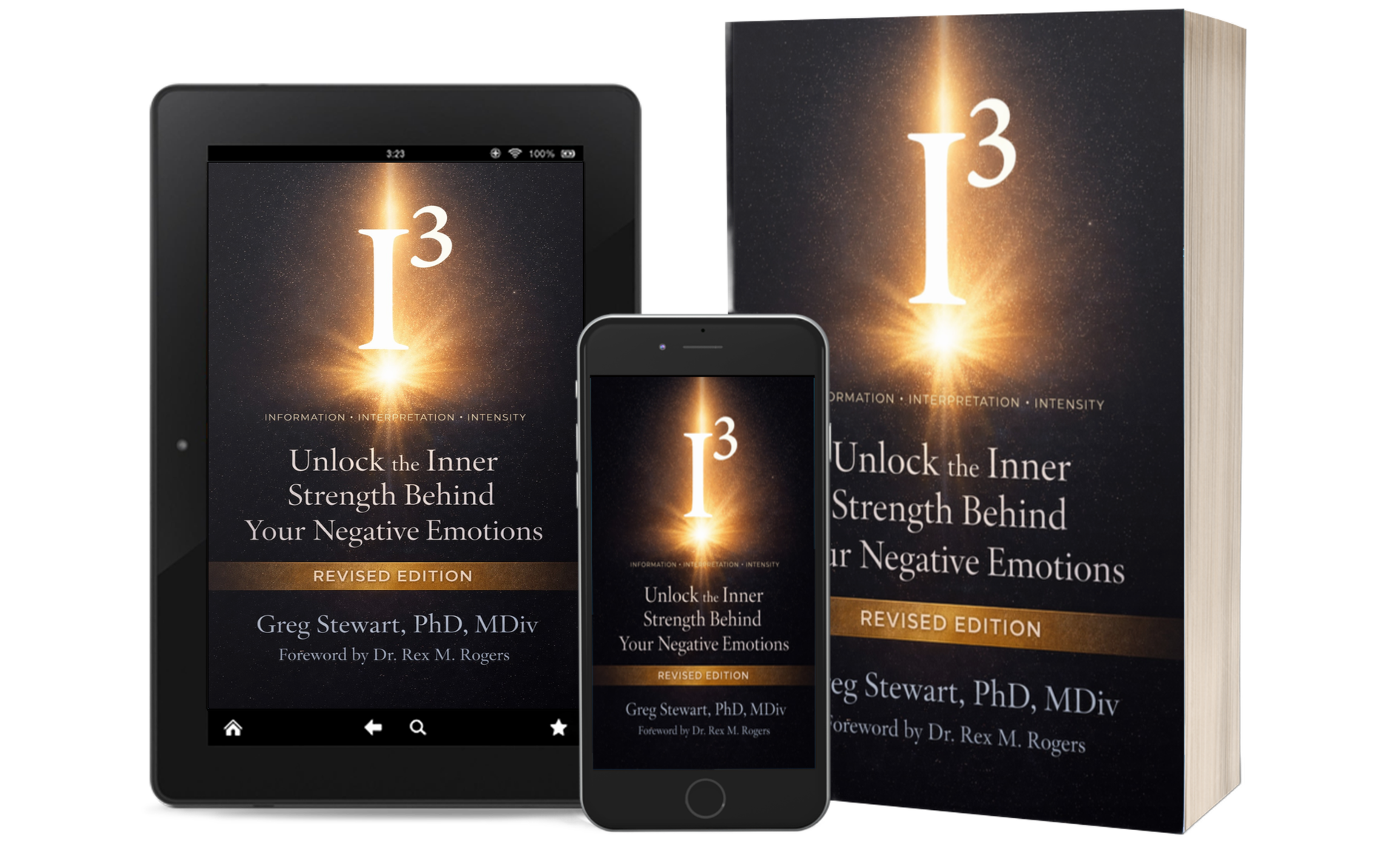
You receive no reply.
Within seconds, your mind supplies one.
“They are angry with me.”
“I have done something wrong.”
“This relationship is ending.”
The facts remain limited. The emotion becomes substantial. Anxiety enters the room before certainty does.
This is how emotional storms begin.
The event itself may be small. The sentence you attach to it may be immense. That sentence becomes an interpretation. The interpretation creates emotional energy. The energy moves you toward expression or action.
The central premise of Chapter 3 in Dr. Greg Stewart’s book, I³: Information, Interpretation, Intensity – Unlock the Inner Strength Behind Your Negative Emotions, is direct:
Emotions do not produce themselves. They come from sentences in our minds.
Those sentences may be thoughts, beliefs, assumptions, or opinions about yourself, the situation, or another person. They may be accurate. They may be distorted. They may be inherited from earlier experiences. They may be formed so quickly that they feel like facts.
They are still sentences.
Your Mind Is Always Calculating Meaning
Your mental model is an internal process that organizes experience. It fills in missing variables, evaluates possible outcomes, assigns importance to those outcomes, and produces emotional energy.
The process often occurs before deliberate reflection.
You hear a tone of voice. You assess it.
You notice a delay. You explain it.
You remember a previous failure. You predict the next one.
Daniel Kahneman’s distinction between rapid, automatic thinking and slower, deliberate thinking helps explain why these interpretations can feel immediate and authoritative. The mind recognizes patterns quickly. It does not always verify whether the pattern belongs to the present moment (Kahneman, 2011).
A mental model may therefore produce a sentence such as:
- “I will never find another opportunity.”
- “I am an idiot. I ruined the relationship.”
- “They did that because they do not respect me.”
- “If this opportunity fails, my life is over.”
- “I should have known better.”
The sentence creates meaning. Meaning creates emotional energy.
This does not make emotion imaginary. It makes emotion understandable.
Emotional energy is not inherently bad. It is the force your mind produces while attempting to solve a problem, protect something valuable, or restore a preferred condition. Positive energy may be expressed through joy, affection, or celebration. Negative energy may lead to protest, withdrawal, confrontation, preparation, or change.
The goal is not to eliminate emotion. The goal is to understand its source and calibrate its force.
The Panama Canal Rule Begins with Information
The I³ framework describes emotional processing through three locks:
- Information
- Interpretation
- Intensity
The Panama Canal Rule states that Lock 3 cannot be reached responsibly until the first two locks have been secured.
Begin with information.
What actually happened?
What did the person say?
What do you know without inference?
What remains unknown?
This discipline matters because people frequently treat an interpretation as information. A delayed response becomes rejection. A facial expression becomes contempt. A mistake becomes proof of incompetence. A medical question becomes a forecast of disaster.
The facts may be real. The conclusion may not be.
Psychology Today describes cognitive reappraisal as the deliberate practice of changing an emotional response by changing the thoughts attached to an experience. That process begins by distinguishing an automatic appraisal from a more accurate interpretation (Psychology Today, 2025).
Do not rush to Lock 3. First, secure the facts.
Interpretation Is Not the Same as Truth
Interpretation is necessary. Human beings cannot function without assigning meaning. The difficulty arises when interpretation escapes examination.
Suppose you make a mistake in a relationship or an important personal decision. Your mind may state, “I am a failure.” That sentence contains more than an observation. It contains a global judgment about identity.
A truthful interpretation may be more specific:
“I made a poor decision.”
“I did not prepare adequately.”
“I avoided a conversation I needed to have.”
“I need to repair the harm.”
Truth does not always feel pleasant. It does create a stable foundation for change.
Forced positivity says, “Everything is fine.”
Truth says, “This was painful, and I can identify what happened.”
Forced positivity says, “I never make mistakes.”
Truth says, “I made a mistake, and I can take responsibility without declaring myself worthless.”
This distinction matters in emotional regulation. Cognitive reappraisal is not the practice of painting every experience in bright colors. It is the practice of examining meaning and choosing an interpretation that is accurate, useful, and proportionate (Cutuli, 2014; Gross, 1998).
The truth sets a person free because truth ends the exhausting work of defending a false story.
The First Cause of Inflated Emotion: A Lie
Inflated emotion often begins with a lie about the situation.
The lie may be obvious:
“I will never get another opportunity.”
“I have destroyed everything.”
“No one will ever love me.”
The lie may also be subtle.
A person receives reassuring medical information and still asks, “But what if the doctor is wrong?” The question may sound cautious. In some situations, it functions as an unprovable conclusion disguised as uncertainty.
Another person thinks, “I do not think I had integrity in that situation.” That statement may be too vague to produce growth. What specifically happened? Was a promise broken? Was information withheld? Was responsibility avoided?
Vague self-condemnation creates shame. Specific truth creates direction.
Answer questions with evidence. Prove character evaluations. Identify the exact behavior that needs to change. Do not use a broad sentence to condemn an entire identity.
Research on ambiguous information shows that emotional interpretation becomes especially vulnerable when facts permit more than one possible meaning (Schoth & Liossi, 2017). The mind dislikes uncertainty. It often fills silence with fear.
The solution is not to pretend uncertainty does not exist. The solution is to name it accurately.
“I do not know yet.”
“That is one possibility, not a certainty.”
“I need more information before I decide what this means.”
These sentences protect the space between information and interpretation.
Emotional Energy Must Be Calibrated
Chapter 3 also presents emotion as energy that should be labeled and measured.
Name the brand of emotion.
Is it anxiety, anger, fear, sadness, shame, insecurity, resentment, or disappointment?
Then measure the intensity.
How much energy does the situation deserve on a scale from 1 to 10?
How much energy are you actually experiencing?
A missed appointment may deserve a 3. A serious threat to personal safety may require a 10. A difficult conversation may deserve a 6, but your history may cause your body to respond with a 9.
The difference deserves attention.
Research published in PLOS ONE found that cognitive reappraisal can require more effort when emotional intensity is high. The same study also found that people who use reappraisal more habitually tend to experience lower cognitive costs and greater reductions in subjective emotional intensity (Ortner et al., 2016).
Practice matters.
You do not become skilled at emotional calibration by waiting for a crisis. You build the skill in ordinary moments.
The work may begin with a simple log:
- What happened?
- What sentence appeared in my mind?
- What emotion did that sentence produce?
- What number describes the intensity?
- What number does the situation objectively deserve?
- Am I believing a lie?
- Am I taking this personally?
- Does this emotion resemble an earlier experience?
This record turns an invisible process into observable information.
Look Inside the House of Your Heart
The chapter’s image of the house of your heart offers another way to understand recurring emotional patterns.
Insecurity waits near the front door.
Anxiety occupies the kitchen.
Fear crouches in the hallway.
Worry watches from the window.
Anger paces through the bedroom.
Depression remains under the covers.
These emotions are not your identity. They are occupants. Some may have lived in the house for years. Some may have arrived through loss, rejection, trauma, or repeated criticism. Some may be responding to the present. Others may be carrying old emotional energy into a new room.
All negative emotion exposes something in you. It may reveal a belief, a fear, an unmet emotional goal, a wound, or a distorted conclusion.
This is not an invitation to shame yourself. It is an invitation to examine yourself.
Put down the microscope you use to inspect everyone else. Pick up the mirror. Ask what your emotional response is revealing about your own interpretation.
The Open Psychology Journal has examined emotional appraisal as part of the process through which people evaluate events in relation to their concerns and well-being (Fiorilli et al., 2017). Psi Chi research has likewise explored how perceptions of seriousness and self-compassion influence emotional experience (Pereira & Deemer, 2023).
Self-examination is not self-attack. It is the beginning of interior mastery.
The Pause Is Where Freedom Begins
Modern Psychological Studies research on response inhibition illustrates the importance of interrupting an automatic response when a more appropriate response is required (Duster et al., 2026).
Emotional maturity requires the same capacity.
You do not need to deny your first reaction. You need to recognize that the first reaction is an output of your current mental model.
Use the pause.
Say:
“I am having the thought that this means rejection.”
That sentence creates distance between you and the thought. It does not declare the thought true. It gives you room to examine it.
Then move through the three locks:
Information: What do I know?
Interpretation: What meaning have I assigned?
Intensity: How much emotional energy is present, and how much is appropriate?
Gross’s research distinguishes between regulating emotion early in the process and attempting to suppress expression after the emotion has already intensified. Reappraisal changes the meaning of the event. Suppression merely attempts to conceal the outward response (Gross, 1998; Gross & John, 2003).
Change the sentence before the sentence becomes a storm.
Practice Truthful Self-Talk
Constructive self-talk does not require empty declarations. It requires sentences that are both encouraging and true.
Instead of:
“I cannot handle this.”
Say:
“This is difficult, and I can identify the next necessary step.”
Instead of:
“I always ruin relationships.”
Say:
“I handled that conversation poorly. I can acknowledge the harm and repair what I can.”
Instead of:
“They must be angry with me.”
Say:
“I do not yet know why they have not responded.”
Instead of:
“I am weak because I feel afraid.”
Say:
“Fear is present. I can decide what action is wise.”
The American Psychological Association emphasizes the relationship among thoughts, emotions, and behavior in psychological treatment and emotional well-being (American Psychological Association, 2024). Your inner sentences matter because they influence the emotional energy available for your next action.
The right sentence does not erase grief, anger, or fear. It gives those emotions a more accurate place to stand.
Become More Through Accurate Interpretation
Your emotions are real. Your first interpretation may still be wrong.
That distinction provides hope.
You are not required to obey every sentence your mind produces. You are responsible for examining those sentences, testing them against truth, and choosing a response that matches reality.
Start with information.
Examine interpretation.
Calibrate intensity.
Emotions do not produce themselves. They come from sentences in your mind. Change the sentence, and you may change the energy. Change the energy, and you may change the action. Change the action, and you begin to change the status quo.
Learn more through Dr. Greg Stewart’s TEDx talk.
Study the complete framework in I³: Information, Interpretation, Intensity – Unlock the Inner Strength Behind Your Negative Emotions.
References
American Psychological Association. (2024). Understanding emotions and emotional regulation. https://www.apa.org/topics/emotions
Cutuli, D. (2014). Cognitive reappraisal and expressive suppression strategies role in the emotion regulation: An overview on their modulatory effects and neural correlates. Frontiers in Systems Neuroscience, 8, Article 175. https://doi.org/10.3389/fnsys.2014.00175
Duster, K., Mozqueda-Fuhrmeister, D., Anderson, K., Conway, M., Piaszynski, J., Winder, A., Courtney, C., & Ramchandran, K. (2026). Digitization of the Switching Stroop Task. Modern Psychological Studies, 32(1). https://scholar.utc.edu/mps/vol32/iss1/1
Fiorilli, C., Pepe, A., Buonomo, I., & Albanese, O. (2017). At-risk teachers: The association between burnout levels and emotional appraisal processes. The Open Psychology Journal, 10, 127–139. https://openpsychologyjournal.com/VOLUME/10/PAGE/127/FULLTEXT/
Gross, J. J. (1998). Antecedent- and response-focused emotion regulation: Divergent consequences for experience, expression, and physiology. Journal of Personality and Social Psychology, 74(1), 224–237. https://doi.org/10.1037/0022-3514.74.1.224
Gross, J. J., & John, O. P. (2003). Individual differences in two emotion regulation processes: Implications for affect, relationships, and well-being. Journal of Personality and Social Psychology, 85(2), 348–362. https://doi.org/10.1037/0022-3514.85.2.348
Kahneman, D. (2011). Thinking, fast and slow. Farrar, Straus and Giroux.
Ortner, C. N. M., Ste Marie, M., & Corno, D. (2016). Cognitive costs of reappraisal depend on both emotional stimulus intensity and individual differences in habitual reappraisal. PLOS ONE, 11(12), Article e0167253. https://doi.org/10.1371/journal.pone.0167253
Pereira, J. R. B., & Deemer, E. D. (2023). A test of a cognitive appraisal model of the influence of perceptions of seriousness and self-compassion as influencing impostor experiences. Psi Chi Journal of Psychological Research, 28(3), 191–200. https://doi.org/10.24839/2325-7342.JN28.3.191
Psychology Today. (2025, November 14). Cognitive reappraisal. https://www.psychologytoday.com/us/basics/cognitive-reappraisal
Schoth, D. E., & Liossi, C. (2017). A systematic review of experimental paradigms for exploring biased interpretation of ambiguous information with emotional and neutral associations. Frontiers in Psychology, 8, Article 171. https://doi.org/10.3389/fpsyg.2017.00171
Try Marblism! They are an incredible staff! Click here: https://marblism.com?via=dr-greg-stewart
The Final 10%: What Your Closest People Know About You but Won't Say

Someone says, “I’m fine,” but their voice has changed.
A loved one becomes unusually quiet. A friend stops offering an opinion. A family member says, “It’s nothing,” while their expression says otherwise. You sense that something is present, yet you cannot name it.
This is the Interpretation Gap. Information is incomplete, so the mind supplies its own explanation. Silence becomes rejection. Distance becomes resentment. A pause becomes proof that something is wrong.
Sometimes the real issue is not what others are thinking. Sometimes it is what they have noticed about us but do not feel safe enough to say.
That hidden portion is the final 10%.
The final 10% is the information in the back of someone’s mind that they would normally keep private. It may concern a habit, a tone, a reaction, or a pattern you cannot see because you are too close to your own experience. It may also reveal a strength you consistently underestimate.
The final 10% belongs to the Blind area of the Johari Window.

The Blind Area Is Not a Verdict
The Johari Window, developed by Joseph Luft and Harrington Ingham, describes four areas of interpersonal awareness:
- The Open area: What you know about yourself and others also know.
- The Hidden area: What you know about yourself but others do not know.
- The Blind area: What others see about you, but you do not see.
- The Unknown area: What neither you nor others yet understand.
The Blind area is not a declaration that you are defective. It is a declaration that no person possesses complete access to their own impact.
You cannot see your own face while speaking. You cannot fully hear your own tone while defending yourself. You may remember your intention while another person remembers the effect of your behavior.
Research supports this limitation. People often know their private thoughts and motives better than others do. Yet close others may know more about observable traits, relational patterns, and social impact than we know about ourselves (Vazire & Carlson, 2011). Bollich, Johannet, and Vazire (2011) argue that explicit feedback from close, knowledgeable people is a particularly important path to self-knowledge.
Self-reflection matters. It is not sufficient by itself.
You may examine your motives and conclude that you are caring. Another person may agree that you care but also observe that you become dismissive when threatened. Both observations may be true.
The final 10% often appears in that difference.
“Bless Their Heart” and the Information You Miss
“Bless their heart” can be an affectionate phrase. It can also mean, “You are clueless, and you do not understand what is happening.”
Consider the possibility that someone has silently blessed your heart.
They may have noticed that you interrupt when anxious. They may have seen that you withdraw when corrected. They may recognize that you demand honesty but punish people when they provide it. They may know that you are more generous, capable, or perceptive than you believe.
The point is not to assume every private opinion is accurate. The point is to admit that private opinions exist.
Psychology Today has repeatedly emphasized that self-awareness involves more than looking inward. It also requires understanding how one is experienced by other people (Psychology Today, 2025). The University of Tennessee at Chattanooga’s Modern Psychological Studies likewise describes psychology as a discipline built through careful observation, inquiry, and communication, not through private certainty alone (University of Tennessee at Chattanooga, n.d.).
Ask yourself:
Is there a gap between my subjective view of myself and the objective view of myself that others hold?
Then ask the more important question:
How will I close that gap?
Reactive Teachability Versus Proactive Teachability
Reactive teachability waits for someone else to build up the courage to correct you.
That is a poor strategy.
People hesitate to offer difficult feedback because they fear anger, withdrawal, argument, or retaliation. They may decide that preserving the relationship requires silence. They may offer the obvious information while withholding the deeper truth.
Proactive teachability reverses the pattern.
It regularly approaches trusted people and asks:
- Where am I blind?
- How can I grow?
- How can I become better?
- What do I do that affects others more than I realize?
- How do I respond when I feel threatened?
- What pattern keeps appearing in my relationships?
- What is one change that would make me easier to love?
- What strength do I underestimate?
Then it goes further.
“I am not looking for the obvious information. I want the information in the back of your mind that you would never share with me. That is the information I need.”
This request creates a clear invitation. It tells the other person that you are not asking for politeness. You are asking for useful truth.
People often underestimate how much others want constructive feedback and how much they may value the opportunity to provide it when the invitation is sincere (Abi-Esber et al., 2022). The invitation does not guarantee that the answer will be comfortable. It does make honesty more possible.
Pride Protects the Self-Image
Teachability requires humility. Pride rejects information before examining it.
Pride says:
- “That is not what happened.”
- “You misunderstood me.”
- “Everyone is too sensitive.”
- “I already know that.”
- “You are the one with the problem.”
Sometimes those statements are accurate. They are not automatically wise.
At its core, pride may protect a deep sense of insecurity. If accepting feedback feels like accepting worthlessness, the mind will reject the feedback to preserve the self. The person does not merely hear, “Your behavior caused harm.” The person hears, “You are harmful, unlovable, or beyond repair.”
That interpretation is too painful, so the mind defends itself.
The I³ framework gives us a disciplined way to interrupt that reaction:
- Information: What exactly did this person observe?
- Interpretation: What else might this feedback mean?
- Intensity: What level of emotional energy is needed for a wise response?
This is the Panama Canal Rule. Lock 3 cannot fill until Locks 1 and 2 are secured. Do not release the full intensity of shame, anger, or defensiveness before securing the information and evaluating the interpretation.
A person says, “You become cold when you feel criticized.”
The information is not yet a final judgment on your character. It is a data point. Ask for an example. Ask what the other person experienced. Ask whether the pattern appears in other relationships.
Use the RHWR grid. Is the feedback rational, healthy, wise, and right?
Do not accept every criticism as truth. Do not reject every criticism as an attack.
Search for Patterns, Not Punishment
One person may misunderstand you. Another may carry resentment. A third may lack important information. Feedback must be tested.
Look for convergence.
If several trusted people, in different settings, describe a similar pattern, pay attention. If one person alone offers a sweeping accusation without examples, hold it with caution. If the same concern appears repeatedly in your closest relationships, do not dismiss it merely because each person expressed it differently.
Research on multisource feedback emphasizes the value of gathering information from more than one observer and processing it through reflection rather than treating one rating as absolute truth (Sargeant et al., 2011). Research on self-, other-, and meta-perceptions also shows why it matters to compare three perspectives:
- How you see yourself.
- How others see you.
- How you think others see you.
De Vries and colleagues (2022) found that inaccurate assumptions about how others perceived a person’s honesty and humility were associated with poorer well-being. The broader lesson is clear. Misunderstanding your reputation creates strain. Accurate perception creates room for adjustment.
Do not pursue feedback to punish yourself. Pursue it to become more accurate.
Tell the Truth With Grace
Truth without grace becomes toxic.
Grace without truth becomes enablement.
Healthy feedback requires both.
John 1:14 describes Christ as full of grace and truth. That pairing provides a valuable standard for difficult conversations. The speaker must communicate commitment before, during, and after the correction:
- “I love you, and I am committed to you.”
- “Here is the pattern I have noticed.”
- “Here is the impact it seems to have.”
- “I am for you, and I remain committed to you.”
The listener must also receive the information with dignity:
- “Thank you for trusting me with that.”
- “I need time to consider it.”
- “Can you give me a specific example?”
- “I may not agree with every conclusion, but I want to understand the experience.”
- “I will look for this pattern in myself.”
Grace does not erase boundaries. You are not required to receive feedback from someone who is abusive, manipulative, or committed to humiliating you. Proactive teachability is not self-abandonment. It is disciplined openness within relationships marked by trust, respect, and appropriate limits.
Practice Proactive Teachability for Seven Days
Pick one person this week who knows you well.
Choose someone who has seen you under stress, not merely someone who admires you from a distance. Ask for a private conversation. Establish the purpose before asking the question.
Say:
“I am working on becoming more self-aware. I want to know where I may be blind and how I can grow. Please tell me what I do that affects people more than I realize. Then tell me the final 10% you may be hesitant to share.”
When the answer comes, do not defend yourself.
Listen. Take notes if appropriate. Ask for examples. Thank the person. Wait before making promises or explanations.
Then process the feedback through I³:
- Information: What was actually said?
- Interpretation: What are at least three possible meanings?
- Intensity: What response would be rational, healthy, wise, and right?
Repeat the practice once each week with a different trusted person. Over time, you will begin to notice patterns. You may also discover strengths that others have seen for years while you remained unaware of them.
This is how the Blind area becomes part of the Open area. It is how subjective certainty gives way to informed self-knowledge.

The Final 10% Makes Change Possible
The goal is not to become dependent on other people’s opinions. The goal is to become less imprisoned by your own assumptions.
Your identity is formed by your opinions, preferences, desires, values, convictions, philosophy, and beliefs. These mental models shape your emotional goals and influence how you interpret every interaction. They are built through DNA, life experiences, and choices. They are also capable of refinement.
Kahneman (2011) describes the speed and confidence of automatic thinking. System 1 produces immediate interpretations. It explains the pause, the silence, and the facial expression before you possess complete information.
Proactive teachability creates a pause.
It gives you access to information you could not produce through introspection alone. It helps you challenge the mental model before intensity takes control. It makes excuses harder to defend because the evidence has been invited into the room.
The final 10% may sting. It may also free you.
Learn more about the I³ framework in Dr. Greg Stewart’s TEDx talk, The Inner Strength Behind Your Negative Emotions. You can also explore his first book, I³: Information, Interpretation, Intensity – Unlock the Inner Strength Behind Your Negative Emotions.
At Becoming More Counseling, Coaching, & Consulting, the work of personal growth begins with the courage to see clearly, receive wisely, and become more intentionally.
References
Abi-Esber, N., Abel, J., Gino, F., & Schroeder, J. (2022). Just letting you know: Underestimating others’ desire for constructive feedback. Journal of Personality and Social Psychology. https://doi.org/10.1037/pspi0000393
American Psychological Association. (2022, March 24). People underestimate others’ desire for constructive feedback. https://www.apa.org/news/press/releases/2022/03/constructive-criticism
Bollich, K. L., Johannet, P. M., & Vazire, S. (2011). In search of our true selves: Feedback as a path to self-knowledge. Frontiers in Psychology, 2, Article 312. https://doi.org/10.3389/fpsyg.2011.00312
Dunning, D., Heath, C., & Suls, J. M. (2004). Flawed self-assessment: Implications for health, education, and the workplace. Psychological Science in the Public Interest, 5(3), 69–106. https://doi.org/10.1111/j.1529-1006.2004.00018.x
Kahneman, D. (2011). Thinking, fast and slow. Farrar, Straus and Giroux.
Luft, J., & Ingham, H. (1955). The Johari window: A graphic model of interpersonal awareness. Proceedings of the Western Training Laboratory in Group Development, University of California, Los Angeles.
Psychology Today. (2025). Unlock the hidden power of self-knowledge. https://www.psychologytoday.com/us/blog/finding-a-new-home/202507/unlock-the-hidden-power-of-self-knowledge
Psi Chi. (n.d.). IQ vs EQ for career success. https://www.psichi.org/page/281Eye-IQ-vs-EQ-for-Career-Success
Sargeant, J., McNaughton, E., Mercer, S., Murphy, D., Sullivan, P., & Bruce, D. (2011). Providing feedback: Exploring a model for multisource feedback. Medical Teacher, 33(9), 744–749. https://pubmed.ncbi.nlm.nih.gov/21854151/
The Open Psychology Journal. (2024). The Open Psychology Journal. https://openpsychologyjournal.com/
University of Tennessee at Chattanooga. (n.d.). About this journal: Modern Psychological Studies. UTC Scholar. https://scholar.utc.edu/mps/about.html
Vazire, S., & Carlson, E. N. (2011). Others sometimes know us better than we know ourselves. Current Directions in Psychological Science, 20(2), 104–108. https://doi.org/10.1177/0963721411402478
de Vries, A., Broks, V. M. A., Bloemers, W., Kuntze, J., & de Vries, R. E. (2022). Self-, other-, and meta-perceptions of personality: Relations with burnout symptoms and eudaimonic workplace well-being. PLOS ONE, 17(7), Article e0272095. https://doi.org/10.1371/journal.pone.0272095
Try Marblism! They are an incredible staff! Click here: https://marblism.com?via=dr-greg-stewart
"Bless Your Heart": Why the People Around You Can See What You Can't

Someone pauses before answering you.
A friend changes the subject. A family member offers a careful smile. A trusted person says, “Bless your heart,” with a tone that carries more meaning than the words.
Sometimes the phrase expresses sincere compassion. Sometimes it means, “You are missing something obvious.” The difference rests in tone, timing, and context.
The more difficult question is this: What if they are seeing something about you that you cannot see about yourself?
That question reaches the center of Chapter 2 of Dr. Greg Stewart’s I³: Information, Interpretation, Intensity – Unlock the Inner Strength Behind Your Negative Emotions. The chapter, “The Blind Can’t See,” examines the personal patterns that remain invisible from the inside while appearing unmistakable to others.
The goal is not shame. The goal is sight.
The Blind Area of the Johari Window
In 1955, psychologists Joseph Luft and Harrington Ingham introduced the Johari Window, a model for understanding interpersonal awareness. The model contains four areas:
- The Arena: Known to you and known to others.
- The Façade: Known to you but hidden from others.
- The Unknown: Unknown to you and unknown to others.
- The Blind Area: Unknown to you but known to others.
The Blind Area deserves attention because it contains information you cannot obtain through introspection alone. It includes repeated behaviors, emotional habits, interpersonal effects, and personal strengths that other people observe while you remain unaware.
You may believe that you are direct. Others may experience you as dismissive.
You may believe that you are calm. Others may experience you as emotionally distant.
You may believe that you are generous. Others may notice that you give freely but resent the lack of appreciation.
You may know that you have “something to work on,” yet remain blind to the degree of the problem. “I know I need to be more patient” can become a permanent substitute for actually becoming more patient.
This is the uncomfortable gap between the subjective view of yourself and the objective view that others hold.

You Know Your Intentions. Others Know Your Impact.
You live inside your intentions.
You know what you meant to say. You know why you reacted. You know the history behind your decision. You know the private pain that shaped your response.
Other people experience your words, timing, tone, expressions, and behavior.
This creates a predictable difference in perspective. You judge yourself by your motives. Others often judge you by your impact.
Neither perspective is complete by itself.
Research on self-knowledge supports this distinction. Vazire and Carlson (2011) explain that others sometimes know us better than we know ourselves, particularly in areas that are observable and socially consequential. They may notice whether we dominate conversations, withdraw under pressure, or create safety for others. We may know our private fears, values, and intentions more intimately than they do.
The point is not to crown one perspective as universally correct. The point is to recognize that each perspective contains information the other lacks.
Dunning, Heath, and Suls (2004) documented the limits of self-assessment. People often lack the very knowledge required to evaluate their own performance accurately. The absence of awareness does not prove the absence of a problem.
That is why confidence cannot serve as evidence of accuracy.
The Interpretation Gap Turns Silence into Fear
The I³ framework begins with information. Without reliable information, the mind supplies an interpretation.
This happens every day.
Someone does not return your call. You conclude that they are angry.
A friend answers with fewer words than usual. You decide that the relationship is damaged.
A loved one grows quiet at dinner. You assume you have disappointed them.
The silence is real. The conclusion may not be.
This is the Interpretation Gap: the distance between what happened and what you decided it means. The “0” matters here. The 0 represents the absence of confirmed information. It is the empty space between the event and the story.
Your mind does not enjoy an empty space. It fills the space quickly, often with fear.
Daniel Kahneman’s distinction between fast and slow thinking offers a useful explanation. System 1 generates rapid impressions through memory, association, and emotional pattern recognition. System 2 can slow the process, evaluate the evidence, and consider alternatives, but it requires deliberate effort (Kahneman, 2011).
The automatic interpretation may be useful. It may also be wrong.
Use the smoke detector principle. A smoke detector alerts you to possible danger. It does not tell you whether the source is burnt toast or a house fire. Your emotional alarm deserves attention, but it does not deserve unquestioned authority.
Ask:
- What information do I actually possess?
- What am I adding through interpretation?
- What other explanations fit the facts?
- What would I need to know before drawing a final conclusion?
This is not emotional detachment. It is emotional accuracy.
Your Mental Model Is Not the Same as Reality
A mental model is the internal structure through which you understand yourself and the world. It includes your opinions, preferences, wants, desires, values, convictions, philosophy, and beliefs.
These elements form your identity. They also shape your macro emotional goals.
If your macro goal is to be respected, you may react intensely when you perceive criticism.
If your macro goal is to be loved, silence may feel like rejection.
If your macro goal is to remain independent, assistance may feel like an insult.
The mental model produces suggestions. It says, “This is what is happening.” But a suggestion is not a verdict.
Your personal history may have taught you that quietness means anger. Another person’s history may have taught them that quietness means reflection. The same information enters two different mental models and produces two different interpretations.
This is why the I³ process requires discipline. Secure Lock 1, Information, before filling Lock 2, Interpretation. Then evaluate the interpretation through the RHWR grid before allowing it to generate Lock 3, Intensity.

Do not pour emotional intensity into an interpretation that has not earned it.
Proactive Teachability Closes the Blind Area
Reactive teachability waits for correction.
It waits for someone else to become frustrated enough, courageous enough, or concerned enough to speak. By then, the feedback may arrive with anger attached to it.
Proactive teachability asks first.
Ask trusted people:
- “Where am I blind?”
- “What do I do that affects others more than I realize?”
- “How do I respond when I feel threatened?”
- “What pattern keeps appearing in my relationships?”
- “What is one change that would make me easier to love?”
- “What strength do I underestimate?”
These questions pull out the final 10 percent. They invite people to say what they may otherwise keep to themselves.
Research on feedback supports this approach. Bollich, Johannet, and Vazire (2011) conclude that self-knowledge often requires explicit feedback from close, knowledgeable people. Their review argues that the road to self-knowledge cannot be traveled alone.
A related multisource study found that adults’ self-perceptions, beliefs about how others viewed them, and actual reports from multiple colleagues did not always align. The researchers found that inaccurate perceptions of how others viewed one’s character were associated with reduced well-being (de Vries et al., 2022). The lesson applies beyond the setting studied: misreading your social impact can create unnecessary strain.
Do not treat every criticism as truth. One person may misunderstand you. Another may carry resentment. A third may lack enough information to judge fairly.
Look for patterns.
When several trustworthy people describe the same behavior across different situations, pay attention. The convergence may be revealing your Blind Area.
Grace and Truth Must Remain Together
Feedback without grace becomes cruelty.
Grace without truth becomes enablement.
Dr. Stewart’s formulation is exact: grace and empathy without truth and boundaries is enablement. Truth and boundaries without grace and empathy are toxic.
Healthy feedback protects the dignity of the person while naming the reality of the pattern. It does not attack identity. It identifies behavior.
Say:
- “When I interrupt, people may feel dismissed.”
- “When I withdraw without explanation, others may assume the worst.”
- “When I defend myself immediately, I prevent people from finishing.”
- “When I promise change without creating a practice, I am asking others to carry the consequences.”
John 1:14 describes Jesus as full of grace and truth. The combination matters. Truth without compassion hardens the heart. Compassion without truth leaves the problem untouched.
The refining fire of self-awareness is not designed to destroy you. It removes what cannot remain if you intend to become more.
Move From Blindness to Interior Mastery
Begin with one recurring pattern.
Do not choose the pattern that makes you look most impressive. Choose the one that appears in the stories people repeatedly tell about their experience of you.
Write three lines:
- My intention: What did I want to communicate or accomplish?
- My behavior: What did I actually say or do?
- Their possible experience: What might it have been like to receive me?
Then ask someone you trust for a concrete example. Listen without explaining. Let the information remain in the room.
Set one micro emotional goal.
If your macro goal is to become a safe and honest person, your micro goal may be to pause for three seconds before defending yourself.
If your macro goal is to build secure relationships, your micro goal may be to ask for clarification rather than assigning meaning to silence.
If your macro goal is to live with interior mastery, your micro goal may be to separate information from interpretation before responding.
Repeat the process. Seek feedback again. Watch for evidence of change.
This is how the Blind Area becomes part of the Arena. You receive information. You evaluate interpretation. You regulate intensity. You practice a new response.
You become less dependent on automatic stories and more capable of deliberate wisdom.
“Bless your heart” may still be a Southern expression of sympathy or criticism. Let it also become a private question:
What might they see that I cannot yet see?
That question requires humility. It also opens the door to freedom.
To explore the I³ framework in greater depth, watch Dr. Greg Stewart’s TEDx talk and read his first book, I³: Information, Interpretation, Intensity – Unlock the Inner Strength Behind Your Negative Emotions. You can also learn more about Becoming More Counseling, Coaching, & Consulting.
References
American Psychological Association. (n.d.). Self-awareness. APA Dictionary of Psychology. https://dictionary.apa.org/self-awareness
Bollich, K. L., Johannet, P. M., & Vazire, S. (2011). In search of our true selves: Feedback as a path to self-knowledge. Frontiers in Psychology, 2, Article 312. https://doi.org/10.3389/fpsyg.2011.00312
de Vries, A., Broks, V. M. A., Bloemers, W., Kuntze, J., & de Vries, R. E. (2022). Self-, other-, and meta-perceptions of personality: Relations with burnout symptoms and eudaimonic workplace well-being. PLOS ONE, 17(7), e0272095. https://doi.org/10.1371/journal.pone.0272095
Dunning, D., Heath, C., & Suls, J. M. (2004). Flawed self-assessment: Implications for health, education, and the workplace. Psychological Science in the Public Interest, 5(3), 69–106. https://doi.org/10.1111/j.1529-1006.2004.00018.x
Kahneman, D. (2011). Thinking, fast and slow. Farrar, Straus and Giroux.
Luft, J., & Ingham, H. (1955). The Johari window: A graphic model of interpersonal awareness. Proceedings of the Western Training Laboratory in Group Development.
Modern Psychological Studies. (n.d.). Modern Psychological Studies. University of Tennessee at Chattanooga. https://scholar.utc.edu/mps/
Psychology Today. (2025). Building self-awareness: Why it’s more than looking inward. https://www.psychologytoday.com/us/blog/everyday-resilience/202506/building-self-awareness-why-its-more-than-looking-inward
Psi Chi Journal of Psychological Research. (n.d.). Past issues. https://www.psichi.org/page/journal_past
The Open Psychology Journal. (n.d.). The Open Psychology Journal. Bentham Open. https://openpsychologyjournal.com/
Vazire, S., & Carlson, E. N. (2011). Others sometimes know us better than we know ourselves. Current Directions in Psychological Science, 20(2), 104–108. https://doi.org/10.1177/0963721411402478
Stewart, G. (2026). I³: Information, Interpretation, Intensity – Unlock the Inner Strength Behind Your Negative Emotions (Revised ed.). https://a.co/d/cQ93cyo
Try Marblism! They are an incredible staff! Click here: https://marblism.com?via=dr-greg-stewart
Wanting More vs. Becoming More: Which One Are You Actually Doing?

You wake before sunrise. The alarm sounds. Your hand reaches for the snooze button before you have formed a complete thought.
You want more sleep.
You also want a meaningful day, a clear mind, and the satisfaction of keeping your word to yourself. Yet the first desire wins. The familiar response takes command.
This is the difference between wanting more and becoming more.
As Dr. Greg Stewart writes in Chapter 1 of I³: Information, Interpretation, Intensity, Unlock the Inner Strength Behind Your Negative Emotions, “Everyone becomes what they want to, only some people think about becoming more.”
The sentence contains two decisive words: want and think.
Want Is Often an Automatic Response
The word want appears straightforward. It is not.
You may say, “I want to exercise,” “I want to stop procrastinating,” or “I want to respond calmly.” Those statements express conscious intentions. They describe the person you hope to become.
But another form of wanting operates beneath intention. Your mental models produce automatic responses. Whatever your mental model produces automatically is what you want to do in that moment.
You want to check the message because uncertainty feels uncomfortable. You want to withdraw because conflict feels threatening. You want to criticize because blame provides temporary relief. You want to hit snooze because sleep offers immediate comfort.
These responses do not necessarily reflect your deepest values. They reflect what your mind has learned to expect, prefer, and repeat.
Research on habit formation describes habits as learned behavioral patterns triggered by familiar contexts. Repetition strengthens the connection between a cue and a response, reducing the need for deliberate thought (Stojanovic et al., 2021). The alarm sounds. The hand moves. The mind explains afterward.
This is not a character judgment. It is a pattern.
Patterns can be understood. Patterns can also be changed.
Kahneman’s Two Systems Explain the Struggle
Daniel Kahneman’s distinction between System 1 and System 2 clarifies the conflict.
System 1 is fast, automatic, associative, and economical. It recognizes patterns and produces immediate impressions. It allows you to drive a familiar route, recognize a friend’s voice, and respond to ordinary demands without analyzing every detail.
System 2 is slower and more deliberate. It weighs evidence, considers consequences, solves difficult problems, and evaluates whether an automatic response is appropriate (Kahneman, 2011).
The snooze button belongs to System 1. It requires little effort. It offers immediate relief. It follows a familiar sequence.
Getting up requires System 2. You must remember the purpose of the morning. You must compare temporary comfort with the consequences of delay. You must choose the effective response while tired.
Kahneman observed that System 2 often accepts the answer supplied by System 1. Deliberate thinking demands energy. The mind prefers efficiency. When a familiar response feels satisfactory, the mind may fail to investigate whether it is effective.
Psychology Today describes this automaticity as the capacity to perform a behavior rapidly and with little conscious intention (Psychology Today, 2021). The American Psychological Association likewise explains that self-control involves resisting immediate rewards in service of longer-term aims, while emphasizing the value of habits, structure, and environmental design (American Psychological Association, n.d.).
The problem is not that automatic thinking exists. The problem is allowing it to make decisions after it has stopped serving you.

Why People Passively Follow Ineffective Mental Models
Many people permit their mental models to decide for them because automatic responses provide three immediate benefits.
1. Familiarity
A familiar response feels safe, even when it produces poor results. The mind often prefers a known disappointment to an unfamiliar possibility.
2. Relief
Avoidance lowers discomfort quickly. Snoozing removes fatigue for a few minutes. Silence removes the risk of a difficult conversation. Scrolling removes attention from an unpleasant task.
3. Efficiency
Deliberation takes effort. When people are tired, anxious, overstimulated, or emotionally intense, they have fewer resources available for careful analysis. They revert to what requires the least thought.
This pattern explains procrastination. A person may genuinely value completion, excellence, or personal responsibility. Yet the immediate desire to escape discomfort becomes stronger than the distant benefit of finishing the task.
A study published in the Psi Chi Journal of Psychological Research found that conscientiousness and college self-efficacy were negative predictors of procrastination among undergraduates. The findings support the relationship between self-regulation, confidence, and goal-directed behavior (Gregory et al., 2023).
Research in Modern Psychological Studies similarly connects self-efficacy with procrastination patterns. Confidence does not eliminate difficulty. It influences whether a person interprets difficulty as a reason to begin or a reason to delay (“Relations between Self-Efficacy and Procrastination Types in College Students,” 2020).
The automatic response says, “Later.”
Thinking asks, “What will later require of me?”
Think Is Present-Tense Consciousness
To think, in the sense used by Dr. Stewart, means more than having thoughts. It means becoming conscious of the response your mental model has produced.
The automatic response says, “Stay in bed.”
Thinking says, “I notice that I want to stay in bed. Is that response effective?”
The automatic response says, “They have not replied. Something is wrong.”
Thinking says, “What information do I actually possess? What interpretation have I added?”
The automatic response says, “I cannot handle this.”
Thinking says, “What is the next appropriate action?”
This is the moment of choice. You do not need to deny the automatic response. You need to examine it.
The Open Psychology Journal describes self-regulation as the capacity to initiate, adjust, interrupt, stop, or change thoughts, feelings, and actions in pursuit of goals. Its review distinguishes between reactive processes and more effortful executive control (Larraín-Valenzuela et al., 2022).
Thinking creates the space between impulse and action.
In that space, you can agree with the automatic response. You can also choose something different.
Introducing I³ and the Panama Canal Rule
The I³ framework, pronounced I cubed, examines the relationship among Information, Interpretation, and Intensity.
- Information asks, “What happened?”
- Interpretation asks, “What meaning am I assigning to what happened?”
- Intensity asks, “How much emotional energy is this producing?”
The Panama Canal Rule provides the sequence. A canal cannot move a ship through Lock 3 until Locks 1 and 2 have been secured. In the same way, you cannot responsibly manage emotional intensity until you have examined the information and interpretation creating it.
This is the discipline of becoming more.
Do not begin with, “How do I get rid of this feeling?” Begin with, “What information is present? What interpretation is operating? What response is effective?”
The snooze-button example follows the same pattern.
Information: The alarm is sounding.
Interpretation: Five more minutes will restore me, and getting up can wait.
Intensity: Fatigue and the desire for comfort feel urgent.
The automatic response is to press snooze. Thinking secures the first two locks. It examines the information and challenges the interpretation. It then evaluates the intensity rather than obeying it.
The effective response may be simple: sit up, place both feet on the floor, and begin the morning.
That action does not prove that you never wanted more sleep. It proves that you can think beyond the first want.
Becoming More Requires Repeated Deliberate Choices
A single deliberate decision matters. Repeated decisions create a new pattern.
Frontiers in Psychology research found that repeated behavior in stable contexts increases automaticity. The researchers also found a reciprocal relationship between self-efficacy and habit strength. Successful repetitions can increase confidence, while confidence can support future repetitions (Stojanovic et al., 2021).
This offers a practical path:
Name the automatic response.
Identify the moment when your mental model takes over.Separate information from interpretation.
Record what actually happened. Then identify the meaning you added.Evaluate effectiveness.
Ask whether the automatic response serves your long-term purpose.Choose one different action.
Make the action specific and immediate.Repeat it in the same context.
Repetition gives the new response a chance to become familiar.
Becoming more does not require constant self-rejection. It requires greater interior honesty.
You do not become more by pretending that the automatic response is absent. You become more by refusing to confuse an automatic response with a final decision.

Wanting More Is Not Enough
Wanting more is valuable. It reveals desire, aspiration, and dissatisfaction with remaining unchanged.
But wanting more does not guarantee becoming more.
You may want patience and still react with anger. You may want discipline and still delay. You may want closeness and still withdraw. You may want a different life while repeatedly selecting the responses that preserve the old one.
The decisive question is not, “What do I want?”
It is, “What does my mental model automatically produce, and will I think carefully enough to choose differently?”
That question moves you from desire to responsibility. It moves you from passive repetition to deliberate formation.
In I³, Dr. Greg Stewart invites readers to examine the inner strength behind negative emotions rather than merely suppressing the emotions themselves. His TEDx talk offers a concise introduction to this approach. His book, I³: Information, Interpretation, Intensity, Unlock the Inner Strength Behind Your Negative Emotions, develops the framework in greater depth.
The next time your first impulse appears, pause.
Name it.
Examine it.
Then decide whether it deserves to become your action.
That is where becoming more begins.
References
American Psychological Association. (n.d.). Willpower. https://www.apa.org/topics/personality/willpower
Gregory, B. B., Golson, M., & Larsen, M. (2023). Psychological and behavioral predictors of procrastination in undergraduates. Psi Chi Journal of Psychological Research. https://cdn.ymaws.com/www.psichi.org/resource/resmgr/journal_2023/28_52_Gregory.pdf
Grass, J., Krieger, F., Paulus, P., Greiff, S., Strobel, A., & Strobel, A. (2019). Thinking in action: Need for cognition predicts self-control together with action orientation. PLOS ONE, 14(8), e0220282. https://doi.org/10.1371/journal.pone.0220282
Kahneman, D. (2011). Thinking, fast and slow. Farrar, Straus and Giroux.
Larraín-Valenzuela, J., Mardones, F., Ansoleaga, E., & Kausel, L. (2022). Conceptualization, tasks and neurobiological correlates of self-regulation in children and adolescents: A systematic review of the literature (2015–2020). The Open Psychology Journal, 15, e187435012202040. https://doi.org/10.2174/18743501-v15-e2202040
Modern Psychological Studies. (2020). Relations between self-efficacy and procrastination types in college students, 25(2). https://scholar.utc.edu/cgi/viewcontent.cgi?article=1476&context=mps
Psychology Today. (2021). The false dilemma: System 1 vs. System 2. https://www.psychologytoday.com/us/blog/a-hovercraft-full-of-eels/202103/the-false-dilemma-system-1-vs-system-2
Stojanovic, M., Fries, S., & Grund, A. (2021). Self-efficacy in habit building: How general and habit-specific self-efficacy influence behavioral automatization and motivational interference. Frontiers in Psychology, 12, 643753. https://doi.org/10.3389/fpsyg.2021.643753
Try Marblism! They are an incredible staff! Click here: https://marblism.com?via=dr-greg-stewart
The Mental Model You Don't Know You're Running

You hear silence and assume rejection.
Someone takes longer than usual to respond, and your mind supplies a verdict. You read a short message and hear anger. You make one mistake and conclude that you are incapable. The facts remain sparse. The emotional response becomes certain.
This is the mental model you do not know you are running.
A mental model is an internal structure that helps you organize experience. It tells you what to notice, what to expect, and what an event appears to mean. It often operates before deliberate thought begins. It is not a conscious decision. It is a practiced interpretation.
That distinction matters.
You may believe that a situation caused your emotion. More precisely, your interpretation of the situation gave the emotion its direction and force. The event supplied information. Your mental model supplied meaning.
Your First Reaction Is an Output
Chapter 1 of Dr. Greg Stewart’s book, I³: Information, Interpretation, Intensity – Unlock the Inner Strength Behind Your Negative Emotions, begins with a direct distinction: want and think are not the same.
Want is the automatic response. It is what your existing mental model produces before you examine it.
Think is the deliberate response. It is the moment you pause, consider the information, and choose how to interpret it.
This does not mean that your first reaction is dishonest. It means that it is incomplete.
A person who grew up around criticism may hear a neutral observation as condemnation. A person who has experienced abandonment may treat delayed contact as evidence of impending loss. A person who has repeatedly felt misunderstood may enter a conversation already preparing to defend himself.
The present moment activates an older map.
Cognitive therapy describes automatic thoughts as immediate appraisals of a situation. These thoughts influence emotion and behavior, often without receiving deliberate examination (Burger et al., 2021). The thought may be brief:
- “They are upset with me.”
- “I have ruined everything.”
- “This will not work.”
- “I am not enough.”
Because the thought arrives quickly, it feels like perception rather than interpretation.
That is the central difficulty. You do not notice the lens because you are looking through it.

Why You Do Not Notice the Model
Mental models become difficult to see for three reasons.
Repetition Makes Them Feel Like Truth
A repeated interpretation becomes familiar. Familiarity creates confidence, even when the interpretation is inaccurate.
If you have often concluded that silence means danger, silence will feel dangerous. If you have often interpreted correction as humiliation, correction will feel humiliating. The emotional certainty comes from repetition, not necessarily from the facts of the present situation.
Schemas, or deeper cognitive structures, organize beliefs about the self, other people, and the world. They influence which parts of an event receive attention and which possibilities appear reasonable. Automatic thoughts express those deeper structures in specific moments (Burger et al., 2021).
The mind does not begin from nothing. It compares the present with what it already knows.
Speed Conceals the Process
Your mind is designed to recognize significance quickly. This capacity protects you. It also creates false confidence.
Modern Psychological Studies recently described the importance of inhibiting a prepotent response when a stimulus creates conflict. The ability to interrupt the first response and select a more appropriate one is central to psychological control (Duster et al., 2026). Emotional life requires a similar discipline. You must learn to recognize the first response without allowing it to become the final interpretation.
Speed is useful. Speed is not wisdom.
Emotion Strengthens the Interpretation
Once an interpretation produces emotion, the emotion can appear to confirm the interpretation.
You think, “Something is wrong.” Anxiety rises. You then use the anxiety as evidence that something is wrong.
This is the interpretation gap. It is the distance between what you know and what you conclude.
The wider the gap, the more room fear has to write the story.
Research on ambiguous information shows that people can develop biased interpretations when the available facts permit multiple meanings (Schoth & Liossi, 2017). The problem is not imagination itself. The problem is allowing an untested interpretation to pose as information.
The Interpretation Gap Is Where Freedom Begins
The interpretation gap is not a flaw. It is a space.
Within that space, you can distinguish:
- What happened.
- What you noticed.
- What you assumed.
- What you felt.
- What you decided to do.
Consider a simple example.
A friend does not respond to your message.
Information: No response has arrived.
Interpretation: My friend is angry, disappointed, or withdrawing.
Intensity: Anxiety, sadness, or anger rises.
The interpretation may be correct. It may also be wrong. At the first moment, you do not yet know.
The disciplined response is not forced positivity. It is accuracy.
Ask:
- What information do I actually possess?
- What meaning did I assign to it?
- What other interpretations fit the same facts?
- What response serves my emotional goal?
Cognitive reappraisal follows this same principle. It changes the personal meaning of an emotional event rather than pretending that the event is pleasant. Wang and Yin (2023) emphasize that effective reappraisal depends on updating the schemas that shape future interpretations. A new thought becomes more reliable when it is supported by repeated, lived experience.
Do not replace fear with fantasy. Replace assumption with examination.

The Panama Canal Rule: Move Through the Locks
The Panama Canal Rule provides a practical structure for this work. A ship does not leap from one level to another. It moves through a series of locks.
Your emotional life requires the same order.
Lock 1: Information
Gather the facts.
Do not begin with the story. Begin with what is observable. Separate what was said from what you inferred. Separate the event from your memory of similar events.
Information is the foundation. Without it, interpretation becomes speculation.
Lock 2: Interpretation
Examine the meaning.
Ask what your mental model is predicting. Identify the belief beneath the reaction. Notice whether the mind is using familiar distortions such as mind-reading, catastrophizing, or all-or-nothing judgment.
Interpretation is necessary. Unexamined interpretation is dangerous.
Lock 3: Intensity
Only after information and interpretation should you address emotional intensity.
The goal is not to suppress emotion. The goal is to understand what the emotion is doing. Anxiety may signal uncertainty. Anger may signal perceived injustice. Sadness may signal loss. Shame may signal a threatened sense of worth.
I³ does not treat negative emotion as an enemy. It treats emotion as information that requires interpretation.
The sequence matters. Many people attempt to regulate intensity before identifying the interpretation that produced it. They try to calm down while continuing to tell themselves that catastrophe is certain. That is an attempt to reach Lock 3 without passing through the first two locks.
You cannot refine what you refuse to examine.
The 0: The Moment Before the Story
The 0 is the interval before interpretation hardens.
It is the pause between the stimulus and the conclusion. It is not emptiness. It is possibility.
At the 0, you do not deny the reaction. You observe it.
You may say:
“I am having the thought that this silence means rejection.”
That sentence creates distance. It identifies the thought without surrendering authority to it.
The 0 also protects you from treating emotional intensity as proof. The body may be alert while the situation remains uncertain. The smoke detector may be loud while the room contains no fire.
The Open Psychology Journal has published work examining emotional appraisal processes and the way people evaluate events in relation to their concerns and well-being (Fiorilli et al., 2017). Psi Chi research likewise demonstrates the importance of appraisal in understanding how people assign significance to difficult experiences (Pereira & Deemer, 2023).
Your response begins with meaning. The 0 gives you a chance to reconsider meaning before intensity takes control.
Personality and Emotional Intelligence Begin Here
Personality influences which mental models become familiar. One person moves toward confrontation. Another withdraws. Another searches for reassurance. These patterns may feel like fixed traits, but they can also reflect practiced interpretations.
Emotional intelligence begins with the ability to recognize the difference between an emotion and the interpretation surrounding it.
You are angry. What does the anger believe?
You are afraid. What does the fear predict?
You are ashamed. What judgment has been placed upon you?
These questions do not invalidate emotion. They make emotion more intelligible.
Psychology Today describes cognitive reappraisal as a method for changing the meaning assigned to an emotional situation (Psychology Today, n.d.). The American Psychological Association’s cognitive-behavioral materials similarly reflect the importance of examining the relationship among thoughts, emotions, and behavior (American Psychological Association, n.d.).
This is how you begin to become more. You do not become more by obeying every reaction. You become more by thinking carefully about what the reaction is asking you to believe.
Practice the Pause
Use this brief exercise when your response feels larger than the available facts.
Name the event. Describe only what an impartial observer could record.
Name the interpretation. State the conclusion your mind supplied.
Name the emotion. Use a precise word. Do not use “bad” as a substitute for understanding.
Name the intensity. Rate it from 0 to 10.
Name another possible meaning. Make it realistic, not artificially positive.
Choose the next action. Act from clarity rather than urgency.
This practice does not guarantee immediate calm. It develops interior mastery. Each repetition gives you more information about the mental model you are running. Each accurate observation weakens the authority of an automatic conclusion.
Over time, the model becomes visible.
Once visible, it can be examined.
Once examined, it can change.
Begin with I³
Dr. Greg Stewart’s TEDx talk develops the broader message of becoming more by confronting the inner processes behind negative emotion. Watch the TEDx talk.
For a deeper study of Information, Interpretation, and Intensity, read I³: Information, Interpretation, Intensity – Unlock the Inner Strength Behind Your Negative Emotions.
Your first reaction is not your identity. It is an output.
Pause. Examine the model. Think before you let want decide who you will become.
References
American Psychological Association. (n.d.). Cognitive-behavioral therapy and the relationship among thoughts, emotions, and behavior. https://www.apa.org/pubs/videos/4310891
Burger, F., Neerincx, M. A., & Brinkman, W.-P. (2021). Natural language processing for cognitive therapy: Extracting schemas from thought records. PLOS ONE, 16(10), e0257832. https://doi.org/10.1371/journal.pone.0257832
Duster, K., Mozqueda-Fuhrmeister, D., Anderson, K., Conway, M., Piaszynski, J., Winder, A., Courtney, C., & Ramchandran, K. (2026). Digitization of the Switching Stroop Task. Modern Psychological Studies, 32(1). https://scholar.utc.edu/mps/vol32/iss1/1
Fiorilli, C., Pepe, A., Buonomo, I., & Albanese, O. (2017). At-risk teachers: The association between burnout levels and emotional appraisal processes. The Open Psychology Journal, 10, 127–139. https://openpsychologyjournal.com/VOLUME/10/PAGE/127/FULLTEXT/
Pereira, J. R. B., & Deemer, E. D. (2023). A test of a cognitive appraisal model of the influence of perceptions of seriousness and self-compassion as influencing impostor experiences. Psi Chi Journal of Psychological Research, 28(3), 191–200. https://doi.org/10.24839/2325-7342.JN28.3.191
Psychology Today. (n.d.). Cognitive reappraisal. https://www.psychologytoday.com/us/basics/cognitive-reappraisal
Schoth, D. E., & Liossi, C. (2017). A systematic review of experimental paradigms for exploring biased interpretation of ambiguous information with emotional and neutral associations. Frontiers in Psychology, 8, 171. https://doi.org/10.3389/fpsyg.2017.00171
Wang, Y.-X., & Yin, B. (2023). A new understanding of the cognitive reappraisal technique: An extension based on the schema theory. Frontiers in Behavioral Neuroscience, 17, 1174585. https://doi.org/10.3389/fnbeh.2023.1174585
Try Marblism! They are an incredible staff! Click here: https://marblism.com?via=dr-greg-stewart
The 'Positive Vibes' Myth: What Science Says About Your Right to Feel Heavy

You have likely heard the instruction: “Stay positive.”
Sometimes it offers encouragement. Sometimes it becomes a command. It tells you to smile when you are grieving, express gratitude when you are frightened, or search for a silver lining before you have had time to understand what happened.
That is not resilience. It is emotional haste.
You have the right to feel heavy. Sadness, disappointment, anger, fear, and discouragement are not evidence of personal failure. They are experiences that require attention. When you dismiss them too quickly, you lose access to the information they carry.
Psychology Today describes toxic positivity as the avoidance, suppression, or rejection of difficult emotions through an insistence on positive thinking. Positivity becomes harmful when it denies the reality of pain rather than helping a person face it (Psychology Today, 2025).
The distinction matters. Healthy optimism says, “This is difficult, and I can respond.” Forced positivity says, “This must not be difficult.”
Becoming More Requires More Than Wanting to Feel Better
Chapter 1 of I³: Information, Interpretation, Intensity begins with a fundamental distinction: the difference between automatic want and deliberate think.
Your automatic want is shaped by your mental models. You want comfort. You want approval. You want certainty. You want painful emotions to disappear immediately. These impulses are understandable, but they are not always wise.
The deliberate think pause creates another possibility. It allows you to ask:
- What am I feeling?
- What information does this emotion contain?
- What am I assuming?
- What else could be true?
- What response would help me become more capable, honest, and whole?
This pause is not passive. It is an act of interior strength.
The culture of forced positivity often eliminates this pause. It urges you to replace sadness with gratitude before you have understood the loss. It encourages you to call fear excitement before you have assessed the danger. It tells you to “move on” before you have processed what happened.
That is how emotional growth is short-circuited. The emotion is not examined. The mental model is not questioned. The person simply attempts to feel different.
Becoming more requires something better. Stop treating emotional discomfort as an emergency. Begin treating it as information.

Heavy Emotions Are Not the Enemy
The I³ framework begins with three connected elements:
- Information: What is happening within you and around you.
- Interpretation: The meaning you assign to that information.
- Intensity: The emotional force produced by the interpretation.
The framework does not suggest that every interpretation is accurate. It suggests that every emotion deserves examination.
Anger may indicate violated boundaries. Sadness may reveal loss. Fear may signal uncertainty or perceived danger. Shame may point toward a conflict between your behavior and your values. The emotion is not automatically correct, but it is rarely meaningless.
This is the beginning of the Panama Canal Rule. A ship does not move directly from one level of water to another. It passes through a sequence of locks. In the same way, emotional intensity should not be treated as an isolated event. Information and interpretation influence the intensity that follows.
Forced positivity attempts to drain the final lock without inspecting the first two.
It says, “Do not feel intense.”
The I³ approach asks, “What information entered the system, what interpretation followed, and what created this level of intensity?”
That question gives you room to think.
What Recent Research Says About Suppression
The research does not support a simplistic claim that every instance of emotional suppression is harmful. Context matters.
A 2025 study in Frontiers in Psychology examined expressive suppression among 956 college students. The researchers found that expressive suppression was associated with subthreshold depression through negative attentional bias. In other words, suppression appeared connected to a pattern in which attention became more focused on negative information. Regulatory emotional self-efficacy weakened this relationship, suggesting that confidence in one’s ability to manage emotions may offer protection (Chen et al., 2025).
The study was cross-sectional, so it cannot establish that suppression directly causes depression. It does, however, offer a useful warning: hiding an emotion does not necessarily resolve the mental process beneath it.
A 2025 study in BMC Psychology offers an important qualification. Among 350 adults, cognitive reappraisal, religious coping, and seeking support were associated with lower depression. Expressive suppression and acceptance did not show significant relationships with depression or anxiety in that particular sample (Zaid et al., 2025).
That finding should not be ignored. Healthy psychological practice requires precision. Acceptance is not a magic instruction, and suppression is not uniformly damaging in every context. Effective regulation depends on the person, the culture, the emotion, the purpose, and the timing.
A PLOS ONE study demonstrates this complexity. In a small sample of Chinese undergraduates completing a frustrating task, expressive suppression reduced depressive experience and physiological arousal more effectively than acceptance in the immediate situation (Yuan et al., 2014). The study’s authors emphasized cultural context.
The wiser conclusion is not “always express everything” or “always suppress nothing.” The wiser conclusion is this:
Do not make suppression your identity. Do not make positivity your disguise. Develop flexibility.
Acceptance Is Not Resignation
Acceptance does not mean approving of pain. It does not mean remaining in harmful circumstances. It does not mean abandoning hope.
Acceptance means acknowledging reality without adding unnecessary judgment.
Say:
“I am sad.”
Do not immediately add:
“I should not be sad.”
Say:
“I am afraid.”
Do not immediately add:
“This proves I am weak.”
The first statement identifies information. The second interpretation may intensify the experience through shame.
Acceptance creates a deliberate think pause. It allows you to observe the emotion before deciding what to do with it. From there, you can seek support, establish a boundary, solve a problem, grieve a loss, or choose a more accurate interpretation.
The American Psychological Association defines resilience as the process and outcome of adapting successfully to difficult experiences through mental, emotional, and behavioral flexibility. It identifies perspective, social resources, and coping strategies as important contributors to resilient adaptation (American Psychological Association, 2022).
Notice what this definition does not require. It does not require constant happiness. It does not require emotional performance. It requires flexibility.

Replace Forced Positivity With Honest Hope
Healthy positivity does not deny pain. It places pain within a larger field of possibility.
It says:
- “This loss matters, and I can receive support.”
- “I feel discouraged, and I can take one constructive step.”
- “I do not understand this yet, but I can resist inventing the worst explanation.”
- “This emotion is intense, but intensity is not the same as destiny.”
The Open Psychology Journal has examined how positive and negative emotions relate to positive psychological functioning. Its findings support a broader view of emotional life: well-being is not built by pretending that difficult emotions do not exist. It is built through awareness, meaning, emotional skill, and constructive engagement (Grover et al., 2020).
The same principle appears in the discipline of psychological research. Modern Psychological Studies publishes experimental studies, theoretical papers, literature reviews, and book reviews by undergraduate researchers. The Psi Chi Journal of Psychological Research likewise provides a scholarly setting for psychological inquiry. Both outlets reflect a basic standard that applies to personal growth as well: examine the evidence before declaring certainty (Modern Psychological Studies, n.d.; Psi Chi Journal of Psychological Research, n.d.).
Your emotions deserve the same intellectual honesty.
Do not rush to label them good or bad. Begin with what is true.
A Simple I³ Practice for Heavy Days
When a heavy emotion arrives, use this sequence:
1. Identify the information
Name the emotion and the immediate situation.
“I feel anxious because I have not received an answer.”
2. Examine the interpretation
Ask what meaning you have assigned to the silence.
“I am interpreting the silence as rejection.”
3. Widen the gap
Ask what else could be true.
“The person may be busy. The situation may require clarification. I do not have enough information yet.”
4. Choose the next response
Take one action consistent with your values.
You may wait, ask a direct question, seek support, or attend to your body before deciding.
This is interior mastery. It does not erase the emotion. It gives the emotion a proper place.
To explore the full framework, watch Dr. Greg Stewart’s TEDx talk. You can also read his book, I³: Information, Interpretation, Intensity – Unlock the Inner Strength Behind Your Negative Emotions.
You do not need to become cheerful before you become wise.
You do not need to deny heaviness before you can carry it.
Pause. Receive the information. Examine the interpretation. Allow intensity to teach you what requires attention.
That is how you become more.
References
American Psychological Association. (2022). Resilience.
Chen, M., Huang, L., Qin, Q., Li, J., Zhang, J., Ma, J., & Song, H. (2025). Impact of expressive suppression on subthreshold depression among college students: A moderated mediation model. Frontiers in Psychology, 16, 1678275. https://doi.org/10.3389/fpsyg.2025.1678275
Grover, R., Aggarwal, A., & Mittal, A. (2020). Effect of students’ emotions on their positive psychology: A study of higher education institutions. The Open Psychology Journal, 13. https://doi.org/10.2174/1874350102013010272
Modern Psychological Studies. (n.d.). Modern Psychological Studies. University of Tennessee at Chattanooga.
Psychology Today. (2025). Toxic positivity.
Psi Chi Journal of Psychological Research. (n.d.). Journal past volumes.
Yuan, J., Liu, Y., Ding, N., & Yang, J. (2014). The regulation of induced depression during a frustrating situation: Benefits of expressive suppression in Chinese individuals. PLOS ONE, 9(5), e97420. https://doi.org/10.1371/journal.pone.0097420
Zaid, S. M., Hutagalung, F. D., Abd Hamid, H. S. B., & Taresh, S. M. (2025). The power of emotion regulation: How managing sadness influences depression and anxiety. BMC Psychology, 13, 38. https://doi.org/10.1186/s40359-025-02354-3
Try Marblism! They are an incredible staff! Click here: https://marblism.com?via=dr-greg-stewart
Are Your Emotions Lying to You? 7 Mistakes You're Making With Your Internal Narrative (And How the I³ Framework Fixes Them)

You receive no reply, and your mind supplies rejection.
Someone speaks briefly, and you conclude that you have done something wrong.
You wake with anxiety, and the feeling becomes evidence that the day will end badly.
The event may be real. The story attached to it may not be.
This is the central problem of Lock 2: Interpretation in Dr. Greg Stewart’s I³ framework. Information enters the mind. Interpretation assigns meaning. Intensity follows. When interpretation becomes distorted, ordinary events can produce extraordinary misery.
Your emotions are not necessarily lying. They are reporting something about your internal state. The error occurs when you treat the emotion-shaped story as a complete account of external reality.
The American Psychological Association defines cognitive distortion as faulty or inaccurate thinking, perception, or belief (American Psychological Association, n.d.). The practical task is not to suppress emotion. It is to examine the interpretation that gives emotion its direction.
The Panama Canal Rule
The I³ framework uses the Panama Canal as a disciplined metaphor. Ships pass through locks in sequence. The first lock must fill before the next one can open.
The same principle applies to emotional life:
- Lock 1: Information , What actually happened?
- Lock 2: Interpretation , What meaning am I assigning to it?
- Lock 3: Intensity , How much emotional energy am I committing?
You cannot secure Lock 3 responsibly until Locks 1 and 2 are examined. If you rush from incomplete information to an untested interpretation, emotional intensity rises before reality has been properly assessed.

Mistake 1: Treating a feeling as a verdict
Distortion: Emotional reasoning
You feel afraid, so you decide that danger is present.
You feel ashamed, so you conclude that you are defective.
You feel rejected, so you assume rejection has occurred.
Emotional reasoning confuses an internal experience with an external fact. The feeling is genuine. The conclusion may be inaccurate.
The 2026 JMIR Mental Health study by ten Thij and colleagues found that markers of emotional reasoning appeared far more often in the language of people seeking help through a suicide-prevention chat service than in counselors’ language. The study does not suggest that every emotionally worded statement is distorted. It demonstrates that emotion-driven language can form part of a broader pattern of rigid, exaggerated thought (ten Thij et al., 2026).
Use this correction:
“I feel afraid. That tells me my system detects threat. It does not yet prove that threat is present.”
Mistake 2: Turning uncertainty into catastrophe
Distortion: Catastrophizing
A delayed response becomes the end of a relationship.
A mistake becomes the ruin of your future.
A difficult conversation becomes proof that everything will collapse.
Catastrophizing makes the worst possible outcome feel like the most probable outcome. It compresses possibility into certainty.
Ask three questions:
- What do I know?
- What am I predicting?
- What is the most likely explanation, not the most frightening one?
This is not forced optimism. It is proportional thinking.
Gawlik and Coifman’s 2026 PLOS ONE research examined whether negative interpretation bias influences emotional responses to positive content. Across three studies, the findings were complex rather than absolute. One study found a small indirect effect, while two did not find significant mediation. The larger lesson is appropriately measured: interpretation bias may influence emotional experience, but context and individual differences matter (Gawlik & Coifman, 2026).
Do not turn one study, one feeling, or one moment into a universal law.
Mistake 3: Making one event represent your entire life
Distortion: Overgeneralizing
You forget one appointment and tell yourself, “I always fail.”
A relationship ends, and you conclude, “No one can be trusted.”
You experience one painful day, and you declare, “My life is hopeless.”
Overgeneralization transforms a specific event into a permanent identity. Watch for words such as always, never, everyone, no one, and everything. These words often signal that a limited observation has become an excessive conclusion.
Replace the global statement with a bounded one:
- “I handled that poorly today.”
- “This relationship ended painfully.”
- “I am struggling in this season.”
Precision restores proportion. A specific problem can be addressed. A global condemnation leaves no clear path forward.
Mistake 4: Assuming you know what silence means
Distortion: Mind-reading
Silence creates an interpretation gap. The mind dislikes empty space, so it fills the space with fear.
“They are angry.”
“They think I am foolish.”
“They do not want me here.”
You may eventually discover that your interpretation is correct. You do not know that merely because it feels convincing.
Research reviewed by Everaert, Struyf, and Koster describes interpretation bias as a tendency to resolve ambiguity through emotionally consistent meanings. Attention, memory, and cognitive control can reinforce the first interpretation that appears, especially when anxiety or depression is present (Everaert et al., 2023).
Treat your conclusion as a hypothesis.
“I am interpreting the silence as rejection. What evidence would confirm or challenge that interpretation?”
Then seek information respectfully rather than conducting an invisible trial inside your own mind.

Mistake 5: Assuming the first interpretation is the only interpretation
Distortion: Rigid interpretation
A flexible mind can hold more than one explanation.
A rigid mind selects one meaning and defends it.
The facial expression was hostile.
The comment was deliberate.
The outcome proves incompetence.
The 2025 Frontiers in Psychology study of breast cancer patients with post-traumatic stress symptoms found that participants with PTSS made more “sad” judgments of ambiguous facial expressions and took longer to respond. The study involved a specific clinical population, so it should not be generalized to everyone. It does, however, illustrate how trauma-related symptoms can shape the interpretation of unclear emotional signals (Wang et al., 2025).
Use the phrase:
“The truth also is…”
The truth also is that the person may have been tired.
The truth also is that the message may have been incomplete.
The truth also is that your history may be influencing your present interpretation.
“The truth also is” does not erase the first possibility. It makes room for additional evidence.
Mistake 6: Letting one negative detail become the whole picture
Distortion: Mental filtering and disqualifying the positive
You receive nine affirming comments and one criticism. The criticism occupies the entire evening.
You complete a difficult task, but notice only the part that went imperfectly.
You experience warmth and connection, but dismiss them as temporary or insignificant.
This mistake narrows attention until the negative detail appears to be the complete record. The 2026 JMIR study identified mental filtering as one of the cognitive-distortion markers that appeared more often in help-seekers’ language than in counselors’ language. Again, the finding concerns patterns across large groups, not diagnoses of individuals (ten Thij et al., 2026).
Correct the filter by recording the complete account:
- What was difficult?
- What went well?
- What remains uncertain?
- What evidence am I discounting?
Do not force yourself to call a painful event good. Include the whole event.
Mistake 7: Treating a familiar story as reliable information
Distortions: Personalizing, labeling, and fortune-telling
Some interpretations feel true because they are familiar.
“I am the problem.”
“This always happens to me.”
“I will never change.”
A repeated internal narrative can become an identity without becoming accurate. Language research on cognitive distortions has identified recurring markers of personalizing, labeling, dichotomous reasoning, and fortune-telling. Such markers can reveal patterns worth examining, but they do not establish a diagnosis by themselves (ten Thij et al., 2026).
Return to Lock 1.
What information is verifiable?
Return to Lock 2.
What interpretation am I adding?
Then ask:
“Is this conclusion based on present evidence, or is it an old explanation seeking new proof?”
That question begins interior mastery.
The Smoke Detector Principle
Negative emotions function like a smoke detector. They provide data. They do not automatically prove that the house is burning.
Anxiety may signal uncertainty, vulnerability, exhaustion, or remembered danger.
Anger may signal violated expectations or an unspoken need.
Sadness may signal loss.
Shame may signal a painful belief about identity.
Treat the signal seriously. Investigate the source. Do not mistake the alarm for the fire.
If your emotions are persistent, overwhelming, or connected to trauma, depression, self-harm, or suicidal thoughts, seek immediate support from a qualified mental-health professional or emergency service.
The purpose of I³ is not emotional numbness. It is disciplined sequence. Gather information. Examine interpretation. Then decide what intensity the moment deserves.
That is how the internal narrative becomes more truthful, more flexible, and more useful.
For a deeper introduction to this framework, read Dr. Greg Stewart’s book, I³: Information, Interpretation, Intensity , Unlock the Inner Strength Behind Your Negative Emotions. You can also watch his TEDx talk for a broader discussion of negative emotions and inner strength.
References
American Psychological Association. (n.d.). Cognitive distortion. APA Dictionary of Psychology. https://dictionary.apa.org/cognitive-distortion
American Psychological Association. (n.d.). Treatment for postdisaster distress: Problematic thinking styles. https://www.apa.org/pubs/books/supplemental/Treatment-for-Postdisaster-Distress/Handout-25.pdf
Everaert, J., Struyf, S., & Koster, E. H. W. (2023). Biased interpretation of ambiguity in depression and anxiety: Interactions with attention, memory, and cognitive control processes. In M. L. Woud (Ed.), Interpretational processing biases in emotional psychopathology (pp. 79–96). Springer. https://doi.org/10.1007/978-3-031-23650-1_5
Gawlik, E., & Coifman, K. (2026). Negative interpretation bias and emotional responses to positive contexts. PLOS ONE, 21(7), e0353912. https://doi.org/10.1371/journal.pone.0353912
Ten Thij, M., Mérelle, S., Gilissen, R., & Bollen, J. (2026). Prevalence of cognitive distortion markers in a suicide prevention chat service: Mixed methods study. JMIR Mental Health, 13, e81213. https://doi.org/10.2196/81213
Wang, M., Liu, Y., Liu, Y., Han, B., Teng, S., & Chen, X. (2025). Interpretation bias among breast cancer patients with post-traumatic stress symptoms. Frontiers in Psychology, 16, 1564359. https://doi.org/10.3389/fpsyg.2025.1564359
Try Marblism! They are an incredible staff! Click here: https://marblism.com?via=dr-greg-stewart