Emotions Don't Produce Themselves: They Come From Sentences in Your Mind
You receive no reply.
Within seconds, your mind supplies one.
“They are angry with me.”
“I have done something wrong.”
“This relationship is ending.”
The facts remain limited. The emotion becomes substantial. Anxiety enters the room before certainty does.
This is how emotional storms begin.
The event itself may be small. The sentence you attach to it may be immense. That sentence becomes an interpretation. The interpretation creates emotional energy. The energy moves you toward expression or action.
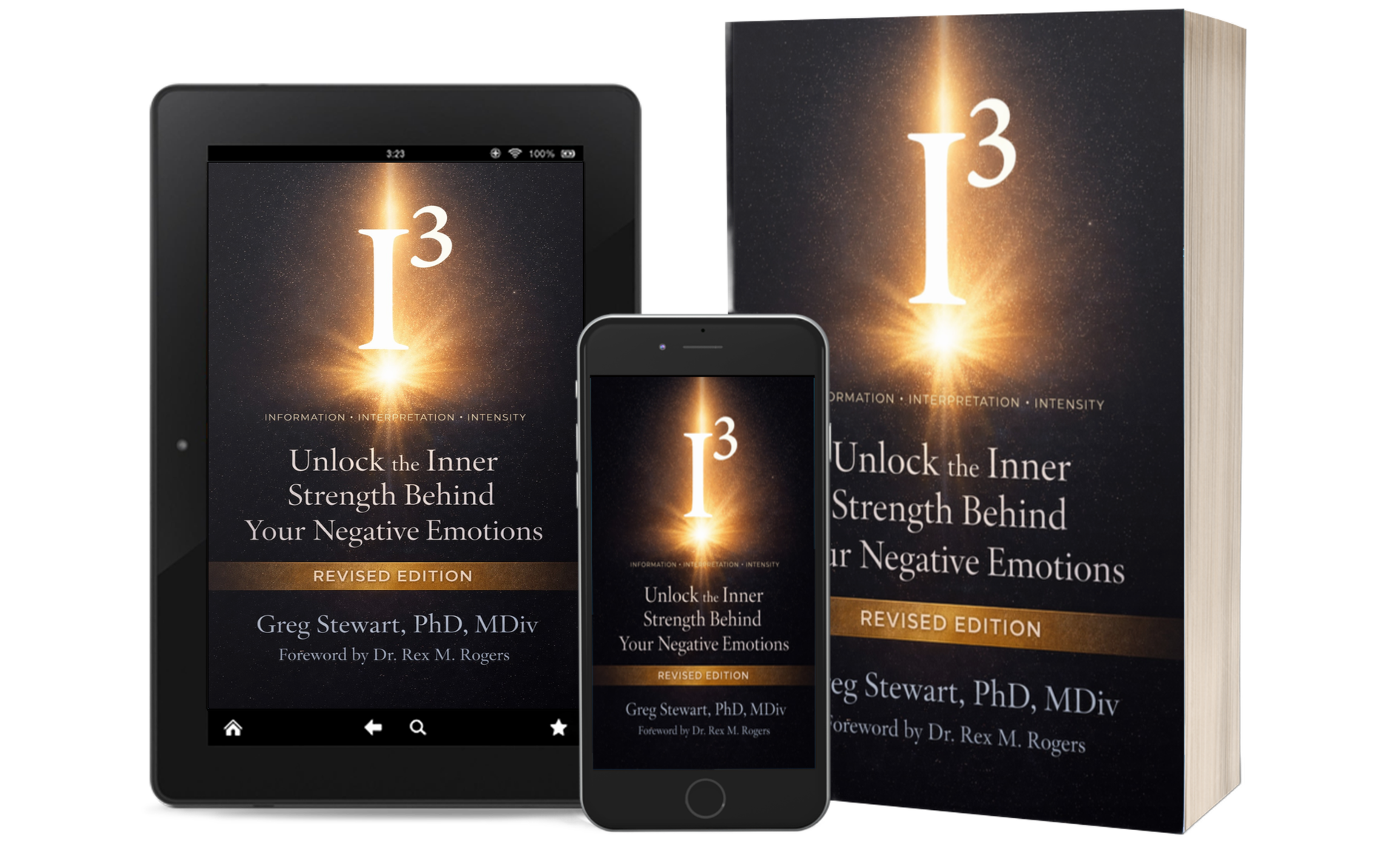
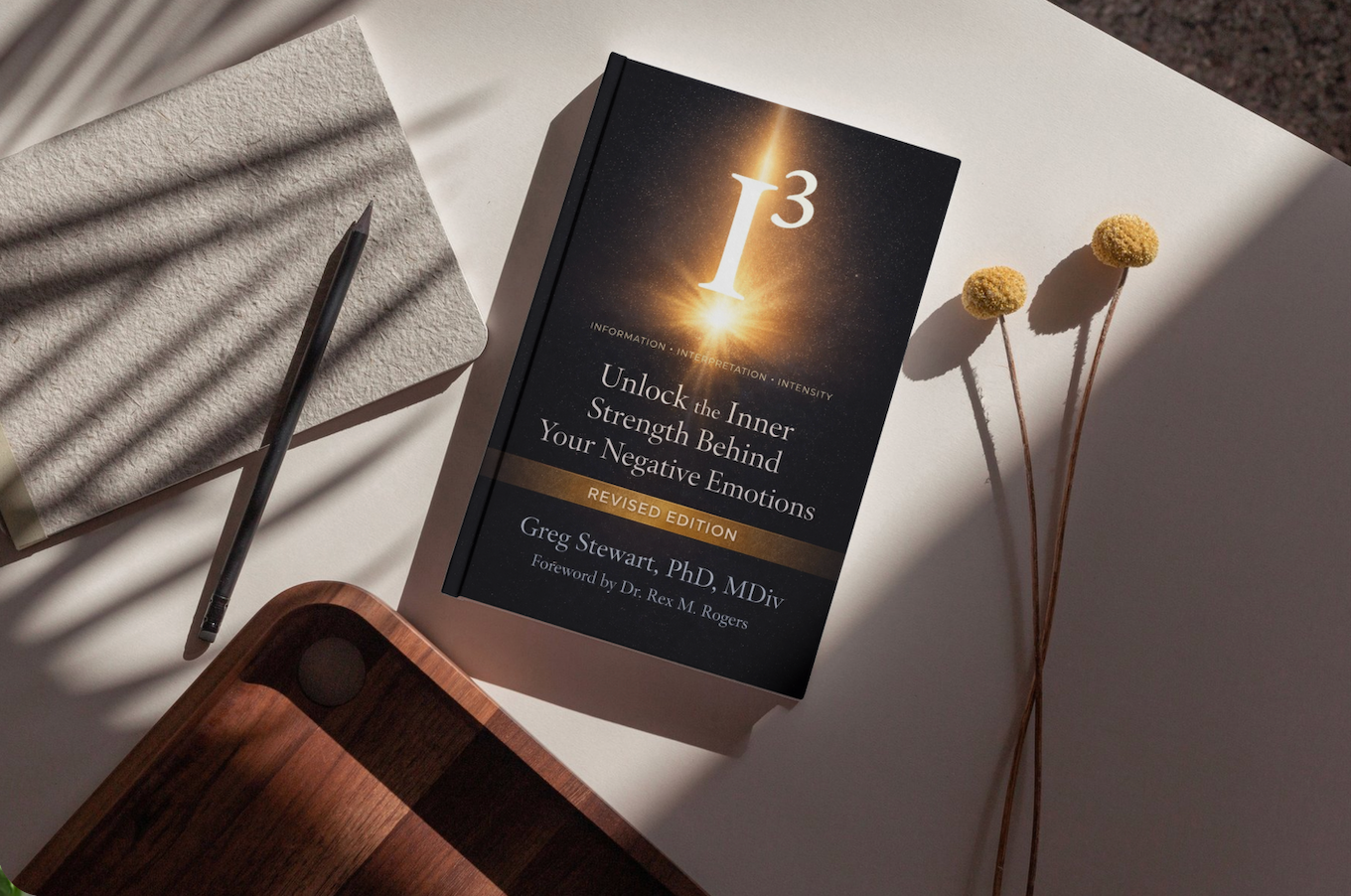
The central premise of Chapter 3 in Dr. Greg Stewart’s book, I³: Information, Interpretation, Intensity – Unlock the Inner Strength Behind Your Negative Emotions, is direct:
Emotions do not produce themselves. They come from sentences in our minds.
Those sentences may be thoughts, beliefs, assumptions, or opinions about yourself, the situation, or another person. They may be accurate. They may be distorted. They may be inherited from earlier experiences. They may be formed so quickly that they feel like facts.
They are still sentences.

Your Mind Is Always Calculating Meaning
Your mental model is an internal process that organizes experience. It fills in missing variables, evaluates possible outcomes, assigns importance to those outcomes, and produces emotional energy.
The process often occurs before deliberate reflection.
You hear a tone of voice. You assess it.
You notice a delay. You explain it.
You remember a previous failure. You predict the next one.
Daniel Kahneman’s distinction between rapid, automatic thinking and slower, deliberate thinking helps explain why these interpretations can feel immediate and authoritative. The mind recognizes patterns quickly. It does not always verify whether the pattern belongs to the present moment (Kahneman, 2011).
A mental model may therefore produce a sentence such as:
- “I will never find another opportunity.”
- “I am an idiot. I ruined the relationship.”
- “They did that because they do not respect me.”
- “If this opportunity fails, my life is over.”
- “I should have known better.”
The sentence creates meaning. Meaning creates emotional energy.
This does not make emotion imaginary. It makes emotion understandable.
Emotional energy is not inherently bad. It is the force your mind produces while attempting to solve a problem, protect something valuable, or restore a preferred condition. Positive energy may be expressed through joy, affection, or celebration. Negative energy may lead to protest, withdrawal, confrontation, preparation, or change.
The goal is not to eliminate emotion. The goal is to understand its source and calibrate its force.
The Panama Canal Rule Begins with Information
The I³ framework describes emotional processing through three locks:
- Information
- Interpretation
- Intensity
The Panama Canal Rule states that Lock 3 cannot be reached responsibly until the first two locks have been secured.
Begin with information.
What actually happened?
What did the person say?
What do you know without inference?
What remains unknown?
This discipline matters because people frequently treat an interpretation as information. A delayed response becomes rejection. A facial expression becomes contempt. A mistake becomes proof of incompetence. A medical question becomes a forecast of disaster.
The facts may be real. The conclusion may not be.
Psychology Today describes cognitive reappraisal as the deliberate practice of changing an emotional response by changing the thoughts attached to an experience. That process begins by distinguishing an automatic appraisal from a more accurate interpretation (Psychology Today, 2025).
Do not rush to Lock 3. First, secure the facts.
Interpretation Is Not the Same as Truth
Interpretation is necessary. Human beings cannot function without assigning meaning. The difficulty arises when interpretation escapes examination.
Suppose you make a mistake in a relationship or an important personal decision. Your mind may state, “I am a failure.” That sentence contains more than an observation. It contains a global judgment about identity.
A truthful interpretation may be more specific:
“I made a poor decision.”
“I did not prepare adequately.”
“I avoided a conversation I needed to have.”
“I need to repair the harm.”
Truth does not always feel pleasant. It does create a stable foundation for change.
Forced positivity says, “Everything is fine.”
Truth says, “This was painful, and I can identify what happened.”
Forced positivity says, “I never make mistakes.”
Truth says, “I made a mistake, and I can take responsibility without declaring myself worthless.”
This distinction matters in emotional regulation. Cognitive reappraisal is not the practice of painting every experience in bright colors. It is the practice of examining meaning and choosing an interpretation that is accurate, useful, and proportionate (Cutuli, 2014; Gross, 1998).
The truth sets a person free because truth ends the exhausting work of defending a false story.
The First Cause of Inflated Emotion: A Lie
Inflated emotion often begins with a lie about the situation.
The lie may be obvious:
“I will never get another opportunity.”
“I have destroyed everything.”
“No one will ever love me.”
The lie may also be subtle.
A person receives reassuring medical information and still asks, “But what if the doctor is wrong?” The question may sound cautious. In some situations, it functions as an unprovable conclusion disguised as uncertainty.
Another person thinks, “I do not think I had integrity in that situation.” That statement may be too vague to produce growth. What specifically happened? Was a promise broken? Was information withheld? Was responsibility avoided?
Vague self-condemnation creates shame. Specific truth creates direction.
Answer questions with evidence. Prove character evaluations. Identify the exact behavior that needs to change. Do not use a broad sentence to condemn an entire identity.
Research on ambiguous information shows that emotional interpretation becomes especially vulnerable when facts permit more than one possible meaning (Schoth & Liossi, 2017). The mind dislikes uncertainty. It often fills silence with fear.
The solution is not to pretend uncertainty does not exist. The solution is to name it accurately.
“I do not know yet.”
“That is one possibility, not a certainty.”
“I need more information before I decide what this means.”
These sentences protect the space between information and interpretation.
Emotional Energy Must Be Calibrated
Chapter 3 also presents emotion as energy that should be labeled and measured.
Name the brand of emotion.
Is it anxiety, anger, fear, sadness, shame, insecurity, resentment, or disappointment?
Then measure the intensity.
How much energy does the situation deserve on a scale from 1 to 10?
How much energy are you actually experiencing?
A missed appointment may deserve a 3. A serious threat to personal safety may require a 10. A difficult conversation may deserve a 6, but your history may cause your body to respond with a 9.
The difference deserves attention.
Research published in PLOS ONE found that cognitive reappraisal can require more effort when emotional intensity is high. The same study also found that people who use reappraisal more habitually tend to experience lower cognitive costs and greater reductions in subjective emotional intensity (Ortner et al., 2016).
Practice matters.
You do not become skilled at emotional calibration by waiting for a crisis. You build the skill in ordinary moments.
The work may begin with a simple log:
- What happened?
- What sentence appeared in my mind?
- What emotion did that sentence produce?
- What number describes the intensity?
- What number does the situation objectively deserve?
- Am I believing a lie?
- Am I taking this personally?
- Does this emotion resemble an earlier experience?
This record turns an invisible process into observable information.
Look Inside the House of Your Heart
The chapter’s image of the house of your heart offers another way to understand recurring emotional patterns.
Insecurity waits near the front door.
Anxiety occupies the kitchen.
Fear crouches in the hallway.
Worry watches from the window.
Anger paces through the bedroom.
Depression remains under the covers.
These emotions are not your identity. They are occupants. Some may have lived in the house for years. Some may have arrived through loss, rejection, trauma, or repeated criticism. Some may be responding to the present. Others may be carrying old emotional energy into a new room.
All negative emotion exposes something in you. It may reveal a belief, a fear, an unmet emotional goal, a wound, or a distorted conclusion.
This is not an invitation to shame yourself. It is an invitation to examine yourself.
Put down the microscope you use to inspect everyone else. Pick up the mirror. Ask what your emotional response is revealing about your own interpretation.
The Open Psychology Journal has examined emotional appraisal as part of the process through which people evaluate events in relation to their concerns and well-being (Fiorilli et al., 2017). Psi Chi research has likewise explored how perceptions of seriousness and self-compassion influence emotional experience (Pereira & Deemer, 2023).
Self-examination is not self-attack. It is the beginning of interior mastery.
The Pause Is Where Freedom Begins
Modern Psychological Studies research on response inhibition illustrates the importance of interrupting an automatic response when a more appropriate response is required (Duster et al., 2026).
Emotional maturity requires the same capacity.
You do not need to deny your first reaction. You need to recognize that the first reaction is an output of your current mental model.
Use the pause.
Say:
“I am having the thought that this means rejection.”
That sentence creates distance between you and the thought. It does not declare the thought true. It gives you room to examine it.
Then move through the three locks:
Information: What do I know?
Interpretation: What meaning have I assigned?
Intensity: How much emotional energy is present, and how much is appropriate?
Gross’s research distinguishes between regulating emotion early in the process and attempting to suppress expression after the emotion has already intensified. Reappraisal changes the meaning of the event. Suppression merely attempts to conceal the outward response (Gross, 1998; Gross & John, 2003).
Change the sentence before the sentence becomes a storm.
Practice Truthful Self-Talk
Constructive self-talk does not require empty declarations. It requires sentences that are both encouraging and true.
Instead of:
“I cannot handle this.”
Say:
“This is difficult, and I can identify the next necessary step.”
Instead of:
“I always ruin relationships.”
Say:
“I handled that conversation poorly. I can acknowledge the harm and repair what I can.”
Instead of:
“They must be angry with me.”
Say:
“I do not yet know why they have not responded.”
Instead of:
“I am weak because I feel afraid.”
Say:
“Fear is present. I can decide what action is wise.”
The American Psychological Association emphasizes the relationship among thoughts, emotions, and behavior in psychological treatment and emotional well-being (American Psychological Association, 2024). Your inner sentences matter because they influence the emotional energy available for your next action.
The right sentence does not erase grief, anger, or fear. It gives those emotions a more accurate place to stand.
Become More Through Accurate Interpretation
Your emotions are real. Your first interpretation may still be wrong.
That distinction provides hope.
You are not required to obey every sentence your mind produces. You are responsible for examining those sentences, testing them against truth, and choosing a response that matches reality.
Start with information.
Examine interpretation.
Calibrate intensity.
Emotions do not produce themselves. They come from sentences in your mind. Change the sentence, and you may change the energy. Change the energy, and you may change the action. Change the action, and you begin to change the status quo.
Learn more through Dr. Greg Stewart’s TEDx talk.
Study the complete framework in I³: Information, Interpretation, Intensity – Unlock the Inner Strength Behind Your Negative Emotions.
References
American Psychological Association. (2024). Understanding emotions and emotional regulation. https://www.apa.org/topics/emotions
Cutuli, D. (2014). Cognitive reappraisal and expressive suppression strategies role in the emotion regulation: An overview on their modulatory effects and neural correlates. Frontiers in Systems Neuroscience, 8, Article 175. https://doi.org/10.3389/fnsys.2014.00175
Duster, K., Mozqueda-Fuhrmeister, D., Anderson, K., Conway, M., Piaszynski, J., Winder, A., Courtney, C., & Ramchandran, K. (2026). Digitization of the Switching Stroop Task. Modern Psychological Studies, 32(1). https://scholar.utc.edu/mps/vol32/iss1/1
Fiorilli, C., Pepe, A., Buonomo, I., & Albanese, O. (2017). At-risk teachers: The association between burnout levels and emotional appraisal processes. The Open Psychology Journal, 10, 127–139. https://openpsychologyjournal.com/VOLUME/10/PAGE/127/FULLTEXT/
Gross, J. J. (1998). Antecedent- and response-focused emotion regulation: Divergent consequences for experience, expression, and physiology. Journal of Personality and Social Psychology, 74(1), 224–237. https://doi.org/10.1037/0022-3514.74.1.224
Gross, J. J., & John, O. P. (2003). Individual differences in two emotion regulation processes: Implications for affect, relationships, and well-being. Journal of Personality and Social Psychology, 85(2), 348–362. https://doi.org/10.1037/0022-3514.85.2.348
Kahneman, D. (2011). Thinking, fast and slow. Farrar, Straus and Giroux.
Ortner, C. N. M., Ste Marie, M., & Corno, D. (2016). Cognitive costs of reappraisal depend on both emotional stimulus intensity and individual differences in habitual reappraisal. PLOS ONE, 11(12), Article e0167253. https://doi.org/10.1371/journal.pone.0167253
Pereira, J. R. B., & Deemer, E. D. (2023). A test of a cognitive appraisal model of the influence of perceptions of seriousness and self-compassion as influencing impostor experiences. Psi Chi Journal of Psychological Research, 28(3), 191–200. https://doi.org/10.24839/2325-7342.JN28.3.191
Psychology Today. (2025, November 14). Cognitive reappraisal. https://www.psychologytoday.com/us/basics/cognitive-reappraisal
Schoth, D. E., & Liossi, C. (2017). A systematic review of experimental paradigms for exploring biased interpretation of ambiguous information with emotional and neutral associations. Frontiers in Psychology, 8, Article 171. https://doi.org/10.3389/fpsyg.2017.00171
Try Marblism! They are an incredible staff! Click here: https://marblism.com?via=dr-greg-stewart