The 'Positive Vibes' Myth: What Science Says About Your Right to Feel Heavy

You have likely heard the instruction: “Stay positive.”
Sometimes it offers encouragement. Sometimes it becomes a command. It tells you to smile when you are grieving, express gratitude when you are frightened, or search for a silver lining before you have had time to understand what happened.
That is not resilience. It is emotional haste.
You have the right to feel heavy. Sadness, disappointment, anger, fear, and discouragement are not evidence of personal failure. They are experiences that require attention. When you dismiss them too quickly, you lose access to the information they carry.
Psychology Today describes toxic positivity as the avoidance, suppression, or rejection of difficult emotions through an insistence on positive thinking. Positivity becomes harmful when it denies the reality of pain rather than helping a person face it (Psychology Today, 2025).
The distinction matters. Healthy optimism says, “This is difficult, and I can respond.” Forced positivity says, “This must not be difficult.”
Becoming More Requires More Than Wanting to Feel Better
Chapter 1 of I³: Information, Interpretation, Intensity begins with a fundamental distinction: the difference between automatic want and deliberate think.
Your automatic want is shaped by your mental models. You want comfort. You want approval. You want certainty. You want painful emotions to disappear immediately. These impulses are understandable, but they are not always wise.
The deliberate think pause creates another possibility. It allows you to ask:
- What am I feeling?
- What information does this emotion contain?
- What am I assuming?
- What else could be true?
- What response would help me become more capable, honest, and whole?
This pause is not passive. It is an act of interior strength.
The culture of forced positivity often eliminates this pause. It urges you to replace sadness with gratitude before you have understood the loss. It encourages you to call fear excitement before you have assessed the danger. It tells you to “move on” before you have processed what happened.
That is how emotional growth is short-circuited. The emotion is not examined. The mental model is not questioned. The person simply attempts to feel different.
Becoming more requires something better. Stop treating emotional discomfort as an emergency. Begin treating it as information.

Heavy Emotions Are Not the Enemy
The I³ framework begins with three connected elements:
- Information: What is happening within you and around you.
- Interpretation: The meaning you assign to that information.
- Intensity: The emotional force produced by the interpretation.
The framework does not suggest that every interpretation is accurate. It suggests that every emotion deserves examination.
Anger may indicate violated boundaries. Sadness may reveal loss. Fear may signal uncertainty or perceived danger. Shame may point toward a conflict between your behavior and your values. The emotion is not automatically correct, but it is rarely meaningless.
This is the beginning of the Panama Canal Rule. A ship does not move directly from one level of water to another. It passes through a sequence of locks. In the same way, emotional intensity should not be treated as an isolated event. Information and interpretation influence the intensity that follows.
Forced positivity attempts to drain the final lock without inspecting the first two.
It says, “Do not feel intense.”
The I³ approach asks, “What information entered the system, what interpretation followed, and what created this level of intensity?”
That question gives you room to think.
What Recent Research Says About Suppression
The research does not support a simplistic claim that every instance of emotional suppression is harmful. Context matters.
A 2025 study in Frontiers in Psychology examined expressive suppression among 956 college students. The researchers found that expressive suppression was associated with subthreshold depression through negative attentional bias. In other words, suppression appeared connected to a pattern in which attention became more focused on negative information. Regulatory emotional self-efficacy weakened this relationship, suggesting that confidence in one’s ability to manage emotions may offer protection (Chen et al., 2025).
The study was cross-sectional, so it cannot establish that suppression directly causes depression. It does, however, offer a useful warning: hiding an emotion does not necessarily resolve the mental process beneath it.
A 2025 study in BMC Psychology offers an important qualification. Among 350 adults, cognitive reappraisal, religious coping, and seeking support were associated with lower depression. Expressive suppression and acceptance did not show significant relationships with depression or anxiety in that particular sample (Zaid et al., 2025).
That finding should not be ignored. Healthy psychological practice requires precision. Acceptance is not a magic instruction, and suppression is not uniformly damaging in every context. Effective regulation depends on the person, the culture, the emotion, the purpose, and the timing.
A PLOS ONE study demonstrates this complexity. In a small sample of Chinese undergraduates completing a frustrating task, expressive suppression reduced depressive experience and physiological arousal more effectively than acceptance in the immediate situation (Yuan et al., 2014). The study’s authors emphasized cultural context.
The wiser conclusion is not “always express everything” or “always suppress nothing.” The wiser conclusion is this:
Do not make suppression your identity. Do not make positivity your disguise. Develop flexibility.
Acceptance Is Not Resignation
Acceptance does not mean approving of pain. It does not mean remaining in harmful circumstances. It does not mean abandoning hope.
Acceptance means acknowledging reality without adding unnecessary judgment.
Say:
“I am sad.”
Do not immediately add:
“I should not be sad.”
Say:
“I am afraid.”
Do not immediately add:
“This proves I am weak.”
The first statement identifies information. The second interpretation may intensify the experience through shame.
Acceptance creates a deliberate think pause. It allows you to observe the emotion before deciding what to do with it. From there, you can seek support, establish a boundary, solve a problem, grieve a loss, or choose a more accurate interpretation.
The American Psychological Association defines resilience as the process and outcome of adapting successfully to difficult experiences through mental, emotional, and behavioral flexibility. It identifies perspective, social resources, and coping strategies as important contributors to resilient adaptation (American Psychological Association, 2022).
Notice what this definition does not require. It does not require constant happiness. It does not require emotional performance. It requires flexibility.

Replace Forced Positivity With Honest Hope
Healthy positivity does not deny pain. It places pain within a larger field of possibility.
It says:
- “This loss matters, and I can receive support.”
- “I feel discouraged, and I can take one constructive step.”
- “I do not understand this yet, but I can resist inventing the worst explanation.”
- “This emotion is intense, but intensity is not the same as destiny.”
The Open Psychology Journal has examined how positive and negative emotions relate to positive psychological functioning. Its findings support a broader view of emotional life: well-being is not built by pretending that difficult emotions do not exist. It is built through awareness, meaning, emotional skill, and constructive engagement (Grover et al., 2020).
The same principle appears in the discipline of psychological research. Modern Psychological Studies publishes experimental studies, theoretical papers, literature reviews, and book reviews by undergraduate researchers. The Psi Chi Journal of Psychological Research likewise provides a scholarly setting for psychological inquiry. Both outlets reflect a basic standard that applies to personal growth as well: examine the evidence before declaring certainty (Modern Psychological Studies, n.d.; Psi Chi Journal of Psychological Research, n.d.).
Your emotions deserve the same intellectual honesty.
Do not rush to label them good or bad. Begin with what is true.
A Simple I³ Practice for Heavy Days
When a heavy emotion arrives, use this sequence:
1. Identify the information
Name the emotion and the immediate situation.
“I feel anxious because I have not received an answer.”
2. Examine the interpretation
Ask what meaning you have assigned to the silence.
“I am interpreting the silence as rejection.”
3. Widen the gap
Ask what else could be true.
“The person may be busy. The situation may require clarification. I do not have enough information yet.”
4. Choose the next response
Take one action consistent with your values.
You may wait, ask a direct question, seek support, or attend to your body before deciding.
This is interior mastery. It does not erase the emotion. It gives the emotion a proper place.
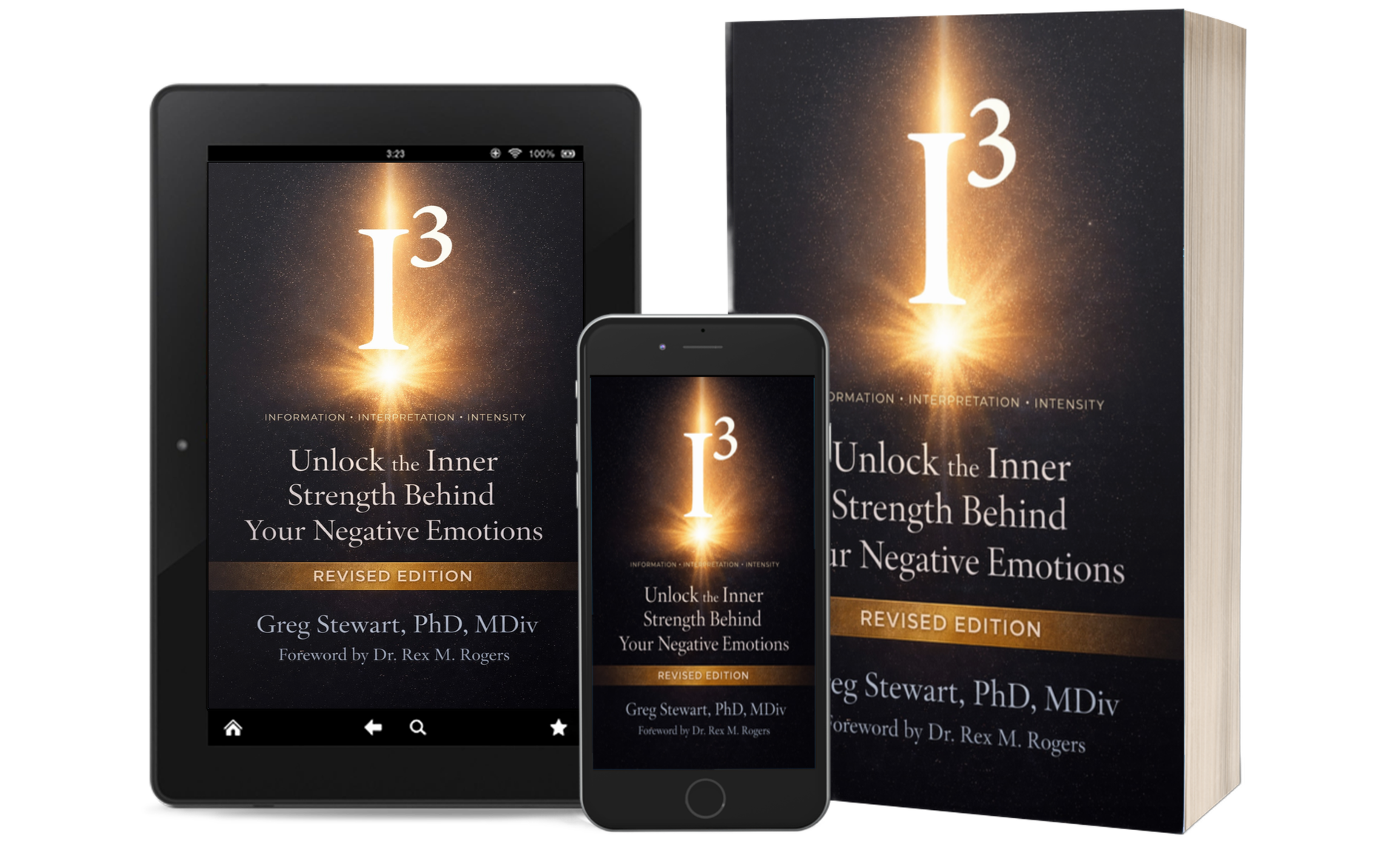
To explore the full framework, watch Dr. Greg Stewart’s TEDx talk. You can also read his book, I³: Information, Interpretation, Intensity – Unlock the Inner Strength Behind Your Negative Emotions.
You do not need to become cheerful before you become wise.
You do not need to deny heaviness before you can carry it.
Pause. Receive the information. Examine the interpretation. Allow intensity to teach you what requires attention.
That is how you become more.
References
American Psychological Association. (2022). Resilience.
Chen, M., Huang, L., Qin, Q., Li, J., Zhang, J., Ma, J., & Song, H. (2025). Impact of expressive suppression on subthreshold depression among college students: A moderated mediation model. Frontiers in Psychology, 16, 1678275. https://doi.org/10.3389/fpsyg.2025.1678275
Grover, R., Aggarwal, A., & Mittal, A. (2020). Effect of students’ emotions on their positive psychology: A study of higher education institutions. The Open Psychology Journal, 13. https://doi.org/10.2174/1874350102013010272
Modern Psychological Studies. (n.d.). Modern Psychological Studies. University of Tennessee at Chattanooga.
Psychology Today. (2025). Toxic positivity.
Psi Chi Journal of Psychological Research. (n.d.). Journal past volumes.
Yuan, J., Liu, Y., Ding, N., & Yang, J. (2014). The regulation of induced depression during a frustrating situation: Benefits of expressive suppression in Chinese individuals. PLOS ONE, 9(5), e97420. https://doi.org/10.1371/journal.pone.0097420
Zaid, S. M., Hutagalung, F. D., Abd Hamid, H. S. B., & Taresh, S. M. (2025). The power of emotion regulation: How managing sadness influences depression and anxiety. BMC Psychology, 13, 38. https://doi.org/10.1186/s40359-025-02354-3
Try Marblism! They are an incredible staff! Click here: https://marblism.com?via=dr-greg-stewart