The ROI of Executive Presence: How the I³ Framework Transforms Leadership
![[HERO] The ROI of Executive Presence: How the I³ Framework Transforms Leadership](https://cdn.marblism.com/W2WenkK33Os.webp)
Free Webinar! May 21st, 12:00-1:00 CT with a chance to win a $1,000 coaching package!

Executive presence is frequently discussed in C-suites and boardrooms as an elusive, intangible quality. It is often described as the "X-factor" or a natural charisma that some possess and others do not. This perspective is not only inaccurate but also expensive. In the modern corporate landscape, executive presence is a measurable asset with a quantifiable return on investment. Organizations that fail to cultivate this in their leadership ranks suffer from higher turnover, stagnant decision-making, and a lack of cultural alignment.
Research into executive coaching reveals that the financial impact of developing leadership presence is substantial. A meta-analysis published in Frontiers in Psychology found that executive coaching has its strongest impact on behavioral outcomes, self-efficacy, and resilience (Nicolau et al., 2023). That matters because those outcomes sit directly beneath sustainable executive presence. ROI studies strengthen the case further: average returns of 5-7 times the original investment have been reported in a 2024 PwC/Association Resource Center study, while returns can climb as high as 788% when employee retention is included in the calculation (Phillips, 2005). For a Fortune 1000 company, the ROI of structured leadership development can reach nearly six times the initial investment.
At Becoming More Counseling, Coaching, & Consulting, we recognize that true executive presence is not a performance. It is the external manifestation of an internal state. To achieve this, leaders must master their internal obstacles through a disciplined methodology. Dr. Greg Stewart, a John Maxwell Leadership certified coach and speaker, utilizes the I³ Framework: Information, Interpretation, and Intensity: to transform leadership from the inside out.
The Invisible Balance Sheet: Why Presence Matters
The ROI of executive presence manifests in three primary areas: decision speed, talent retention, and strategic influence. A leader who commands a room does not do so by volume or ego. They do so through the clarity of their thought and the calibration of their emotional state. When a leader lacks presence, the organization pays a "distrust tax." Decisions are questioned, teams become fragmented, and the strategic vision is diluted by a sea of internal noise. Gallup’s research adds weight to the cost of that failure: leaders account for 70% of the variance in employee engagement. In plain terms, leadership presence is not cosmetic. It shapes morale, discretionary effort, and retention at scale.
John Maxwell’s Law of the Lid sharpens this business case: “Leadership ability is the lid that determines a person’s level of effectiveness” (Maxwell, J. C., 2007, p. 1). Executive presence affects that lid. Harvard Business Review has likewise highlighted executive presence and relationship skills as critical factors for C-suite advancement. When Information is distorted, Interpretation is reactive, and Intensity is poorly calibrated, a leader’s effectiveness compresses. When the I³ Framework is disciplined, that lid rises, and so does organizational performance.
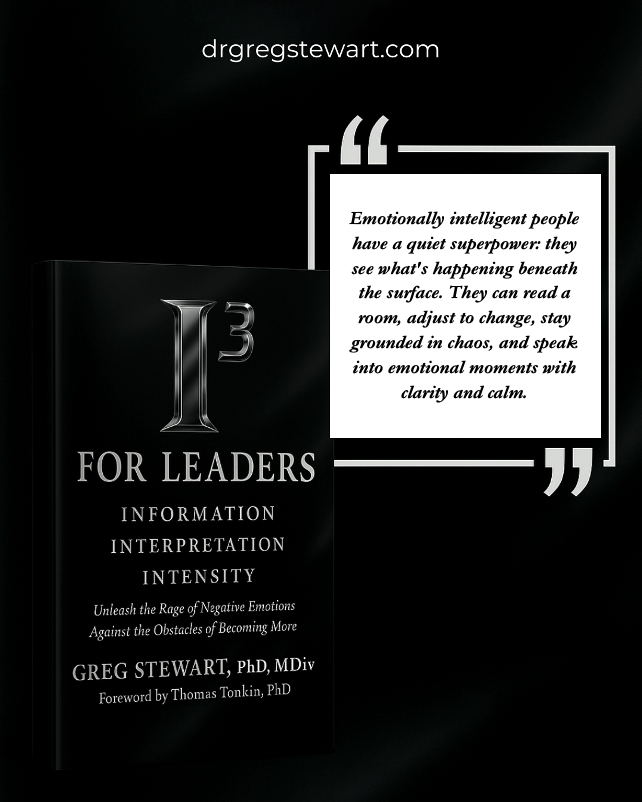
"Leadership is defined not by the best of times, but the worst of times," as noted in Dr. Greg Stewart’s book, I3 for Leaders. In a crisis, the ROI of presence is found in the ability to maintain organizational velocity while others are paralyzed by fear.
The I³ Framework: The Core of Internal Mastery
Traditional leadership training focuses on external behaviors: how to stand, how to speak, and how to present with professional excellence. While these elements have their place in a culture of "Classic Excellence," they are hollow without a substantive foundation. The I³ Framework focuses on the internal mechanics that drive these external behaviors.
Information: The Foundation of Clarity
The first pillar of the framework is Information. In the C-suite, the challenge is rarely a lack of data; it is an abundance of noise. A leader with a high ROI of presence knows how to separate the signal from the distraction. This requires a disciplined approach to what information is allowed to influence the internal state.
Information overload leads to strategic paralysis. To increase leadership influence, one must master the art of identifying the strategic data points that actually move the needle. This is the first step in building what we call the "Iron Man Core": a spiritual and psychological resilience that allows a leader to stand firm amidst chaos. It also aligns with the coaching outcomes identified by Nicolau et al. (2023), where behavioral improvement, self-efficacy, and resilience emerged as the strongest benefits of executive coaching. When a leader possesses the right information, their presence is grounded in reality, not speculation.
Interpretation: The Gap Between Data and Action
The second pillar is Interpretation. This is where most leaders falter. Data is neutral; the meaning we assign to it is not. The "Interpretation Gap" is the space between receiving information and deciding what it means for the organization.
Leaders who fail to master their interpretation often fall victim to cognitive biases, overconfidence, or unmanaged fear. This results in a distorted view of the landscape, which is quickly sensed by boards and subordinates. Maxwell makes the trust equation plain: “Character makes trust possible, and trust makes leadership sustainable” (Maxwell, J. C., 2018, p. 41). That is not abstract encouragement. It is operational reality. Interpretation reveals character under pressure. When leaders repeatedly assign grounded meaning to events rather than indulging panic, ego, or assumption, trust deepens and the ROI of executive presence compounds. As Dr. Greg Stewart frequently emphasizes, "Everyone becomes what they want to, only some people think about becoming more." To become more, a leader must audit their internal narratives.
Is a market downturn an existential threat, or is it a strategic opportunity to consolidate? The interpretation determines the leadership response. By mastering the Interpretation Gap, an executive projects a sense of calm authority that is infectious. This is the essence of Mastering the Interpretation Gap, an essential skill for any senior leader.
Intensity: The Emotional Thermostat
The final pillar is Intensity. This is the calibration of the emotional response to a given situation. High-stakes environments, such as a multi-million dollar merger or a hostile board meeting, require a specific level of intensity. If the intensity is too low, the leader appears disconnected or weak. If it is too high, they appear volatile and untrustworthy.
Intensity is not about suppressing emotions; it is about utilizing them. Dr. Stewart’s philosophy encourages leaders to "unleash the rage of your negative emotions against the obstacle of becoming more." Instead of allowing frustration or anxiety to leak out as toxic behavior, the disciplined leader directs that energy toward overcoming the internal barriers to their goals. This is The Intensity Thermostat in action.

Duty and Discipline Before Dopamine
The ROI of executive presence is built on the mantra: "Duty and Discipline before Dopamine." We live in a corporate culture addicted to the quick hit of dopamine: the temporary high of a successful meeting, a positive social media post, or a short-term win. True leadership presence requires the discipline to choose the harder path of long-term strategic alignment and internal growth.
Classic excellence is not achieved through shortcuts. It is found in the daily habit of self-regulation and the commitment to a standard that transcends the current mood of the market. This standard is reflected in everything from the precision of a strategic plan to the professional environment of the office.
A Dallas Boardroom Case Study: The I³ Framework in Action
Consider a recent scenario involving a senior leadership team at a prominent firm in the Dallas Arts District. The team was facing a potential crisis involving a strategic pivot that threatened to alienate several key stakeholders. The tension in the room was palpable. The CEO, an internal processor, felt the mounting pressure of the "distrust tax" as his team began to splinter into factions.
By applying the I³ Framework, we helped the CEO recalibrate.
- Information: He stripped away the gossip and focused on the core financial and operational data points.
- Interpretation: He identified that his team’s resistance was not born of malice but of unaddressed fear regarding their own roles in the new structure. He shifted his interpretation from "mutiny" to "misalignment."
- Intensity: He used his internal frustration not as a weapon against his team, but as fuel to prepare a more transparent and courageous communication plan.
The result was a successful pivot that not only saved the deal but also increased the team's trust in his leadership. The ROI was clear: millions of dollars in saved revenue and the preservation of a high-performance culture.
Internal Change Precedes External Change
The fundamental truth of executive presence is that internal change must precede external change. You cannot command a room if you cannot command yourself. Leaders who attempt to bypass the internal work of the I³ Framework are merely "machines managing other machines," as Dr. Stewart writes in I3 for Leaders. Maxwell’s leadership principles reinforce the same conclusion: effectiveness rises or falls with the leader’s internal capacity, and sustainable trust is built through character. The I³ Framework gives leaders a disciplined way to strengthen both. Dr. Greg Stewart’s John Maxwell Leadership certification supports this integration of leadership principle and behavioral transformation.
To achieve the 700% ROI that executive presence can offer, you must be willing to confront the internal obstacles others wish they could. You must be willing to move beyond the search for dopamine and embrace the duty of becoming more.
Take the Next Step: Join the Leadership Engine
If you are ready to stop managing and start leading with a presence that delivers measurable results, we invite you to join our upcoming webinar. This is an opportunity to deep-dive into the I³ Framework and the Panama Canal Method for mastering emotional calibration.
Free Webinar: The Leadership Engine Thursday, May 21st, 12:00-1:00 CT Attend for a chance to win a $1,000 coaching package.
Learn how to calibrate your leadership thermostat and drive the ROI of your executive presence to new heights.
Register Now for the Leadership Engine Webinar
For those ready to move faster, we offer personalized executive coaching and consulting services designed for the C-suite and senior leadership.
Call 469-485-0387 to schedule a consultation.
Becoming More White Papers
To further your development, download our secondary resource:
- The Panama Canal Method: Your 3-Step Guide to Mastering Executive Presence and Emotional Calibration
Every leader becomes what they want to. Only some choose to become more. The standard is set. The discipline is yours to embrace. We look forward to seeing you on May 21st.
References
Frontiers in Psychology: Nicolau, A., Candel, O. S., Constantin, T., & Kleingeld, A. (2023). The effectiveness of executive coaching: A systematic review and meta-analysis. Frontiers in Psychology, 14, 1089797.
Gallup: Gallup, Inc. (2015). State of the American Manager: Analytics and Advice for Leaders.
Harvard Business Review: HBR. (2026). When Executive Presence Backfires. Harvard Business Review.
Maxwell, J. C.: Maxwell, J. C. (2007). The 21 Irrefutable Laws of Leadership: Follow Them and People Will Follow You. Thomas Nelson.
Maxwell, J. C.: Maxwell, J. C. (2018). Developing the Leader Within You 2.0. HarperCollins.
Phillips, J. J.: Phillips, J. J. (2005). The bottom line of executive coaching: Evidence of 700 percent return on investment. Development and Learning in Organizations, 20(6), 26-28.
PwC/ICF: PwC & International Coaching Federation. (2024). Coaching Statistics: The ROI of Coaching in 2024.