
7 Mistakes C-Suite Leaders Make With Change Management
![[HERO] 7 Mistakes C-Suite Leaders Make With Change Management (and What to Do Instead)](https://cdn.marblism.com/WIP6lWaWY6i.webp)
Change is hard. Leading it is harder.
You've seen the stats: 70% of change initiatives fail. Not because the strategy was wrong, but because how we lead through it falls apart. I've coached dozens of C-Suite leaders who launched brilliant transformations only to watch them stall six months in. The culprit? Predictable, avoidable mistakes that erode trust faster than any market disruption.
If you're rolling out a new system, restructuring teams, or shifting company culture, this post is your field guide. Let's talk about the seven most common traps executives fall into, and what to do instead.
Mistake #1: Starting Without a Real Strategy (Just a Vision)
You know what needs to change. You've communicated why it matters. But when someone asks, "Okay, how do we actually do this?", crickets.
The Problem: Most change initiatives die in the messy middle because leaders confuse a vision with a strategy. Vision is the destination. Strategy is the roadmap, complete with mile markers, rest stops, and contingency routes.
What to Do Instead:
Before you launch, map out the how using a proven framework. Kotter's 8-Step Process, Lewin's Model, or Prosci's ADKAR are solid starting points. But here's the key: customize it. What works for a tech startup won't work for a 50-year-old manufacturing firm.
Ask yourself: If I left the company tomorrow, could my leadership team execute this change without me? If the answer is no, your strategy isn't ready.

Mistake #2: Going Silent After the Big Launch
You sent the all-hands email. You did the Town Hall. You're feeling good about the kickoff energy. Then... you move on to the next fire.
The Problem: Change communication isn't an event: it's a drumbeat. When leaders front-load the message then disappear, teams interpret the silence as "this wasn't that important after all." Old habits creep back in.
What to Do Instead:
Repeat your message. Weekly. In every meeting. On Slack. In performance reviews. Make it so consistent that your team can recite it back to you.
One CEO I worked with created a simple mantra: "Customer-first decisions, every time." He said it in every leadership meeting for 18 months. It became muscle memory. That's how change sticks.
Mistake #3: Pushing Too Hard, Too Fast, Too Much
You're ambitious. You want results yesterday. So you stack three major changes on top of each other and set aggressive deadlines.
The Problem: Change fatigue is real. When you push too hard, mistakes multiply, quality drops, and your best people burn out. Worse: they stop trusting your judgment on what's actually urgent.
What to Do Instead:
Pace yourself. Break big transformations into digestible 90-day sprints. Celebrate small wins. Let your organization absorb one change before layering on the next.
I call this the "digestion principle." You can't eat three meals at once and expect to feel good. Same with organizational change.
Mistake #4: Asking Your Team to Change While You Stay the Same
This one's brutal, but it's the truth: If you're not visibly adopting the change yourself, why would anyone else?
The Problem: Leaders often see themselves as architects of change, not participants in it. But your team is watching everything you do. If you're asking them to use the new CRM but you still email your assistant for reports, the message is clear: this doesn't apply to me.
What to Do Instead:
Be the first adopter. Go through the training. Use the new tools. Talk openly about what's hard for you. Vulnerability builds trust, and trust accelerates change.
One executive I coached started every staff meeting by sharing his struggle adapting to a new project management system. It gave his team permission to struggle too: and they helped each other through it.

Mistake #5: Treating Change Management Like a "Nice to Have"
You've budgeted for the new software. You've hired consultants for implementation. But when it comes to change management resources: training, coaching, internal comms: you cut corners.
The Problem: Change management isn't a soft skill add-on. It's the difference between adoption and abandonment. When you underfund it, you're essentially buying a Ferrari and refusing to pay for gas.
What to Do Instead:
Staff it properly. Hire people with actual change management expertise: not just project managers wearing a different hat. Give them authority, budget, and a seat at the table.
A manufacturing client of mine allocated 20% of their ERP implementation budget to change management. Result? They hit 89% adoption in six months instead of the industry average of 40%. That ROI speaks for itself.
Mistake #6: Assuming Everyone in the C-Suite Is Actually On Board
Public support is easy. Resource commitment is hard.
The Problem: You think you have executive alignment because everyone nodded in the boardroom. But when it's time to free up their teams for training or shift budget priorities, suddenly there's resistance. Without unified C-Suite commitment, your initiative lacks the muscle to push through obstacles.
What to Do Instead:
Get explicit commitments before you launch. What resources will each executive provide? What will they personally do differently? Put it in writing.
If someone won't commit, pause. A half-supported change initiative is worse than no initiative at all. It wastes time, money, and erodes trust across the organization.
Mistake #7: Ignoring the Culture Elephant in the Room
You're asking people to collaborate more, but your culture rewards individual achievement. You want innovation, but your systems punish failure.
The Problem: When change conflicts with culture, culture wins. Every time. Employees will smile, nod, and then default back to "how we've always done things" because that's what actually gets rewarded.
What to Do Instead:
Name the cultural tension out loud. If your change requires a cultural shift, say so. Then align your systems: compensation, promotion criteria, performance reviews: to reinforce the new behaviors.
This is where the I³ Framework becomes powerful. You need Power (the authority to change systems), Influence (the ability to shift mindsets), and Intimacy (the trust to have hard conversations about culture). Miss any one of those, and your change dies on the vine.

Your 30-Day Change Management Reset
If you're in the middle of a struggling initiative, here's how to course-correct in the next month:
Week 1: Audit your strategy. Can someone outside your inner circle explain the how? If not, clarify it.
Week 2: Restart communication. Send a transparent update: what's working, what's not, what you're adjusting.
Week 3: Model the change yourself. Pick one visible behavior you'll adopt and share it publicly.
Week 4: Secure real commitments. Meet one-on-one with each executive stakeholder and lock in specific resources.
That's it. Four weeks. Four moves. You'll be shocked how much momentum you can recover.
Free Resource: The Change Leader's 90-Day Playbook
Want a step-by-step guide to leading change that actually sticks? I've created a free PDF download based on the strategies from my I³ for Leaders book: complete with templates, scripts, and a 90-day implementation roadmap.
Download your free playbook here and start leading change with confidence. Call 469-485-0387.
The Bottom Line
Change management isn't a project: it's leadership. And leadership isn't about having all the answers. It's about staying present, staying consistent, and staying committed when things get messy.
You don't need to be perfect. You just need to be intentional.
If you're ready to lead your organization through transformation without losing your people, let's talk. Executive coaching can give you the clarity and accountability to turn these principles into practice.
Because the goal isn't just to survive change: it's to become more through it.
Dr. Greg Stewart
Becoming More Counseling, Coaching, & Consulting
www.becomingmore.com
Call 469-485-0387
Becoming More Leadership Blog
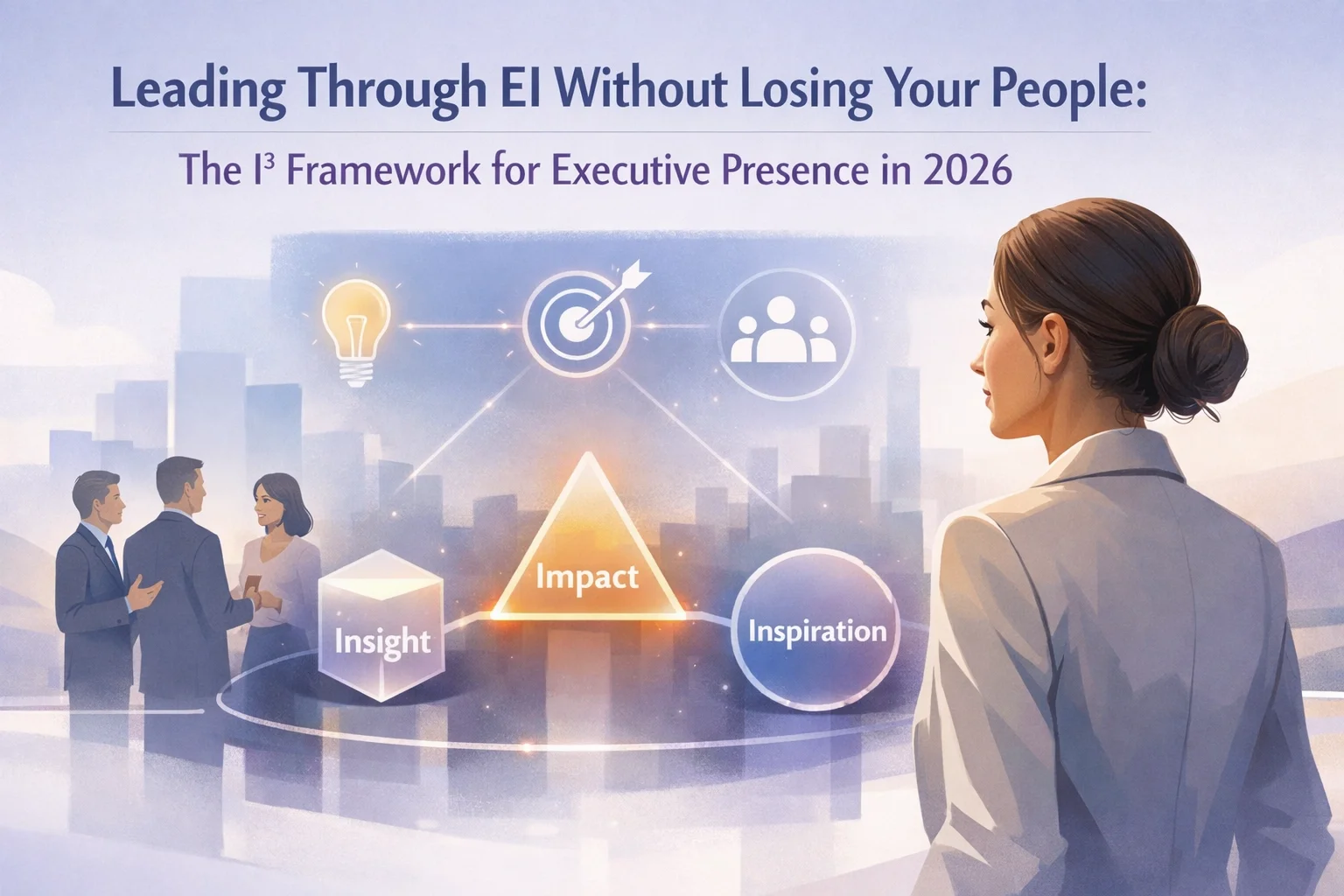
Leading Through EI Without Losing Your People: The I³ Framework for Executive Presence in 2026
We are living in the era of the emotional leader.
The World Economic Forum's 2025 Future of Jobs Report officially named emotional intelligence as a "Power Skill": not a soft skill, not a nice-to-have, but a power skill critical for organizational survival. Flowprofiler's research echoes this, showing that leaders who master EI don't just improve culture: they drive measurable performance outcomes.
Yet here's the paradox: most C-Suite leaders were trained to suppress emotion, not weaponize it. We climbed the ladder by being rational, composed, and bulletproof. But that old playbook is costing us our people, our influence, and frankly, our humanity.
The solution isn't learning to "feel more" or taking a weekend retreat to discover your feelings. It's about learning to identify, interpret, and channel emotional intensity in a way that fuels decision-making, builds trust, and creates executive presence that people actually want to follow.
This is the I³ Framework. And it's how leaders stop managing emotions and start leveraging them.

The Real Problem: Emotional Suppression Destroys Executive Presence
Harvard Business Review's 2025 research on executive presence revealed something counterintuitive: leaders who demonstrate self-awareness of their emotional states are rated significantly higher in gravitas, authenticity, and influence than those who project "unshakeable composure."
Translation? Your team knows when you're faking it. They can feel the disconnect between what you're projecting and what's actually happening inside you. And that disconnect erodes trust faster than any missed deadline.
Most leadership development focuses on emotional regulation: teaching leaders to keep their emotions in check. But regulation is just suppression with better branding. What we actually need is emotional weaponization: the ability to take negative emotions like frustration, anxiety, or anger and redirect that raw energy toward solving the problems in front of us.
This isn't about "venting" or "being authentic" in some unfiltered, chaotic way. It's about recognizing that emotions carry information and intensity: both of which are fuel for high-performance leadership when channeled correctly.
The I³ Framework: Information, Interpretation, Intensity
The I³ Framework gives leaders a repeatable process for turning emotional data into strategic advantage. It has three components:
1. Information: What Is the Emotion Telling You?
Every emotion is a messenger. Fear tells you there's risk. Anger tells you a boundary was crossed. Frustration tells you there's a gap between where you are and where you want to be.
Most leaders shoot the messenger. They dismiss the emotion as irrational, inconvenient, or unprofessional. But emotions are information systems: they're your internal radar picking up signals before your conscious mind catches up.
The first step in the I³ Framework is asking: What is this emotion trying to tell me?
If you're frustrated with a direct report's performance, the information isn't "this person is incompetent." It's "there's a misalignment between expectations and execution." That's actionable intelligence.
2. Interpretation: What Does It Mean in Context?
Raw emotional data is useless without interpretation. This is where most leaders either over-interpret or under-interpret.
Over-interpretation looks like: "I'm anxious about this merger, therefore it's a bad idea."
Under-interpretation looks like: "I'm anxious about this merger, but I'll ignore it because emotions aren't relevant to business decisions."
The I³ approach is different. You interpret the emotion in context by asking: Is this emotion proportional to the situation? What belief or assumption is triggering this intensity?
Springer's 2025 research on emotional intelligence in organizational settings found that leaders who actively interpret their emotional responses (rather than reacting to them) improve employee engagement by as much as 23%. Why? Because they model emotional maturity, which creates psychological safety for the entire team.

3. Intensity: How Do I Channel This Energy?
This is where weaponization happens. Emotions generate intensity: a surge of physiological and psychological energy. Most leaders either bottle it up (suppression) or let it leak out sideways (passive aggression, micromanagement, volatility).
The I³ Framework teaches you to direct that intensity toward your obstacles. Angry about missed targets? Channel that energy into a focused problem-solving session with your team. Anxious about a board presentation? Use that adrenaline to over-prepare and anticipate every question.
This is what I call Unleashing the Rage of Negative Emotions Against the Obstacles of Becoming More. It's not about pretending you're calm. It's about using the fire inside you to forge something better.
The Iron Man Core: Your Internal Reactor
The I³ Framework doesn't work if you're running on empty. You need an Iron Man Core: a self-sustaining internal source of purpose, values, and identity that powers you even when external conditions are hostile.
Too many leaders build their core on external validation: titles, salaries, performance reviews, market share. But external validation is unreliable. Markets crash. Teams leave. Titles change. If your sense of self depends on external factors, your emotional intensity becomes chaotic and reactive.
The Iron Man Core is different. It's built on intrinsic values: the things you stand for regardless of outcomes. When you know who you are at your core, emotional intensity becomes directed and disciplined rather than erratic and destructive.
This is where executive coaching becomes non-negotiable. You can't build an Iron Man Core alone. You need someone outside the system to help you identify the gap between who you think you are and who you actually are when the pressure's on.

Proactive Teachability:
Destroying Your Blind Spots
One of the most dangerous myths in leadership is that self-awareness is something you "achieve" and then you're done. In reality, self-awareness is a discipline, not a destination.
The I³ Framework includes a concept called Proactive Teachability: the practice of actively seeking feedback to expose blind spots before they become career-limiting liabilities.
Here's what it looks like:
Weekly Check-Ins: Ask a trusted colleague or team member: "What's one thing I did this week that helped the team? What's one thing I did that created friction?"
360 Feedback Without the Fluff: Don't wait for annual reviews. Create informal feedback loops where people feel safe telling you the truth.
The Test of Truth: Treat your beliefs about yourself as hypotheses to be validated. If you think you're a great communicator, test it. Ask your team if they feel heard. Ask your peers if your messages land clearly.
Harvard Business Review's 2025 findings show that leaders who practice proactive feedback-seeking are rated 40% higher in executive presence than those who wait for formal performance reviews. Why? Because they're constantly closing the gap between intent and impact.
Executive Presence Isn't About Charisma: It's About Congruence
Let's kill the myth: executive presence is not about being the most charismatic person in the room. It's about congruence: alignment between what you feel, what you think, and what you do.
When your internal state matches your external behavior, people trust you. When there's a gap, people feel it: even if they can't articulate why.
The I³ Framework gives you a daily practice for maintaining congruence. You're not suppressing emotions to look composed. You're identifying them, interpreting them accurately, and channeling their intensity in a way that moves the mission forward.
That's presence. That's influence. That's the kind of leadership people follow: not because they have to, but because they want to.

The 2026 Leadership Standard
We are entering a leadership environment where emotional fluency is no longer optional. AI can handle data. Automation can handle processes. What your organization needs from you is something machines can't replicate: the ability to read a room, interpret emotional signals, make values-driven decisions under pressure, and mobilize people toward a shared vision.
The I³ Framework isn't just a model: it's a competitive advantage. Leaders who master it will outperform, out-influence, and outlast those who don't.
If you're ready to stop managing your emotions and start weaponizing them, the I³ Online Course walks you through the complete framework. It's 8 lessons, a workbook, and the exact process I use with C-Suite clients to build emotional intelligence that drives results.
You can also explore more about our executive coaching programs designed specifically for senior leaders who refuse to settle for outdated leadership models.
The question isn't whether emotional intelligence matters. The question is: are you going to let your emotions control you, or are you going to weaponize them to become the leader your people actually need?
References:
World Economic Forum & Flowprofiler (2025). Future of Jobs Report: Power Skills for the Next Decade.
Harvard Business Review (2025). Executive Presence Through Self-Awareness: The New Leadership Imperative.
Springer (2025). Emotional Intelligence and Organizational Performance: A Meta-Analysis.